This page is for to anyone who wants to learn, restart, or improve their bridge. Suggestions are very welcome and if you spot any errors please let me know so they can be corrected.
Mike Ingle
| |
| |
|
|
 LEARNING BRIDGE LEARNING BRIDGE |
Bridge lessons are the best way to learn the game. However, if you can't get to bridge lessons there are other ways to make a start and even if you are having lessons you will still find it helpful to back up what you have learnt.
The following suggestions are intended to help you to build your own DIY course or supplement the lessons you are having:
- Books and quick reference guides

If you are about to start lessons with an EBED teacher, you will probably be advised to use Beginning Bridge Book 1 (Student Workbook). You can get this from the EBU website but before you rush off to order one , be aware that if you are going to need it for a taught course your teacher will be able to get it for you at a large discount.
Other popular books are:
Bridge for Complete Beginners, by Paul Mendelson
The Times Beginner's Guide to Bridge, by Andrew Robson
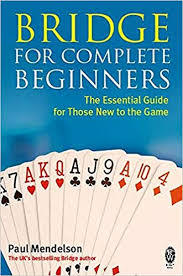 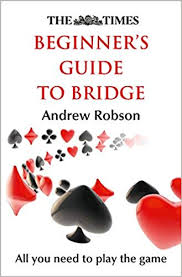
All the above teach the Acol bidding system. Once you have reached that stage a "No Fear Bridge" crib sheet will be helpful. 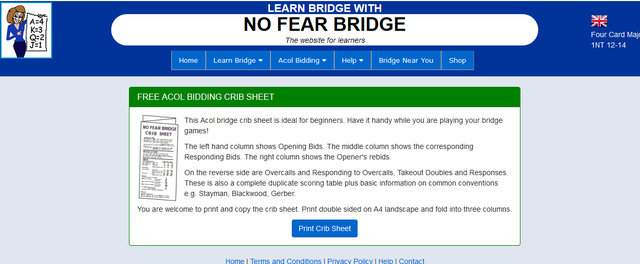
You can download this from:
https://www.nofearbridge.co.uk/crib_sheet.php
Click on the above link and you should be able to print it straight off but if it doesn't work Google "no fear bridge Acol crib sheet".
"Flipper charts" are handy alternatives to crib sheets which you might be able to use when you first start playing. There are a number of good ones available and many beginners find them very useful. Look for one written by Ron Klinger (Acol version), Andrew Robson, or the EBU.
- Internet Guides and Videos
There's lots of material on the net, but much of it assumes you already know something about the game and is from the US where Acol is something of a rarity. If you are starting from scratch and learning Acol the following video series is hard to beat (click on the title)
Sky Bridge Club: beginning ACOL
If searching on YouTube/videos you need to be fairly precise and type something like "Learn Acol Bridge" into Google. Disregard any scathing reviews or criticisms of "opening on four card majors" and "weak no trump" . They're probably from the US and are referring to differences between Standard American and Acol bidding systems. The differences are a source of endless and sometimes heated debate. Ignore it. Stick with Acol if you're learning bridge from scratch in the UK. You can always rethink it at a later date.
The following video is recommended by someone currently learning bridge as being easy to understand and closely following the layout of Beginning Bridge, listed above, but with the warning that the bidding system described is a little dated (i.e. is not modern ACOL). It is thought to be part of a BBC 2 series from the 1970s. Just click on the title:
Join us for Bridge with Shaw Taylor
- Practise, practise, practise
You will learn faster and enjoy the game much more if you can practise regularly with friends a couple of times a week to reinforce anything you've learnt. A crib sheet or "flipper chart" - see above - will help to settle misunderstandings (everyone gets it wrong sometimes so something to refer to is helpful). And, of course, if your friends are established players you will certainly pick up valuable tips along the way.
A particularly useful piece of kit is a set of Andrew Robson's Beginning Bridge and accompanying Arrow Packs (£15.00) available from his website (click here). These will enable you to deal a large number of set hands, without seeing the front of the cards......
............after playing a hand in the normal way you can then check back to the book and get the expert's view. This is highly recommended for groups playing at home after they have learnt the basics of the game. It's like having a sympathetic expert on hand to put you back on track if things go awry!
- ....and yet still more..
You could also try playing a very social kind of bridge at Oswestry Cricket Club, where sessions are held on the first Saturday of each month from October to March, starting at 1.30pm,
...and finally: Good luck and enjoy the game: we hope to see you soon.
|
|
|
|
|
|
 RETURNING TO THE GAME AFTER SOME YEARS? RETURNING TO THE GAME AFTER SOME YEARS? |
Welcome! If you have mainly played social bridge at home up to now, or are thinking of coming back to the game after a long interval you will find a warm welcome at Oswestry Bridge Club (OBC).
Duplicate Pairs
Like most bridge clubs in the UK, OBC plays contract bridge in the form of duplicate pairs. This means that all the hands for the evening are pre-shuffled and dealt (by computer) into special boards. After you have played a set, the boards are passed on unchanged to another table, and you will also play another pair of opponents. Therefore during the evening everyone will be playing the same sets of hands against different players, which enables you to see how you have performed with any given set of cards compared with other people. The idea behind this is that it gives you a much better idea of how you performed than if you had just shuffled the hands each time and then relied on Lady Luck to give you a bumper crop of aces and kings.
If you have not played duplicate before it might be a good idea to have a chat with John Davies (see above) or one of the other club members first, to find out more details.
Not played for donkeys' years?
Not sure if you can remember it all? Why not try out online some of the hands that have recently been played at the Club, and see how you get on? It's free and you don't even have to register any personal details. Simply click here and follow the instructions for "Play it Again, Sam". Or just contact John (on the Home Page) or another member of the Club (see Contact Us).
|
|
|
|
|
|
|
|
| GOT A QUESTION? |
No problem: just click here to contact us, or go to Contact Us on the Menu.
|
|
|
|
|
|
|