| The Motto |
Social Bridge is just a Game, not a war. Enjoy.
Bridge Tournaments are serious contests, follow the rules there.
|
|
|
|
|
|
| Web Site |
 Welcome to the DEMICOMA Bridge Academy tournaments page.
The idea is to have Bridge games that
- are free as long as possible, short, and sweet
- are based on trust
- promote freedom and innovation
- allow players to be more creative and imaginative in their bidding and play
- offer a mirror that allows them to introspect and improve
- cater to two Bridge worlds, some for the revellers, some for the nerds
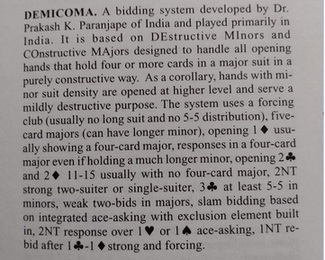
DEMICOMA is the name of the bidding system developed by Dr. Prakash Paranjape 'panja. DEMICOMA was developed in early 1980s. Panja and Vivek Bhand have won many Indian National Championships playing DEMICOMA in the 1990s and early 2000. More than a dozen players have played the system in high level competitive event. DEMICOMA makes bidding simple and intuitive.
|
|
|
|
|
|
| Make Bridge Popular Again! |
 Bridge was a popular game from 1930s to 1980s. Its popularity was on the wane perhaps from 1990s. Sometime around 1990s, the system restrictions were put in place. The number of systems in play - the diversity - decreased drastically as a result. Later, when bridge robots came into being, they only played two over one. When I checked the conditions of contest for the 2011 World Computer Bridge Championships, the first item said that a contestant robot MUST play some form of Standard American. Slowly, but surely, learning bridge became synonymous with learning Standard American. A game that was fun turned into drudgery. Rituals became more important than understanding of principles.
Fortunately, in last few years, there have been some welcome developments. For one, the robots are beginning to play different systems. Secondly, online bridge has led to an explosion of data. Millions of deals have been played; thousands have been commented upon; and hundreds thoroughly analysed. Practised Pairs are now a norm in high level competitions. Players are spending far more time on their methods than they used to a few decades back. The inadequacy of some legacy methods is clearly being felt by a number of good players. This hasn't yet resulted in the development of new methods at the level of systems, but an opening is definitely being created for the development of a few. I have no doubt that the coming years will replicate the 1960s and 1970s when we had different versions of Precision and other strong Club methods. Perhaps, we will have even more innovative framework.
The conditions of contest, the system policies, and many other ethics and propriety issues are perhaps holding back the progress and innovation, and possibly, the spread of the game. At least, that is what my feelings are. I hope you appreciate my worries.
|
|
|
|
|
|