| CABC 50th Anniversary Celebration |
Chepstow’s Archway Bridge Club marked its 50th anniversary on Sunday 11 October 2026. On that day members of the club - past and present - together with friends from the Forest of Dean Bridge Club and dignitaries from the Welsh Bridge Union gathered at the recently renovated Lindors Country House for drinks, lunch, speeches, and, of course, to play bridge.
Whilst none of the current members of the Archway has played at the club since its inception, Marion Shewell has managed an excellent 47 years and she offered her recollections on the evolution of the club, including the beneficial aspects of technology (for scoring, dealing and playing online) and how it has moved venue over the years. After many years at the Palmer Centre, situated in the centre of Chepstow - hence the Archway name - the club moved to St Arvans, before switching to its current location, The Chepstow Club, where it now meets every Monday evening.
During the afternoon of celebration, the 48 attendees played bridge in two adjoining rooms. The field ranged from a handful of players that took lessons last autumn to two players often selected for the Welsh Ladies team.
Using the standard format for a large field, the competition produced two winning pairs. For those sitting East-West, winners were Paula Grobbelaar and Jon Dullforce. Winners for North-South were Colin Clarke and Grace Martyn. The triumph of the latter, well into her eighties, highlights that age is no barrier to success at the table.
All those who attended are grateful to the team for their excellent planning and organisation of a memorable day.
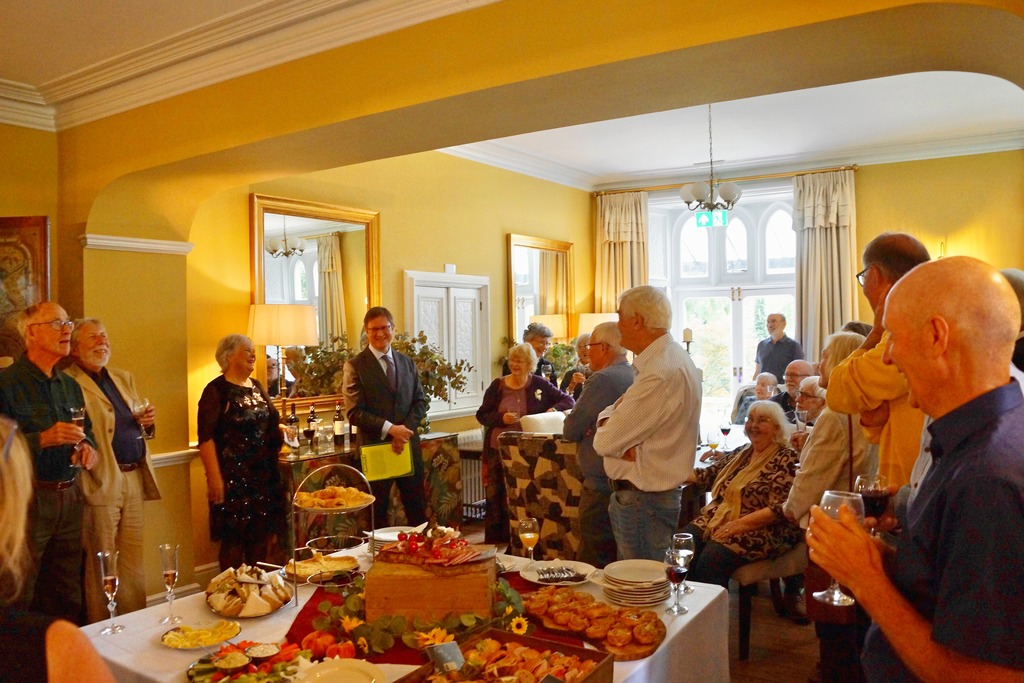 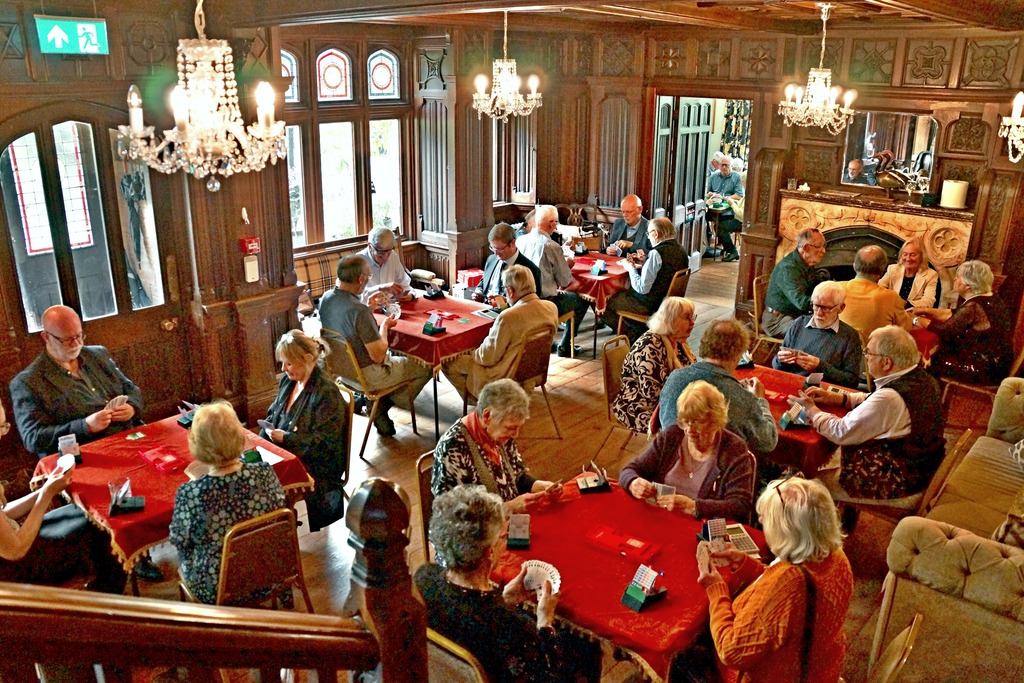 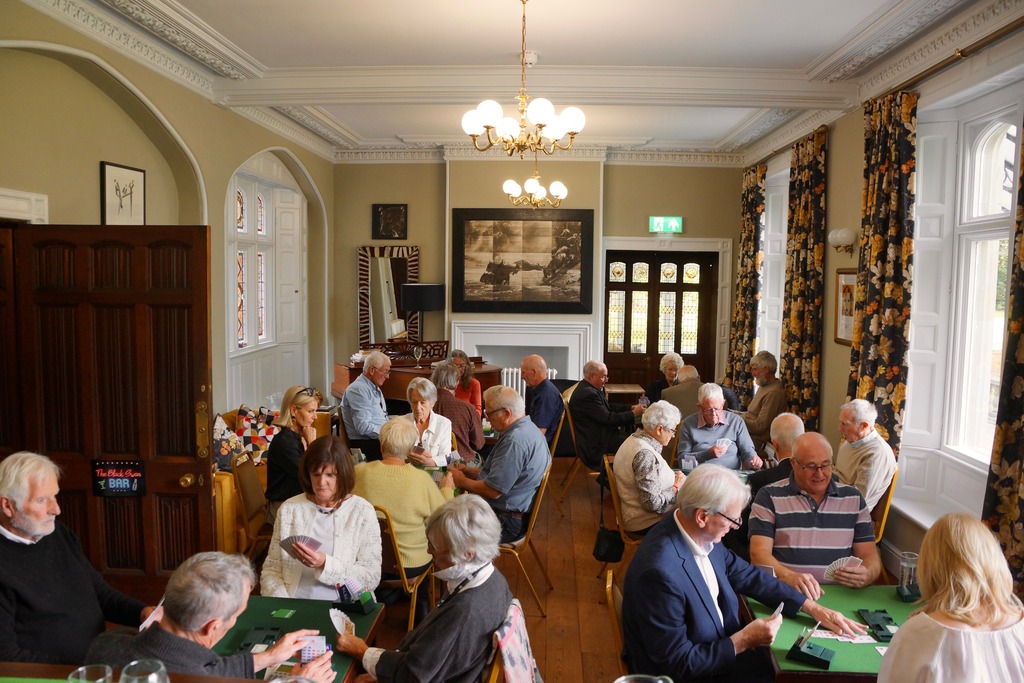
An additional selection of photographs is available here: Photos
The hands played and results are available here: Results
|
|
|
|
| Archway Bridge Club - Now at the Chepstow Club |
CABC meets at The Chepstow Club, 10 Moor St, Chepstow, NP16 5DD
We are a friendly, enthusiastic club, offering a warm welcome to new members of any standard.
We meet every Monday, starting promptly at 6:45 p.m.
Further to the discussion at the March 2026 AGM, we will be aiming to play 24 boards on our club nights.
There is some free on-site parking available, but...
Drivers MUST register their cars on the console/screen when you enter the Chepstow Club.
|
|
|
|
| CABC - 2025/26 Introduction to Bridge and Training Sessions - A resurgence at Archway |
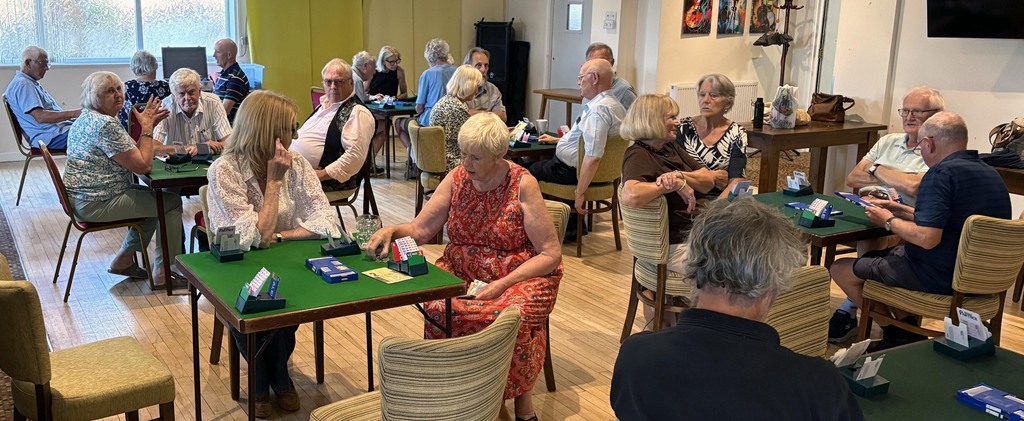
We are pleased to see that after Richard's 2025/26 Introduction to Bridge Course (and associated training sessions), that the attendees are now playing duplicate bridge on a Monday evening. Despite quite a number of regular players being away on holday we had 7 tables on 17th August - the highest level of attendance for a number of years. We hope that this will become the new norm. We have an evening of free bridge on 7th September, perhaps an 8-table movement in sight?
|
 |
|
|
|
| Dates for your Diary |
Please make a note of the following dates:
5th October - Claret Cup (Match Points)
Sunday 11th October - CABC 50th Anniversary Celebration - see above
9th November - Simultaneous Pairs: Children in Need
30th November - Free Bridge Evening
14th December - Christmas Party
|
|
|
|
| Richard's Lessons - May 2026 |
|
|
|
| In search of a partner? |
If you are hoping to play on a particular evening, but lacking a partner, the easiest way to try and secure a game is to send a message to the club’s WhatsApp group.
If you are not on this group, but wish to join, send a request to Stewart Anderton (s.anderton@btinternet.com)
If for any reason you prefer to not take this approach, please contact Richard Stevenson (rs240uk@yahoo.co.uk), and he will try and find you a partner.
|
|
|
|
| Teams League: League 14 - Winter 2026-2027 |
League 14 - Winter 2026 - 2027
The new league is now underway. Please let Stewart know when team captains have arranged their match dates and these will be added to the schedule below. Similarly, please pass on results which will be included in the matrix. .
| TEAM |
Team Members |
1 |
2 |
3 |
4 |
5 |
6 |
7 |
TOTAL |
RANK |
| 1 |
Pete Smith and Liz Klinkert, Stewart Anderton and Hugh Green |
Oct Bye |
Nov |
Dec |
Jan |
Feb |
Mar |
Apr |
0 |
3 |
| 2 |
Greg Howell and Paula Grobbalaar, Jon Plews and Leo Williams |
Nov |
Dec Bye |
Jan |
Feb |
Mar |
Apr |
Oct |
10 |
1 |
| 3 |
Brian Harden and Marion Shewell, Caroline Gawler and Pat Davey |
Dec |
Jan |
Feb Bye |
Mar |
Apr |
Oct |
Nov |
0 |
3 |
| 4 |
David Green and Grace Martyn, Lee Blanning and Jon Dullforce |
Jan |
Feb |
Mar |
Apr Bye |
12 Nov |
Nov |
Dec |
0 |
3 |
| 5 |
Pete Taylor and Graham Eele, John Mayo and Jean Chuter |
Feb |
Mar |
Apr |
12 Nov |
Nov Bye |
Dec |
12 Jan |
0 |
3 |
| 6 |
Richard Stevenson and Anna-Marie O'Brien, Jackie and Ian Poulter |
Mar |
Apr |
Oct |
Nov |
Dec |
Jan Bye |
Feb |
0 |
3 |
| 7 |
Ray Marden and Sheila Montgomery, Steve Satterthwaite and Mike Wyatt |
Apr |
10 |
Nov |
Dec |
12 Jan |
Feb |
Mar Bye |
10 |
1 |
| |
Bold names are Team Captains |
|
|
|
|
|
|
|
|
|
|
|
|
|
| Teams League: League 13 - Summer 2026 |
League 13 - Summer 2026
All matches have been played and the Summer 2026 League is now complete.
Many congratulations to Pete, Graham, Jon and Lee on a great result - nearly 16 VPs per match. League 14 (2026-2027) starts in October 2026 - see below.
| TEAM |
Team Members |
1 |
2 |
3 |
4 |
5 |
6 |
7 |
TOTAL |
RANK |
| 1 |
Pete Taylor, Graham Eele, Lee Blanning, Jon Dullforce |
Mar Bye |
14 |
20 |
10 |
15 |
20 |
15 |
94 |
1 |
| 2 |
Pete Smith, Liz Klinkert, Caroline Gawler, Pat Davey |
6 |
May Bye |
12 |
12 |
12 |
10 |
15 |
67 |
3 |
| 3 |
Steve Satterthwaite, Mike Wyatt, John Mayo, Jean Chuter |
0 |
8 |
July Bye |
18 |
1 |
10 |
13 |
50 |
5 |
| 4 |
John Plews, Leo Williams, Jackie Poulter, Ian Poulter |
10 |
8 |
2 |
Sept Bye |
17 |
16 |
3 |
56 |
4 |
| 5 |
Greg Howell, Paula Grobbalaar, Stewart Anderton, Hugh Green |
5 |
8 |
19 |
3 |
Apr Bye |
16 |
20 |
71 |
2 |
| 6 |
Ray Mardon, Sheila Montgomery, David Green, Grace Martyn |
0 |
10 |
10 |
4 |
4 |
June Bye |
14 |
42 |
6 |
| 7 |
Sue Blake, Maggi Little, Steve Dobney, Harry Kear |
5 |
5 |
7 |
17 |
0 |
6 |
Aug Bye |
40 |
7 |
|
|
|
|
| July 2026 Ecats Simultaneous Pairs |
The results from this SIMS event, in aid of Kidney Research UK and the British Heart Foundation, are available here: The tabs at the top of the page allow you to access CABC results, individual standings, etc. Thank you all for taking part and thank you Anna and Mark Newton of ECats for organising the event.
|
|
|
|
| Recent Competition Winners |
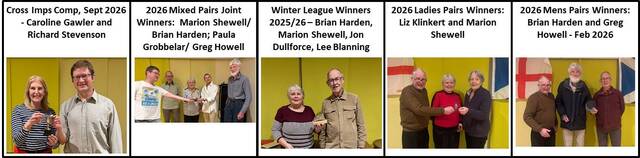
Congratulations to all of the above - very enjoyable competitions.
|
|
|
|
| Tips and Techniques |
A tool for self-imrovement
Getting better at bridge takes time and effort – there are no shortcuts. In years gone by, many players would read books to improve. That's still an option, but thanks to the Internet, there is also the opportunity to play many hands and review the line you have taken, for better or worse. If you play club-bridge once a week, you might have just six hands as declarer, with no access to card-by-card replays. Supplement this with some on-line play, and it’s easy to declare and review 50 or more boards per week.
One downside of growing up in the UK is that you begin by learning Acol, while most of the rest of the world plays a form of 5 card majors, which dominate on-line bridge. However, now it’s possible to practice by yourself for free playing Acol (or 2-over-1, Precision, etc.). To do so, join IntoBridge (https://IntoBridge.com/).
As well as playing plenty of boards against random opposition on IntoBridge, each day you’ll have the opportunity to play 5 boards against an expert. Often these international players release videos, recording their thoughts while they are playing. Thanks to this, afterwards, you can learn where you – and possibly they – went wrong. You can find out more about the daily challenge here: https://www.youtube.com/watch?v=yVkkq2hZQHk
The unassuming cue bid
When partner opens the bidding and you have strong trump support, you want to keep the opposition out of the bidding and immediately jump to game. So, what should you do when you have opening points and trump support? Maybe you will also jump to game? But that can put partner in a quandary. Bidding is a communication between you and your partner, describing your hand so partner knows whether to consider a slam, a pass, or a double.
Distinguishing between simply trump support and a strong raise is possible by adding to your armoury the unassuming cue bid, which is a bid of opponent’s suit. Offering an explanation of when to use the unassuming cue bid is professional bridge teacher Rob Barrington, playing against the robots in the Wednesday Morning Tournament. Head to board 4, starting at 18:50, to enjoy his insights. See: The Unassuming Cue Bid.
What to open?
Hands with a 6-5 distribution are incredibly powerful, hence the phrase ‘6-5, come alive’. So, if you have enough points, you’ll open. But what do you do if you have a 6 card minor and a 5 card major. Do you bid the major first, given that you need less high-card points to make major game than a minor game? Or do you fear if you open a major, you’ll never described your shape to partner? Offering clear advice on what to do is recently crowned World Grand Master Gavin Wolpert, playing in The Wednesday Morning Tournament. The hand in question is board 3, starting at 16:46. See: What to Open?
Aces and spaces?
Bridge has a number of well-known phrases. You may be familiar with ‘six-five, come alive’, ‘the five level is for the opponents’, and ‘aces and spaces’. But what are your thoughts on the latter?
According to leading bridge theorists Aces are undervalued by the Milton point count (Ace =4 points, King=3 points, etc.) - a value of 4.5 is a better representation of an ace's true value. But what about all those spaces? If you want the view of an Australian bridge pro, take a look at board 3 from his efforts in the BBO weekly free tournament (his play on board 3 starts just over 9 minutes in to this 28 minute video and the Aces and Spaces comments follow after he has played the board. See: Aces and Spaces.
|
|
|
|
| 2022-23 CABC Roll of Honour |
Congratulations all.
| 2023-24 |
Face to Face |
Online |
| PAIRS |
|
|
| Open |
S. Montgomery/R.Mardon |
|
| X-Imps |
S. Montgomery/R.Mardon |
S.Montgomery/R.Mardon |
| Mixed |
B. McLaughlin/H.Beaune |
M.MacKenzie/G Gowling |
| Ladies |
C.Gawler/P.Davey |
|
| Mens |
D.Smith/R.Stevenson |
|
| TEAMS |
|
|
| League 8 - Winter 23-24 |
|
R. Stevenson/G.Howell/C.Gawler/P. Davey |
| League 7 |
|
S. Montgomery/R.Mardon/ S.Blake/ L.Klinkert |
| Knockout |
|
P.Smith/L.Klinkert/S.Blake./T.Walter |
|
|
|
|