| Check Out the ACBL Website |
We are truly fortunate to have two teachers in Sioux City to offer bridge lessons in person just for the love of the game. If you can attend Diane Howard's Advanced Class on Monday mornings or Leon Koster's Beginning Bridge on Thursday you are very fortunate. There are many online and You-Tube videos offering more learning opportunities.. I would like to highlight one found on the ACBL site. Click HERE.. This is the ACBL "Learn Bridge" page and starts with you need a deck of cards and three friends. Next, the ACBL has two featured series. The first, Deal Me In starts in July 2023 with very basic concepts of bidding and play. The July 2023 lesson also explains some common terms like "Opener" and "Advancer." You may proceed through nearly 30 mini lesson in bidding and play with a new one added monthly. The second series is It's Your Call, taken from the pages of the ACBL Bulletin a new challenge is added weekly.. The articles present a bidding opportunity, then rate your choice, and provide expert commentary on the various possible alternatives. What's great about these features? Together there are more articles than you will likely get through. Second, they are available both the afternoon and middle of the night. You may leave, then come back, at your own pace.. Finally, consistent high quality content produced by the ACBL staff, is tailor made for persons interested in learning bridge and advancing their game. N.B. The Deal Me In Series may best be viewed starting in the earliest offerings, so paging back is probably a good idea. It's your Call, does not seem to be order dependent.
|
|
|
|
|
|
| Learning Bridge is a Journey |
"I play Goren." Such a statement isn't heard as often as it once was but then again neither is "I play bridge." For a few of us learning bridge in the early 60s "Goren" was state of the art. Charles Goren was one of the foremost players of the 1940s and 1950s. His true contribution to the game of bridge was the introduction of point count bidding based upon the 4 3 2 1 evaluations. Goren changed hand valuations away from Quick Tricks and suit length to High Card Points and evaluating short suits, commonly 3 points for a void, 2 for singleton and 1 for a doubleton. The journey to "modern" systems has not been cataclysmic but rather a slow evolution with new ideas pasted on top of existing practices. In the realm of hand evaluation most players retain the 4-3-2-1 honor count also use suit length as a primary evaluation tool. Most teaching now starts with a simplistic version of a "Standard" bidding then refines and adds nuances, treatments, and ever evolving conventions. Learning basic bridge is the process of building a foundation, then adding new things which are compatible. Thus, avoiding teaching a historical approach which may have been the true fundamental underpinning to modern bidding but which would need to be unlearned as the process continues. Learning bridge should be considered a journey with something new every time you play and every time you take a deeper dive into any aspect of the game. Nike Athletics coined the phrase "JUST DO IT", this certainly applies to bridge as well. "Just Do It" enjoy the journey, with bridge no one ever stops learning.
|
|
|
|
|
|
| Why Part 1 - Learning is Hard. |
Learning to play bridge is not easy. Then for the most part, things which are rewarding are seldom easy. One difficulty in learning to play bridge is the elements of the game are interrelated. It is nearly impossible to introduce all the elements at the same time. Thus students are taught "How" to do each of the elements but not the "Why". This results in learning "rules" such as "Always open a 12 point hand." "Never open a four card major." (What's a major, anyway?) "Open your best minor." "Never lead away from a king." "Split your honors." "Second hand low." The list goes on and on. This seemingly endless list of rules for bidding and play leaves the new player feeling there is a rule for everything or almost everything and they just need to learn "The Rules." The symptom of a player caught up in this misconception is the question: "What should I have done with....?" Or in a supervised learning environment "What do I do with....?" The ACBL has coined the phrase "Bridge, a game of infinite possibilities." This is in fact the fascination of bridge, no two deals are identical. And when, in duplicate bridge, the same hands are played multiple times often the bidding or play is different at each of several tables. So to answer the most common question only once, "What should I have done with....?" There is no 'should', only 'could.' It is better learn to see or consider choices or alternates. Of course, some alternatives are better than others. Sorting them out is what learning bridge is all about.
What are the elements which can not all be taught at the same time? How do they interrelate? Just like in Chess where there is one overall goal "trap (checkmate) opponent's King" in bridge the goal is to score the most points on offense or hold opponents to the least possible tricks while on defense. Understanding scoring is the first element of the game. Second, element determine the optimum contract. What suit should be trump and how many tricks might be had by each side in fulfilling or defeating the contract.? Third, how may a hand be played to maximize the tricks taken by your partnership, the play or defense of each hand includes logic, luck, and subterfuge, And in subterfuge one may find delight in many a hand.
In Bridge one pair or the other will score points on each hand. Never do both pairs score on the same hand. However rarely both pairs may score zero in a hand called a "Pass-Out" when the auction ends without a reaching a contract.
- Element 1: You want to score points.
- Element 1.1 You score points by making or defeating a contract.
- Element 2 "The Auction" In bridge the opposing pairs bid to determine the final contract.
- Each player in turn, starting with dealer makes a call and each subsequent call must be at a higher level than all previous bids, or PASS or DOUBLE.. If your partnership is successful in out bidding the opponents your side (Declarer) takes the offense and the other side plays defense. If you make your contract you get points determined by the suit chosen and the number of tricks taken. If you fail to make your contract the defense gets points based upon how far below the contract you were. One of the edgy things is if rather than letting you play a successful contract the defense finds a contract which they can almost make, like down 1 or 2 tricks, your score for setting them may be less than your score for making your potential contract.
- Element 2.1 In order to exercise sound judgment in the auction you must understand the scoring.
- Element 2.2 The auction is really a conversation. Each player uses the auction to describe their hand to their partner, while opponents listen in as well. As each player bids and describes their hand, the objective is three fold 1) to form a mental picture of partner's hand 2) form a mental picture of the opponents' hands. 3) Find the sweet spot of a makeable contract or defensive contract which denies success to the opponents without great risk.
- Element 3, The play of the hand. Whether you are playing offense or defense your first focus should be how to capture the minimum number of tricks to complete (or defeat) the contract. Bidding starts at half the tricks (6) so a bid at the one level is a commitment to take 7 total tricks. Likewise, a bid at the two level is for 8 tricks. Conversely to set a two level contract the defense needs 6 tricks (holding Declarer to 7).
- Element 3.1. The auction, what you r partner bid and what the opponents bid may be the key to playing or defending the hand.
- Element 3.2 When you play the hand as Declarer your partner's hand goes face up on the table. You (Declarer) play both hands. It is really nice if the better hand is hidden, not face up for inspection. Keeping secrets should be part of the game plan and be a consideration in both the auction and the play.
In defending or play Elements of scoring and the auction come into consideration. An experienced player will evaluate risk and reward in planning the play and consider whether one extra trick is worth the risk of going down and missing the whole contract.
So back to my first premise, scoring, bidding, and play are intertwined. It is very hard to consider one without involving the other two. Still it is harder yet to study three things at once. Confusion abounds as well meaning teachers sometimes jump from one concept to the next. The alternative, learning to bid ("The Auction) first is like learning in a vacuum. The blending of all the concepts will be difficult at first but keeping in mind they all work together and none of the elements is an island unto itself. Learning to play bridge is a journey and one we are all on together.
Part 1 in a Series focusing upon Why, not What nor How.
..... see less
Learning to play bridge is not easy. Then for the most part, things which are rewarding are seldom easy. One difficulty in learning to play bridge is the elements of the game are interrelated. ..........
..... see more |
|
|
|
|
|
| Why Part 2 - Scoring |
Scoring in bridge is relatively simple, yet it amazes me me how often, after the fact, many people say: "How much was that?" To me the final score has been so entwined with both the auction and play no one should be asking about the score. So let's address scoring.
Basics, I am going to deal with what is called "Chicago" style scoring where each hand is considered in a vacuum, rather than Rubber style scoring where the results are cumulative. Rubber bridge has many nuances which are not applicable to "Chicago" scoring. Rubber scoring is often the first system learned but not applicable to this discussion.
The basics of scoring of an individual bridge hand considers three factors: trick score, contract level, and bonus points.
TRICK SCORE Points are awarded for each odd trick (trick above 6) in a successful contract. Put another way in order to score points as Declarer one must "make the bid" meaning take the minimum number of tricks declarer contracted to take. However, all suits are not treated equally in value of trick score. The suits in rank order are clubs, diamonds, hearts, and spades. (alphabetical order, if you had not noticed.) Clubs and diamonds are called the minor suits and their trick score is 20 points per trick, hearts and spades are called major suits and their value is 30 points per trick. There is another joker called "No Trump" which is 40 for the first trick and 30 thereafter, more on No Trump later. The auction consists of out bidding the opponents and obtaining a GAME BONUS if possible. Game bonus is awarded for scoring 100 or more trick points on a the single hand. Game bonus is situationally either 300 or 500 points. I am going to consider the 300 point situation first. (called non vulnerable or NV for short) CONTRACT LEVEL To earn the game bonus you must contract for the number of tricks which will achieve game. (Absent a game bonus there is a "contract bonus" of 50 points.) For example, if a contract of 3 Hearts is bid and made. 3 x 30 + 50 = 140. A bid of three hearts but making 4 (3H+1) (10 total tricks) 4 x 30 +50 = 170. However a bid of 4 hearts making 4, earns a game bonus of 300 points because the contract value was 100 or more points. 4 hearts (4H=): 4 x 30 + 300 = 420. Clearly the game bonus is worth pursuing when one compares 170 points (3 hearts making 4 (3H+1)) with 420, (4 hearts making 4 (4H=)). So a quick "box score" of final contracts:
Final Contracts (4 plus 1 for the Majors)
| Bid |
♣ |
♦ |
♥ |
♠ |
NT |
| 4 |
130 |
130 |
420 |
420 |
430 |
| 5 |
400 |
400 |
450 |
450 |
460 |
Clearly major suit contracts are more desirable than minor suit contracts. They are less work and more "pay". This simple fact is the "Why" of most bidding systems. Less clear, but still key 3NT, also garners a game bonus 40+30+30=100. When you are bidding mentally considering the point out come of each bid is a good exercise until it becomes automatic.
As the saying goes there are two sides to every coin. Understanding the relative effects of going set is also important. Simply, 50 points a trick NV and 100 points Vul. penalty for failing to make the contracted bid. A quick example, suppose the cards are such your side (N-S) can make 1 spade and opponents (E-W) can make 2 hearts. If the final contract is 2 hearts making 2 (2H=) opponents score 110. But consider 2 spades down 1 (2S-1) opponents score 50, 3 spades down 2 (3S-2) opponents score 100.. Aggressive bidding, going down 2 is relatively better than allowing opponents to play 2 hearts for 110.
Results of 1 Spade vs 2 Heart Contest
| N-S |
E-W |
N-S |
E-W |
| 1S= |
1H+1 |
+80 |
-110 |
-80 |
+110 |
| 2S-1 |
2H= |
-50 |
-110 |
+50 |
+110 |
| 3S-2 |
2H= |
-100 |
-110 |
+100 |
+110 |
| 4S-3 |
2H= |
-150 |
-110 |
+150 |
+110 |
VULNERABILITY is a condition carried over from Rubber Bridge which affects scoring. In Chicago Style it is artificially assigned in each set of 4 deals. Deal 1: No One; Deal 2: N-S; Deal 3: E-W; Deal 4: Both. In Chicago Style scoring the vulnerability is 100% artificial as each hand is treated independently. It referred to as Vul or Non-Vul and textually abbreviated as (V or Vul) and NV. It means when a side is vulnerable their game bonus is enhanced from 300 to 500 points. But also the penalty for failure is enhanced from 50 per trick to 100 per trick. In bridge discussions vulnerability is referred to as "equal" or "favorable" Favorable means "you" are not vulnerable (NV) and opponents are vulnerable. Why favorable?? Because you have even more leeway to take chances at a final contract if opponents possibly can make a vulnerable game. Consider two results 4 hearts making while vulnerable 4x30+500=620 versus 4 spades NV down 3 -3x50=150 not so bad. (Yes there is something called a "double" and then the NV minus tricks are 100, 300, and 500) and the Vul minus tricks are 200, 500, and 800 when doubled. (OUCH))
..... see less
Scoring in bridge is relatively simple, yet it amazes me me how often, after the fact, many people say: "How much was that?" To me the final score has been so entwined with both the auction and ..........
..... see more |
|
|
|
|
|
| Why Part 3 - Hand Evaluation |
While I love the history of bridge, and how systems and methods developed over time. I am going to cut to the quick and examine the current thinking in hand evaluation. This is a case of yes High Card Points are obvious now but when developed by Charles Goren the 4-3-2-1 count revolutionized bridge. Hand strength has two factors High Cards, and Shape. High cards are simply valued as Ace =4, King = 3, Queen =2, and Jack = 1. A deck of cards has four suits, 40 HCP (High Card Points) total. Your share is 10. More than 10 is nice, way more is good, and way, way more is great. How often does that happen?
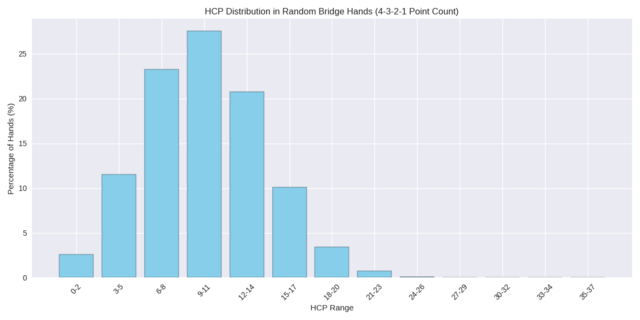
-
- 6–8 HCP: 23.35%
- 9–11 HCP:27.84%
- 12–14 HCP: 20.54%
We have 71% of all hands huddled around the middle. Bridge systems are geared to deal best with this type of hand. The big, big hands 21-26 occur in about 1.7% of all hands dealt.
Distribution is a second factor. Old teaching counted shortness but now generally length is considered the primary distribution factor. HCP + Distribution ='s Total Points (TP). Length points are added one for each card in excess of 4 in a given suit. so 4-4-3-2 no length points 5-5-2-1 add 2; 6-3-2-2 add 2 and so on. Why standardize the approach? Why not use card sense, a count of winners, and a guess instead of formalize HCP with distribution considerations? The answer is: "Bridge is a partnership game." It is easier to communicate in the limited language of bridge, within agreed parameters. There is no real way to say "I feel good about this hand let me play it." Frankly you don't want that kind of conversation with your partner. Thus partners must bid in a way to facilitate the formation of joint decisions.
Reevaluation once the auction starts, assuming it does not go BID PASS PASS PASS. (Pass Pass Pass ends all auctions and is sometimes described as "Swish.") You will get a second chance to bid. More important you get a chance to reevaluate your hand based upon any bid made by your partner or opponents. Now shortness in opponent's suit is a plus, but more important a fit with partner is what you want to find. What kind of fit? An eight card fit, In a nutshell, if you hold 8 cards of a suit the cards held by Opponents will split 3-2 or 2-3 62.5% of the time. (Odds split evenly!) However, if you only hold 7 cards and opponents hold 6 they are split 3-3 only 31.25% of the time. The card split 4-2 or worse 68.75% of the time. (Evens split Oddly.) This is why an eight-card fit is considered beneficial maybe even magical. Bridge bidding systems are designed to find an eight-card fit whether it be 4-4, 5-3 or 6-2.
The generally accepted point ranges and fit to achieve game and slam for bids in the 4 to 7 (13 total tricks) are set out in the following table
| Trick count |
Total points (partnership) |
Distributional adjustments |
Notes |
| 4 |
~25–26 HCP |
-1 HCP with a strong 8–9 card fit and a doubleton/singleton; -2 HCP if one hand is 5–5 (or better) with good intermediates. |
Focus on fit quality and stoppers; upgrade hands with 10-card fits, downgrade with scattered values and poor texture. |
| 5 |
~28–29 HCP |
-1 to -2 HCP with a 9–10 card fit and shortness; -2 to -3 HCP if one hand is highly shapely (e.g., 6–4 or 7–4) and values are concentrated. |
Eleven tricks demand good control structure; long trumps plus ruffing value can compensate for lower HCP. |
| 6 |
~31–33 HCP |
-2 HCP with a solid 9–10 card fit, a source of tricks, and shortness; -3 HCP when controls are excellent (few quick losers) and one hand is very distributional (e.g., 6–5). |
Use cue-bidding and keycard to verify controls; upgrade for a known “source of tricks” (running side suit), downgrade with two fast losers. |
| 7 |
~35–37 HCP |
-2 to -3 HCP only with perfect fit, first/second-round control in every suit, and a near-certain source of extra tricks; otherwise keep the full HCP benchmark. |
Grand slams are control-driven; confirm missing keycards and side-suit control, and avoid 4–1 fits unless texture is exceptional. |
..... see less
While I love the history of bridge, and how systems and methods developed over time. I am going to cut to the quick and examine the current thinking in hand evaluation. This is a case of yes High Ca ..........
..... see more |
|
|
|
|
|
| Why Part 4 - The Auction |
Part 1, it is hard (but rewarding) to learn to play bridge. Part 2, you must learn to score a bridge result. Part 3, you must learn to evaluate your hand.
You are HERE--> Part 4, you must learn to communicate with your partner. Winks, nods, raised eye brows or foot taps are not allowed. In fact the ONLY words used are the numbers one through seven, the suits clubs, diamonds hearts, and spades, the words "no Trump", Pass, Double, and Redouble. Fifteen (15) words that is it. In fact you can learn to play in a second language in a relatively short time, 15 words. You should be thinking there "There must be more." And there is it is the order in which the words are used which adds much of the meaning to the actual bids. That order is restricted in that each Call other than Pass Double and Redouble must always be at a higher than the prior proposal hence "an auction." Partners use what is called a bidding system to determine partnership meaning for bids. Here is a short list of systems in use Goren, ACOL, Standard American (SA), SA 5 card Majors, SAYC (Yellow Card), 2/1 Game Forcing, Big Club, Precision, (Some of which I can even play, sort of.) I am not going to address any of the Systems here but rather the over all WHY and the objectives of a system as a whole.
- Communicate the strength of your hand.
- Opening bides have point ranges associated with them, most are limited by upper and lower values.
- Responses to openings generally have minimum values but no upper limit.
- Communicate the shape of your hand.
- Opening bids may be used to show both distributions and promise or deny specific High Card Points.
- Responses may show specific distributions or at least minimum suit lengths
- Communicate a fit has been found and the relative strength of that fit.
- Fit and strength combined dictate optimum level of the final contract.
- Communicate meanings related to opponent's bids essentially using their bids to narrow the meanings of your own. calls.
All of the above are done with eye to the final score and the strength your partner has communicated to you. Take an example, most systems have some High Card Values or Total Points required to open the bidding suppose partner has passed initially and now you got into the auction and opponents are competing in both Hearts and Diamonds. It appears they may settle for a Diamond contract, if you don't push your suit at them again. Diamonds the minor is going to score less than hearts the major think about the score let them play the minor. Conversely if you think they have found the best contract then take another bid at the risk of going down as the points gained for setting you may not exceed the points they would have gotten for for being in the right contract. Here you have combined understanding the score (and consequences) with your own hand evaluation and your evaluation of the hands your opponents are showing. Whew, it is the whole tamale.
..... see less
Part 1, it is hard (but rewarding) to learn to play bridge. Part 2, you must learn to score a bridge result. Part 3, you must learn to evaluate your hand.
..... see more |
|
|
|
|
|
| Why Part 4A - Bidding Elements |
This is not "How" but rather the "Why" of some basic bidding systems. Briefly reviewing Elements from Scoring and Evaluation
- Game bids are 3NT, 4 of a major (♥ ♠ ), 5 of a minor (♣ ♦ );
- Slam bonuses for bidding and making 6 or 7 Are on top of game bonuses.
- 4 3 2 1 HCPs are added to length points.
- Bidding is limited to 15 words. (the numbers 1-7, 4 suit names, Pass, Double and Redouble, and No-Trump
- Hands should be reevaluated as partnership fits are determined, likewise devalued for adverse placement of cards in LHO's hand.
- Auctions are a conversation with partner.
Games are easier to come by in the majors, which makes the major suit fit and game the goal of most systems. Minor suits are often disrespected and used as stepping stones to major games.
Bidding systems are designed to locate eight card fits in the proposed trump suit.
Eight card fits are important because when you hold an eight cards in a given suit between the two hand opponents are arithmetically limited to five. Sounds so basic, but five outstanding cards will split 3-2 over 60% of the time, while six outstanding cards will split 3-3 only about 1/3 of the time, thus breaking 4-2 (or worse) 2/3rds of the time. For control of any suit there is a world of difference between a seven card fit and an eight card fit. The favorable division of the outstanding cards is the big why of searching for an 8 card fit. Why a major fit? Because major games are easier to make requiring only 10 total tricks, as compared to 11 in the minors. Again restating the obvious, but the point: is bridge is not difficult but the "why" of things is sometimes forgotten and replaced by rules.
Common eight card fits are 4-4; 5-3; and 6-2. The conversation starts in the auction and sounds like this.
- "I have more than my share of high cards and a five card major suit which is ___" ;
- "I have more than my share of high card points but no 5 card major suit."
- "I have above150% of my share of HCPs and a squarish hand."
Nice plain English language descriptions of an hand. The only problem is (as mentioned before) we only have 15 words to work with. And therein lies the rub. The three "conversation starters" above can be reduced in bridge talk to:
- One Spade,
- One Diamond (psst, my diamonds are better than my clubs) and,
- One No-Trump,
each respectively. correspond to the foregoing "what you would like to say, but can't."
Those starters are a mouth full for just two words each.. Next partner responds first in plain English:
- "I have no points and no real fit.".
- Hey I have some points but more importantly we have an 8 card fit!" and
- "I have some points. What do think of my suit?"
Again in just a word or two:
- "Pass" (very under rated),
- 1♥ - 2♥ or 1♠ - 2♠ (I have 3+, we have 8.).
- 1♣ - 1♥ or
- 1♥ - 1♠ can't help you with hearts but I have 4 spades and close to my share of HCPs.
I am not trying to talk about a specific system for bidding except maybe a slight prejudice toward opening only 5 card majors and choosing the your best minor as an alternative if you are opening the bidding. What I am emphasizing is a bridge auction is simply a conversation. Bidding systems of course delve deeper into auction and the stronger the two hands are the more elaborate the bidding sytem gets to describe almost the exact hand held by each player. How often do those big hands come up, you ask? Strange you should ask, I happen to have a small chart right here: First Column, combined points of both hands. Column Two, the percentage of times counting only HCP and then Column Three, HCP but adding length points too. Look at the meat and potatoes ranges 18 to 23 points happening 46% of the time and if you include the hand in the "or worse" another 30% of all hands. So now the simple conversations and simple auctions cover about 75% of the hands. You can employ simple bidding and be spot on about 3/4's of the time.
| Combined Points |
HCP Only (%) |
HCP + Length (%) |
| <12 |
3.79 |
1.73 |
| 12–14 |
8.92 |
5.14 |
| 15–17 |
17.51 |
12.05 |
| 18–20 |
23.90 |
19.91 |
| 21–23 |
22.42 |
23.45 |
| 24–26 |
14.66 |
19.68 |
| 27–29 |
6.56 |
11.68 |
| 30–33 |
2.17 |
5.90 |
Percentages reflect 100,000 simulated deals; combined points are North–South totals. “HCP + Length” adds 1 point for each card beyond 4 in any suit per hand.
..... see less
This is not "How" but rather the "Why" of some basic bidding systems. Briefly reviewing Elements from Scoring and Evaluation
- Game bids are 3NT, 4 of a major (♥ ♠ ), 5 of a minor (♣ ♦ );
- Slam bonuses for bidding and making 6 or 7 Are on top of game bonuses.
- 4 3 2 1 HCPs are added to length points. ..........
..... see more |
|
|
|
|
|
| Why Part 5 - Play of the hand |
The play of the hand differs slightly between offense and defense. The methods are different but goal is the same. Take the most tricks possible. Declarer is given two advantages in the play. First, and most important Declarer controls both his hand and Dummy's. He may plan the play with certainty once he captures a trick in his hand or in dummy. Second, Declarer plays last to the first trick. This allows him to play the minimum winning card or continue to guard a weak position. Declarer's course should be to plan the play count the winner's which are certain and determine where the potential additional tricks may be developed. Declarer should keep secrets. Declarer should disclose as little as possible about the content of their hand. Two ways to do this:
- Always play the top of touching honors from the closed hand.
- If you lead from dummy to the closed hand and win with the J from the holding AKQJ then RHO knows exactly where AKQ are (not on dummy not in partner's hand not in his hand And he now knows about 10 of HCP's you have shown during the auction.
- Do not show a solid side suit until it is necessary. Any suit you are not showing, opponents may need to consider to be part of their partner's holdings.
Defense is different. At the sometimes considerable risk of enlightening Declarer, from the opening lead onward, every card played by both defenders should be done with an eye toward educating partner about the strengths and weaknesses of your hand starting with the opening lead. There are many systems for defensive card signals. You need to discuss which system you are going to use with your partner before play commences. The key considerations for defense may come before the opening lead.
- Review the auction. (if you don't remember ask for a review.)
- Did partner bid?
- Did dummy show a suit?
- Did Declarer show a two suited hand?
- Consider your hand.
- Do you have a suit that will deliver tricks now?
- If your suit needs help do you have a way to get back to it later?
- Do you have a safe way to see dummy? (Ace from Ace, King for example.)
- Do no harm. Anything which may negate the Declarer's advantage of playing last.
After the opening lead, defensive signals are dependent upon the system chosen by your partnership. But contrary to Declarer, play the lower of touching honors suggesting a higher card is almost always right. The best defenses use the Element's found in hand evaluation and auction to defeat, or at least limit, Declarer's success.
..... see less
The play of the hand differs slightly between offense and defense. The methods are different but goal is the same. Take the most tricks possible. Declarer is given two advantages in the play. Fi ..........
..... see more |
|
|
|
|
|
| Why Part 6 - Counting |
Bridge is a counting game. You must be able to count to at least 13. The hardest thing to do is to learn to count cards as they are played. How one counts is highly dependent upon how an individual's mind works. Surprisingly (or not) everyone's works a little differently. You want to count trump. How many have been played? Do the opponents still hold one or more? Mistakes are made made all the time. What I find works for me is to count whole tricks. "Once for 4, twice for 8, two left on the board, three in my hand, that's 13." Side suits can be counted the same way. This is a matter of practice. Very few new player will successfully, count all four suits or even just trump when they start to play. Worry not, practice. Why count? Playing an extra round of trump, "to be sure" may cost a cross ruff or ability to protect a weak spot in the combined hands. Counting in a side suit my disclose you actually hold the 13th card in a given suit, at NT or after trump has been drawn a 13th card might as well be an Ace. Playing an established side suit is as good or even better than leading trump when opponents hold a single high trump card. Make them use it to capture the side trick.
..... see less
Bridge is a counting game. You must be able to count to at least 13. The hardest thing to do is to learn to count cards as they are played. How one counts is highly dependent upon how an individua ..........
..... see more |
|
|
|
|
|