 An Introduction An Introduction |
Duplicate Bridge is not more difficult than any bridge you are currently playing. The best way to look at it is: "It is the same, but different." On this page are explanations of some of the differences and quirks of Duplicate Bridge. Why they are different or 'quirky' and "Does it really matter anyway?" To answer the last question first, "No, it does not matter everyone coming to a club game is there to have fun." This page is intended to let a new duplicate player have some idea about how duplicate is different or quirky without being overwhelming. That said, I am known to let my enthusiasm to be exactly that, overwhelming. (Like a Golden Retriever Puppy, maybe cute but also really, really, annoying.) If you read a couple of topics and feel "It is all too much!" Stop, come back later and read something different.
|
|
|
|
|
|
| In less than 30 words, Why We Play Bridge. |
|
Bridge is a game of honor. We compete not just for points or prizes, but for the deep satisfaction of doing something well, fairly and in partnership.
Bronia Jenkins -- Executive Director, American Contract Bridge League
|
|
|
|
|
|
|
| What is Duplicate Bridge? |
Duplicate Bridge is everyday, home grown, kitchen bridge with some elements of luck eliminated as much as possible. This is accomplished by using small trays called 'boards' to hold the cards for each deal.. By the mechanics of never gathering the whole trick to the winning side the cards may be replaced in the board after the hand has been played. The hand is replayed by two or more other pairs in the subsequent rounds. Each deal is played multiple times by different pairs. Likewise, pairs change opponents every round so they can test their skill against new opponents. Scoring is done by comparing how well each partnership did compared to other pairs holding the same cards.. Do you need to be perfect? Heck no, everyone makes mistakes. A typical game is about three and a half hours. The Sioux City club uses all pre-dealt computer hands, After the game is completed the results are available on the results tab of this site.
|
|
|
|
|
|
| Who is The Director? |
The Director in a Club game is a specially trained person responsible for the smooth operation of the game.. Often the Director is also playing in the contest. If an irregularity happens and they always do, the Director's job is to apply the Laws of Duplicate Bridge and restore equity as much as possible to allow comparative scoring.. As a Player you don't need to know any of the technical rules. Just call out "Director Please!"
|
|
|
|
|
|
 What is the ACBL? What is the ACBL? |
The American Contract Bridge League or ACBL is a North American organisation which provides all sorts of administrative services to local clubs and helps organize tournaments. The ACBL has adopted the "Laws of Duplicate Bridge" which guide the director in running the game.. The ACBL has a charity policy and a National partnership with The Alzheimer's Association raising over $10 million in support since 2013. Local Clubs and Units also hold Charity games supporting local charities. The ACBL Bulletin for July 2025 had a comprehensive 100 year history of contract bridge if you are interested you can read it here History Of Bridge More information on the ACBL is available at ACBL.org.. The title for this box is a clickable link. The ACBL offers a "Guest Membership" for new, not returning members, it's free and offers 120 days of benefits. Here is the low down:
Steps to Join as a Guest Member
- Go to the official sign-up page:
Visit www.acbl.org/guest-join.
- Fill out basic information:
You’ll be asked for:
- Name
Email address
ZIP code
A few other contact details
- Create a username and password:
This sets up your personal profile page.
- Receive confirmation:
ACBL sends a confirmation email the next business day with:
Your Guest Member number
A link to your profile page
Access to your masterpoint count (updated after play)
Links to benefits like the Bridge Bulletin and game results
- What You Get as a Guest Member
- Play in any club or tournament game
Earn up to 20 masterpoints
Receive ACBL Live and Live for Clubs results emails
Read the digital Bridge Bulletin
- Enjoy the membership for 120 days, free of charge
..... see less
The American Contract Bridge League or ACBL is a North American organisation which provides all sorts of administrative services to local clubs and helps organize tournaments. The ACBL has adopted t ..........
..... see more |
|
|
|
|
|
| Zero Tolerance does it matter? |
Yes it does. I will start with both a confession and a story. Confession first, I have gotten so wrapped in the moment I have been in violation.. It is a fact and I am not proud if it. I do try to be better. The story.. It was 1976 I invited a professor from the U of I Computer Science faculty, who had been my mentor, to play in a weekly game.. The rude and dismissive behaviors at several tables was so bad I was too embarrassed to ask him back a second time.. The ACBL adopted a Z-T policy in 1998 and the conscious effort of all players has made the environment at all levels of competition much better.. Not perfect but markedly better. If you had a negative experience in the past, trust me it is different now.. A link to the ACBL policy is in the box title.
|
|
|
|
|
|
| How many Master Points do you have? |
Some one is bound to ask you, sooner or later how many points do you have?. Just what are "Master Points" and where do you get them. Short answer Master Points are awarded at all ACBL sanctioned games and come in many colors signifying the level of tournament play where the points were earned. The accumulation Master Points is a mark of significant success. Some folks, my self included, have "Longevity Points." When you have been playing a long time you have had an opportunity to gather points lots of places. But back to the question: "How many points do you have?" Well if you are truly new to duplicate then the answer is probably "None," but that is about to change.
..... see less
Some one is bound to ask you, sooner or later how many points do you have?. Just what are "Master Points" and where do you get them. Short answer Master Points are awarded at all ACBL sanctioned games and come in many colors signifying the level of tournament play where the points were earned. ..........
..... see more |
|
|
|
|
|
| Systems, Conventions, and Treatments |
Systems, Conventions, and Treatments sounds a bit like "Lions and Tigers and Bears." Oh my! Sometimes people hear these words and figuratively say "Oh my!" and run away. If asked, they may just say: "I play plain, ordinary, Goren Bridge. I don't play any of those system - convention things." Well, sorry to disappoint but "Goren" is a system. If you play "a Short Cub" that is a treatment. If you have ever encountered the idea of bidding Four No Trump to "Ask for Aces" it is a convention called Blackwood. Likely you are using all three without really knowing it. Now, please stay with me as I delve a bit deeper into each one.
A "system" is an approach to the whole problem of bidding or style of play. As previously stated "Goren" is one of the systems and when combined with the idea of High Card Points (HCP) is the foundation for most other modern bidding systems. If we were drawing a family tree of bridge Goren would be solidly in the trunk and there is nothing wrong with it. Tracing a lineage to the most common system in use today (in the USA) I would toss out these labels on my way to "Two Over One." Standard American, Standard American Western Style, and finally "Two Over One." Each step more or less a generation of thinking in how to bid a bridge hand. Partnerships use the system they are most comfortable with playing.
A "convention" is a bid with an artificial meaning and structure of responses from your partner. Blackwood is one such, used to ask for Aces. The key to a "convention" is it like a stimulus / response, kick a dog and get bit, chain of events, if A then B. Sometimes conventions make sense sometimes they just "are". Do you need to use conventions? "No." Will other people use them in a duplicate game? "Yes."
A "treatment" is like a convention but lacks the automatic set of responses. Say what? A treatment is a way to describe a particular type of hand. Probably the most common is opening One No Trump. Partnerships often use different ranges "most common" 15-17 HCP other treatments (somewhat dictated by the System) are to use a range of 14 to 17, 16 to 18 or even 12 to14 HCP. The One No Trump bid describes a hand but does not require a particular response.
Lions and Tigers and Bears, Oh my!
..... see less
Systems, Conventions, and Treatments sounds a bit like "Lions and Tigers and Bears." Oh my! Sometimes people hear these words and figuratively say "Oh my!" and run away. If asked, they may just ..........
..... see more |
|
|
|
|
|
| Alerts and Announcements |
One of the basic rules of duplicate bridge is the opponents are entitled to know what your agreements are with your partner. This is accomplished four ways. First, if you have a question about what an opponent's bid means when it is your turn to bid you can ask the partner of the bidder "What does that bid mean?" . The partner of the bidder will tell you what he thinks it means. Notably the person making the bid is not allowed to interrupt or correct his partner. Second, is the alert procedure. When your partner makes a bid with a special meaning you say "ALERT." The opponent to ask what the bid means. The "Alerter" is not allowed to proceed with an explanation without being asked for one. This is to avoid explaining to your partner what his bid means to you. Again, the bidder is not allowed to to interrupt or offer a "better" or "correct" explanation. Third, is announcements. Some bids are to be announced by the partner of the bidder complete with the meaning. This is like a mini alert without waiting for the question. For example, because different people play different ranges for No Trumps, when your partner opens One No Trump you announce 15 to 17 or 12 to 14 what ever the case may be. Here is a link to the common announcements. Announce These.pdf Finally each person should have a completed convention card on the table. This card, which doubles as a private score card contains the agreements of the partnership in a check the box, unform format.
..... see less
One of the basic rules of duplicate bridge is the opponents are entitled to know what your agreements are with your partner. This is accomplished four ways. First, if you have a question about wha ..........
..... see more |
|
|
|
|
|
| What is BBO |
Bridgebase Online aka BBO is the largest online Bridge community claiming 1000's of tables in play, all day, everyday. BBO has an affiliation with ACBL and sponsors both person v person tournaments and person v robot tournaments with a robot partner and robot opponents.. Many areas of BBO are absolutely free.. You can play solitare against robots or play with a partner agaist other live people for free.. If you want to practice and discuss with a partner agaist robots you may need rent a robot or two.. They are cheap.. Of course BBO wants you you to join their prize $$$ tournaments, you can but you don't need to.. Sign up with the BBO web site, select a unique username and you are good to go.. My user name is iowa2,. If you see me say hi and identify yourself, The title box on this item is a clickable link.
..... see less
Bridgebase Online aka BBO is the largest online Bridge community claiming 1000's of tables in play, all day, everyday. BBO has an affiliation with ACBL and sponsors both person v person tournaments and person v robot tournaments with a robot partner and robot opponents.. Many areas of BBO are absolutely free.. You can play solitare against robots or play with a partner agaist other live people for free.. If you want to practice and discuss with a partner agaist robots you may need rent a robot or two.. They are cheap.. Of course BBO wants you you to join their prize $$$ tournaments, you can but you don't need to.. Sign up with the BBO web site, select a unique username and you are good to go.. My user name is iowa2,. If you see me say hi and identify yourself, The title box on this item is a clickable link.
..........
..... see more |
|
|
|
| What is a Bidding Box? |
One picture is worth a 1000 words or so they say. (Unless you are being paid by the word, I am not.)
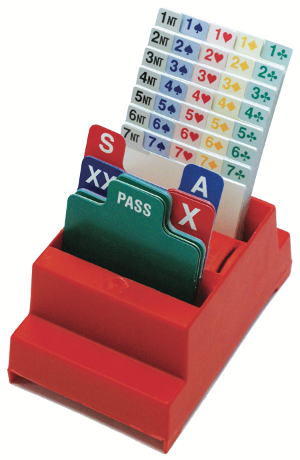
There are four of these on each table. When you want to make a bid you pull out the card you want and place it face up on the table. When the auction comes back around to you do it again; leaving your original bid showing. Before the opening lead everyone returns their bids to the box.
Because the bids ae face up on the table there is no reason to ask for a review during the auction. The use of the bidding boxes achieves many other objectives. First, other tables do not overhear an auction for a board they are going to play later. Second, it avoids voice inflexion in a bid. (Is there a difference between opening "ONE Club" and "I think I'll bid a club?" Well there is not suppose to be ... Third, it cuts down noise in the room. Fourth, it changes a "slip of the tongue" in to "fumble fingers" for a miss bid and if it was just a clear accident it is easy for director to fix. Anything bad about bidding boxes?? Well if you hit when with your elbow and nock it on the floor it is a royal pain. Not that I have ever done so, just heard tell, so to speak.
..... see less
One picture is worth a 1000 words or so they say. (Unless you are being paid by the word, I am not.)
There are four of these on each table. ..........
..... see more |
|
|
|
|
|
| Actually playing the hand, How does that go? |
After the auction is complete the player on the Declarer's left makes the opening lead just like any other bridge game. One difference, the person on lead makes the lead face down. And either says "Any questions Partner? or looks at them in a "meaningful" way same question. There are at least three reasons for this. Once in a while we all have a "lapse of attention" and after a convoluted auction it may not actually be your lead. The face down lead is a "no blood, no foul" solution.
After the lead is faced dummy places his hand face up on the table. The trump suit on the his right (Declarer's left) and alternating suit colors. There is no required order when playing no trump. To play a card from Dummy, Declarer designates the card by name "Play the Six of Spades." short cuts are allowable like "Play a low spade", "cover" and so on. Dummy picks up the card and holds on or near the table. When the trick is finished each player turns the card and points it in the direction of the pair winning the trick. At the end of play it is customary to mix your cards before returning them to the tray. Discussion of a hand is to be avoided. Believe it or not, a player at another table might take a hint from hearing "Holly Mudder of Gad, ya made SEVEN NO TRUMPS!!"
..... see less
After the auction is complete the player on the Declarer's left makes the opening lead just like any other bridge game. One difference, the person on lead makes the lead face down. And either says "Any questions Partner? or looks at them in a "meaningful" way same question. ..........
..... see more |
|
|
|
|
|
| Defensive Card Signals |
Defensive card signals are common in Rubber Bridge or Party Bridge call it what you may. In general, the style of defensive card play is shown on the convention card (bottom of the backside) and you can ask if you are declarer but not dummy. The most common are "Standard" (sometimes Lord knows "Standard" means! But Generally a higher than necessary card added to a trick says: "I Iike this suit".), "Upside Down" means the opposite of "Standard" and Odd / Even where an Odd card says "I like it." You are allowed to ask about the style of discards but not what a particular card means.
..... see less
Defensive card signals are common in Rubber Bridge or Party Bridge call it what you may. In general, the style of defensive card play is shown on the convention card (bottom of the backside) and you can ask if you are declarer but not dummy. ..........
..... see more |
|
|
|
|
|
| Scoring in Duplicate Games |
The scoring in Duplicate Bridge is definitely the same, but different. Each hand is scored entirely separate from every other hand, there are no part scores, legs, rubbers or honors. There is no scoring above and bellow the line. What we do have are bonuses for bidding and making a part score, games or slam on each board The part score is always 50, game bonus is 300 or 500 depending upon vulnerability.
Undertricks are just like rubber bridge. Here are some samples game requirements are 3 NT, 4 of a Major and 5 of a Minor suit. So some quick samples 2H making 3 140 (90+50); 4H making 4 NV 420 (120+300); 3NT NV 400 and 3Nt +1 430; 5D making 6 is 420. So when it comes to match pointing 3NT takes the cake. After the game results are compared with every one else that played the same hand. Each pair gets one point for doing better than someone else and a half point for doing the same.
|
|
|
|
|
|