 Introduction Introduction |
I became a certified director in 1977. The age was BC (before computers) The emphasis at the time was on movements, fouled boards, factoring and the ever present flubs in auctions and play.. Skip forward nearly 50 years. I find, according to the ACBL, once certified, always certified. If I should elect to take a formal course and fail the test, still certified. Strange indeed. So I have been studying the refresher course and other directing materials. In doing so I came upon some new concepts. I am going to lay those out below as much for my own benefit as that of a casual reader. Nothing solidifies a concept for me more than writing about it.. Each of the blocks has the "social" feature turned on.. If you think I have something wrong please tell me.. If you have a question especially one starting with "But what if...?" Ask, I will try to answer with a cite to authority. Another introductory thought. The WBF publishes a book called The Laws of Duplicate Bridge (2017 Ed.) adopted by the ACBL, EBU, WBF and others. The title is neither "The Rules of Duplicate Bridge" nor "93 Suggestions About Our Game." The Laws are updated roughly every 10 years. The next version is planned for 2027. Modifications are considered by not only the ACBL but the EBU (European Bridge Union) and WBF (World Bridge Federation) such changes are not made lightly. The Laws are not considered mere guidance.. Another consideration, our Club game is friendly. No one wants to make someone uncomfortable by nit picking Laws or procedure. However, OTOH, you don't want to not know the Laws to only get your hiney burned by a Sectional or Regional Director claiming your action constitutes an infraction.. Or worse, in my opinion, getting bullied by someone who claims to KNOW the rules and assures you it is not necessary to bother the Director. It helps to know what to expect when something goes sideways. (And it always does.) Update: I am adding a feature to these pages for reference and to improve readability. Click on a item looking like this for more details. Show LAW Law 25A1: If a player changes a call, the Director shall be summoned... This works an open / close switch to display appropriate additional information. I am still working out how it might best be used. There is also a reset feature if you have several boxes open and just want to close them all. It looks like this ...
|
|
|
|
| Guilty as Charged |

Oh here is an example of something I am so guilty of and I have been cautioned not to "Self Direct." The problem arises in assuming everyone has a working knowledge of the nuances of penalties that can arise. Bad assumption. And here is an example from ACBL Duplicate Decisions on how any assumption can go south: Example: A defender drops an honor on the table. Declarer tells the defenders: “Don’t worry, it’s just a penalty card,” and the card stays on the table with no call for the Director. A few tricks later, declarer calls the Director when the partner of the player with a penalty card ends up on lead, to enforce the lead restrictions. The defenders now say if they knew about lead restrictions, they would have defended differently and maneuvered to have the penalty card played earlier without any consequences (which is true). The Director deals with the penalty card, giving declarer their options, and then applies Law 11A. The defending side will get the table score, and the declaring side will get an adjusted score based on what would have happened if the Director had been summoned when the irregularity occurred. NOTE to SELF Do not self direct.
..... see less
Oh here is an example of something I am so guilty of and I have been cautioned not to "Self Direct." The problem arises in assuming everyone has a working knowledge of the nuances of penalties that ..........
..... see more |
|
|
|
|
|
| Should we Call the Director? |
Should we call the Director? Like the question, "Partner could I have played that any better? " When you ask the question you already know the answer is "yes". But in calling the Director most people who have been playing "awhile" think they know the answer and will often engage in some level of Self Directing. Here is a table of common bridge situations which Director actually needs to resolve. Often it is a case in which independent judgement is necessary. Players at the table can not exercise even if they are familiar with the specific applicable Laws.
| Infraction / Situation |
Players May Self‑Rectify? |
Director‑Only Action |
Law Cite |
| Insufficient Bid |
❌ No |
Determine if a replacement bid is comparable; apply UI protections; adjust score if needed |
Law 27 |
| Call Out of Rotation |
❌ No |
Decide whether the call may be accepted; determine comparable call; apply penalties |
Law 30–32 |
| Opening Lead Out of Turn (faced) |
❌ No |
Allow declarer’s options; permit withdrawal of faced card; manage UI |
Law 54–56 |
| Opening Lead Out of Turn (facedown) |
❌ No |
Allow withdrawal of the facedown card; restore proper leader |
Law 54A |
| Play Out of Turn |
⚠️ Sometimes |
Director clarifies options; may allow play to stand or require correction |
Law 53–59 |
| Revoke |
❌ No |
Determine if revoke occurred; decide if it was established; award trick(s) if required |
Law 61–64 |
| Exposed Card by Defender |
⚠️ Sometimes |
Determine if card becomes a major or minor penalty card; enforce play restrictions |
Law 50 |
| Exposed Card by Declarer |
✔️ Yes |
No director action unless misinformation or UI issues arise |
Law 48 |
| Misinformation (Mistaken Explanation) |
❌ No |
Allow auction to be reopened after three passes; adjust score if damage |
Law 21B, 47E |
| Unauthorized Information (UI) |
❌ No |
Determine logical alternatives; adjust score if UI‑based action chosen |
Law 16B |
| Claim / Concession Dispute |
❌ No |
Adjudicate the claim; assign result |
Law 68–70 |
| Score Correction After Posting |
❌ No |
Director corrects scoring errors within time limits |
Law 79 |
| Adjusting a Score for Damage |
❌ No |
Only the Director may assign an adjusted score |
Law 12 |
| Restoring Equity After Irregularity |
❌ No |
Director determines the most equitable result |
Law 12C1 |
| Failure to Alert / Wrong Explanation |
❌ No |
Director determines misinformation, damage, and possible score adjustment |
Law 21, 40B |
| Players Agree to “Fix It Themselves” |
✔️ Yes |
Director confirms legality; otherwise players may not self‑direct |
Law 9 |
|
|
|
|
|
|
| A Minor Penalty Card |
The concept of a minor penalty card came about more or less in 2012.. Notably 25 years after I became a director and while I was playing nearly exclusively on line where a penalty card is impossible. The laws define a Minor Penalty Card as a single card of rank nine or lower, accidentally exposed—like being dropped or played unintentionally. It must remain face up on the table and be played before any other card of the same suit and rank or lower, though not necessarily at the first legal opportunity. Every card not a minor penalty card is a major penalty card. So if you have a minor penalty card what happens?

..... see less
The concept of a minor penalty card came about more or less in 2012.. Notably 25 years after I became a director and while I was playing nearly exclusively on line where a penalty card is impossible. ..........
..... see more |
|
|
|
|
|
| Leads Out of Turn |
Here is a summary on the Law when the wrong opponent leads during the play. This is offered to raise awareness not as a substitute for a director call. The dangerous thing is a partial explanation of any Law or Law driven procedure to opponents leaves you on the hook for a subsequent complaint by the opponent they would have acted differently if they knew all the rules.
If a defender leads when it was their partner’s turn to lead, declarer may:
- Accept the Lead
- Declarer can simply play to the trick.
- However declarer does not lose the right to accept the lead by stopping play and calling the Director
- Reject the Lead
- Declarer may require the lead to be retracted.
- The card improperly led becomes a major penalty card
- Exercise Penalty Card Rights
If the lead is rejected and the card becomes a penalty card, declarer may:
- Require the proper defender to lead the suit of the penalty card (once only).
- Prohibit the proper defender from leading that suit as long as they hold the lead. (In either of these cases the penalty card is then picked up. In the event partner of offender is unable to comply with request, too bad Declarer does not get to choose again.)
- Or allow the proper defender to lead any suit, leaving the penalty card on the table.
Important Notes:
- Dummy cannot intervene or call attention to the irregularity during play.
- Declarer’s rights kick in immediately upon noticing the irregular lead.
- From a Defender's point of view if Partner leads when it should be your lead, say nothing unless you know what to do. You do not have an obligation to call attention to your own partner's mistake. If declarer accepts the lead it is over and there is no more penalty.
Opening Lead Out of Turn
This is just like the forgoing but two options are added. Suppose you are declarer and RHO makes the opening lead.
- You may accept the lead, lay down your hand as dummy and have partner play the hand.
- You may accept the lead and see dummy before you play from your hand.
- You may reject the lead then the card lead becomes a major penalty card and #2 and #3 above apply.
But, what if...
West is on lead and North leads, East plays, South plays and West says "Hold on its my lead." Director!! West should be given the option to accept the lead (except on Trick 13.) But if the lead is not accepted all three cards played thus far are returned to the appropriate hand. East does NOT have a penalty card Why?? Show Answer In this case Declarer must have lead from his hand or dummy thus inducing East to play a card. Because Declarer was the offender East / West are not penalized. but, Unathorized Information (UI) may apply.
..... see less
Here is a summary on the Law when the wrong opponent leads during the play. This is offered to raise awareness not as a substitute for a director call. The dangerous thing is a partial explanatio ..........
..... see more |
|
|
|
|
|
| Comparable Calls (edited 11/8/25) |
The concept of a comparable call arises in two circumstances. First, most commonly, an insufficient bid, the second and less common when there has been a call out of rotation. The auction goes 1♣ 2♥ 1♠ and LHO says: "insufficient." The first consideration needs to be did the 1♠ bidder intend to bid 1♠? Everybody knows he did not intend to make an insufficient bid. Did the player's brain tell his hand "Pull the 1♠ card." If not, then this was an unintended bid. The 1♠ card goes back in the box and the intended bid is placed upon the table. There are no consequences. The player has the burden to convince the director this was the case. It might be a tough sell if the player maintains the intended bid was Double or Pass. Best Practice let the Director sort it out. Often it is "Oh sorry." and the Two Spade card (or what ever) is substituted to make the bid sufficient. The bid is now sufficient. If done before the director has ruled, this is referred to as "Premature Replacement" under Law 27C. If the 1S call was "intended" then his LHO has the right to accept the intended bid even if it has been replaced. How about an auction which starts 2♦, followed by 2♣? What was the intended bid? The Director needs to make this determination away from the table. Is a bid of 3♣ all the same if 2♣ was the intended bid? (This assumes the bidder did not see the 2♦ open.) What if the substituted bid is Double? Or something else entirely? Suddenly there is much more to think about than just making the bid sufficient.
The second situation arises when there has been a bid out of turn. If it is not accepted, then if only passes precede the correct time to bid the out of turn bid must be repeated. However suppose East opens 1♦, out of turn, and now North, Sweet Old Boy that he is, opens 1♦, What can East do? Clearly he can not bid 1♦ nor in most systems would an auction that goes 1♦, 2♦ show the same hand as an initial opening bid of 1♦. Pursuant to the Laws if East does not make a comparable bid his partner must pass one round. (Law 31A 2.(b) 31A 2. Law 31A 2.(b) A. RHO’s Turn to Call When the offender has called at his RHO’s turn to call, then: 1. If that opponent passes, offender must repeat the call out of rotation, and when that call is legal there is no rectification. 2. If that opponent makes a legal bid, double or redouble, offender may make any legal call: (a) When the call is a comparable call (see Law 23A), there is no further rectification. Law 26B does not apply, but see Law 23C. (b) When the call is not a comparable call (see Law 23A), offender’s partner must pass when next it is his turn to call. Laws 16C,26B and 72C may apply. )) So, is there a comparable bid? I believe this will be a difficult position for most partnerships unless their system defines a direct cue bid over a minor as natural with opening values. (unlikely)
It turns out since 2007 (again I was not playing F2F bridge then) a new Law, later renumbered to "Law 23" was adopted which deals with the whole concept of comparable bids. A full description from ACBL Duplicate Decisions may be found in Comparable Calls.pdf. The long and short of it is if the replaced call conveys no more information than the original call which was withdrawn or canceled then the auction can proceed without a problem and there are no lead penalties. This follows one of the directives to a Director "restore normal" if possible. However the technical aspects of how Comparable Calls are determined are much more nuanced. One of the interesting examples went this way: Suppose the auction goes 1NT P 2D 2S 2H. If 2H is not accepted, Opener may bid anything without barring or penalizing partner in any way. Why? Because the Two Heart bid showed nothing more than was already shown by the initial 1NT opening. It was an automatic response to the transfer by Responder. Another consideration if the player making an insufficient bid does not make a comparable bid his partner is barred for the rest of the auction. (Law 27B 2. 27B Law 27B 2. 2. except as provided in B1 above, if the insufficient bid is corrected by a sufficient bid or by a pass, the offender’s partner must pass whenever it is his turn to call. The lead restrictions in Law 26B may apply, and see Law 72C. ) For this reason the offender is not permitted to substitute a double or redouble unless it is a comparable call. The linked document above regarding comparable bids runs about four pages.
The analysis and rectification needs to go this way. After RHO bids 2H and offender next bids 1S. First, did the offender's brain tell his hand pull the 1 Spade card?. If so, offender's LHO may accept the bid and make any bid which would be sufficient after 1 spade. If the 1 Spade bid was not intended the offender may do what he intended to do initially. It is as if the 1 Spade bid never happened. However, it may stretch the credibility of everyone should the offender now select a call from the other pocket like a Pass or Double.. Second, if the insufficient 1 Spade bid is not accepted we arrive at the comparable bid analysis, If the replacement bid for the withdrawn 1 Spade bid is not a Comparable Bid partner must pass one (1) round. LAW 30B1(ii) & 31A2(b) Law 30B1b(ii) When the call is not a comparable call(See Law 23A) offender's partner must pass when next is his turn to call. Laws 16C, 26B, and 72C may apply. Law 31A2 (2). If that opponent makes a legal bid, double or redouble, offender may make any legal call: (a) When the call is a comparable call (see Law 23A), there is no further rectification. Law 26B does not apply, but see Law 23C. (b) When the call is not a comparable call (see Law 23A), offender’s partner must pass when next it is his turn to call. Laws 16C,26B and 72C may apply. ) and lead restrictions may apply. Law26B
Law 26B B. Lead Restrictions When an offending player’s call is withdrawn and it is not replaced by a comparable call, then if he becomes a defender, declarer may, at the offender’s partner’s first turn to lead (which may be the opening lead), prohibit offender’s partner from leading any (one) suit which has not been specified in the legal auction by the offender. Such prohibition continues for as long as the offender’s partner retains the lead.
N.B. (edit) When I wrote this I intended to emphasize the application of comparable bids but I was drawn into a nuanced difference in situations. First discussed, was a bid out of rotation which if not replaced by a comparable bid results in partner being barred one round. OTOH, if the offender made an insufficient bid and replaces it with a bid that is not comparable, then Offender's partner is barred for the rest of the auction. This is a case of two similar situations having two different impacts upon the auction.
|
|
|
|
|
|
| Convention Cards |
The ACBL uses the Conditions of Contest to reaffirm some of the rules and procedures. And while they are used as guides they can be very specific and like "gravity" they are not just good ideas "It's the Law." This one causght my attention regarding Convention Cards:
5) Each member of a partnership must have a completed convention card available.
-
a. Both cards of a partnership must be identical.
-
b. If a Tournament Director (TD) determines that neither player has a substantially completed card:
-
The partnership may only play the ACBL Standard American Yellow Card (SAYC), if available, or other basic methods approved by the TD.
-
Only standard carding may be used.
-
This restriction may be lifted at the beginning of a subsequent round after convention cards have been properly prepared and approved by the TD.
-
The partnership will receive a 1/6 board matchpoint penalty for each board played, commencing with the next round and continuing until the restriction is lifted.
-
In IMP-scored team games, penalties are at the discretion of the TD.
-
c. If the TD determines the partnership has at least one substantially completed convention card but has not fully complied with ACBL regulations:
-
The TD may issue warnings.
-
If the deficiency is not corrected in a timely manner given the circumstances, the TD may assign penalties as deemed appropriate.
..... see less
The ACBL uses the Conditions of Contest to reaffirm some of the rules and procedures. And while they are used as guides they can be very specific and like "gravity" they are not just good ideas "It' ..........
..... see more |
|
|
|
|
|
| Defender Getting in a Hurry |
Rule 57 caught me off guard. Read it carefully, then read it again. (which I did) then I thought: “Uff ta, that one could bite you in the butt.” Here is the rule in question.
LAW 57 PREMATURE LEAD OR PLAY
A. Premature Play or Lead to Next Trick When a defender leads to the next trick before his partner has played to the current trick or plays out of turn before his partner has played, the card so led or played becomes a major penalty card, and declarer selects one of the following options. He may:
- 1. require offender’s partner to play the highest card he holds of the suit led, or
- 2. require offender’s partner to play the lowest card he holds of the suit led, or
- 3. require offender’s partner to play a card of another suit specified by declarer,
- 4. forbid offender’s partner to play a card of another suit specified by declarer.
The defender that gets ahead of his partner because “it doesn’t matter” or “I know what’s going to happen” can cause havoc with a premature play. Situationally, Declarer seeing a high winning card from his RHO before LHO has played can say to LHO “Trump it if you can.” Or “Play High.” (or Low.) In the fifty plus years I have been playing I am sure I have seen a defender get ahead of their partner a few times. I have probably been guilty of it myself. But I have never seen the Law executed, but a Law is a Law. It is in the book.
For completeness here is the rest of Law 57 (it does not soften the result found in Part A, or at least not very much.)
B. Offender’s Partner Cannot Comply with Rectification When offender’s partner is unable to comply with the rectification selected by declarer (see A above) he may play any card, as provided in Law 59.
C. Declarer or Dummy Has Played 1. A defender is not subject to rectification for playing before his partner if declarer has played from both hands. However, a card is not considered to be played from dummy until declarer has instructed (or otherwise indicated the play). 2. A defender is not subject to rectification for playing before his partner if dummy has of his own volition prematurely selected a card before his RHO or has illegally suggested that one be played. 3. A premature play (not a lead) by declarer from either hand is a played card and if legal may not be withdrawn.
D. Premature Play at RHO’s Turn When a defender attempts to play (not lead) to a trick at his RHO’s turn, Law 16 may apply. If his card can be legally played to the trick, it must be played at his proper turn: otherwise, it becomes a major penalty card.
..... see less
Rule 57 caught me off guard. Read it carefully, then read it again. (which I did) then I thought: “Uff ta, that one could bite you in the butt.” Here is the rule in question.
LAW 57 PREMATURE ..........
..... see more |
|
|
|
|
|
| Lead Penalties |
Numerous situations may create lead penalties. Some are obvious (or should be), while others are less apparent and may not take effect immediately.
This is doubly problematic as a lead when Declarer has a right to impose a penalty becomes a major penalty card. Here are some examples:
- Probably the most common partner has a Major Penalty Card then if you gain the lead Declarer has three options:
- Require a lead in the penalty card suit. Or
- Deny a lead in the penalty suit the ban continues as long as the player retains the lead In either case the penalty card is returned to the player's hand and may be played at any time.
- Declarer may say the player may do as they wish in which case the penalty card remains on the table.
- If a defender during the course of the auction changed a bid in such a way as to convey information not shown by the actual auction official auction then if the partner of the bidder obtains the lead (even after the initial lead) penalties may apply then, say at trick six.
Here is an example: After a call is replaced by a non compatible call then lead penalties may occur. When offender’s partner is first on lead, declarer may prohibit the partner from leading any (one) suit not specified by the offender in the legal auction. The following example is from Director training materials:
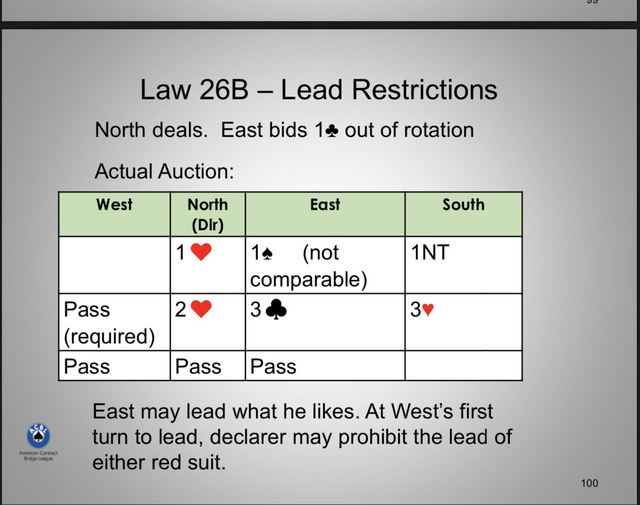
I think the part of this rule that sutprises me that not only is incompatible bid punished by barring partner for one round but after the "illness" is arguably cured the lead penalties still apply. In the foregoing example had East rebid spades then at Wests first turn to lead Declarer would have had his choice of one of three suits.
..... see less
Numerous situations may create lead penalties. Some are obvious (or should be), while others are less apparent and may not take effect immediately.
This is doubly problematic as a lead when Declarer ..........
..... see more |
|
|
|
|
|
| LHO after an Insufficient Bid (Amended 11/26) |
Re-written 10/14 this was confusing I hope the re-write is easier to understand.. Nobody intentionally makes an insuffient bid.. But the Laws consider any bid in which the brain says bid xxx and the hand pulls the xxx card as an intentional bid.. You did not, for example, reach for 2♦ bid card and drop 2♥ card on the table.. After an intentionally made bid which is insufficient Offender's LHO has the right to accept the insufficient bid. If he does the auction continues from that point If LHO does not accept the bid then Offender must make "Compairable Bid." If you are uncertain about what a ccmpairable bid is check out the article by that name. In deciding whether to accept or require a compairable bid It might be relevant for LHO to first discover whether the offender has a compairable bid which would allow the auction to proceed undisturbed, hence Law 20F1 allows Offender's LHO to ask the Offender’s partner about the meaning of any potential replacement call, prior to deciding whether to accept the bid.
Auctions with insufficient bids can become complicated
LHO does not waive his right to accept the insufficient bid by simply observing it occurred. Further, either opponent can complicate matters by offering an opinion like "You have to make it sufficient." Which just is not true. Offender must substitute a comparable bid in order to proceed without consequences. For example consider the auction 1NT 2♦ 2♣ (the 2♣ bid made intentionally and not accepted by LHO.) Assuming 2♣ was Stayman 3♣ may not show the same suits, however 3♦ (cue bid, Stayman) might. The answer is "Call the Director" even when you think you know the right rule and elected action, you don't want to be the person responsible for explaining it to your opponents. Further the Director can confer with players away from the table which avoids poluting the hand with Unauthorized Information. A replacement non-comparable bid when made requires partner to pass for the remainder of the auction. Another subtle point. Say the auction goes: 2♠ 1♦ (clamorous Insufficients) OH 3♦. Sill the Offender's LHO may accept the original (but not unintended) bid of 1♦, make any bid allowed over 1♦ and the auction proceeds from there. Further, lead penalties may apply if the Offenders become Defenders and an insufficient bid is replaced with a xall which is not comparable. Call the Director. Finally, the 1♦ if not accepted or the 3♦ bid if 1♦ is accepted, are Unauthorised Information (UI) for Offenders, but Authorised Information for their opponents. Did I mention "Call the Director"??
|
|
|
|
|
|
| No Hearts, Partner?. Whoops! |
Two things here.. First, best practice is to always ask or never ask.. I find my self asking only some of the time, which, while permitted, can lead to UI (Unauthorised Information).
Second, when a defender corrects an unestablished revoke, declarer has the right to change the card played next in rotation after the revoke. (Whether it be from his own hand or from dummy.) If declarer does change the card he played, then the next defender can now also change his card, but only if it was played in rotation to the card declarer withdrew. Since the defenders, in this case, are members of the offending side; any cards they withdraw become penalty cards. In the event, Declarer has revoked but such action has not become established, then upon correction the next defender to play may withdraw their card and substitute another. The withdrawn card is not a penalty card, nor does a substitution create Unauthorized Information. The cascading nature of this event had not occurred to me and I can not recall it occurring.
|
|
|
|
|
|
| Unauthorized Information (UI) |
Law 16B is the heart of Unauthorized Information. Frankly, without having my attention called to the practical aspects of the Law, despite years of playing I have not understood "Unauthorized Information" (UI) and still, certainly, have more to learn. First, here is 16B(1):
B. Extraneous Information from Partner
1. Any extraneous information from partner that might suggest a call or play is unauthorized. This includes remarks, questions, replies to questions, unexpected alerts or failures to alert, unmistakable hesitation, unwonted speed, special emphasis, tone, gesture, movement or mannerism.
(a) A player may not choose a call or play that is demonstrably suggested over another by unauthorized information if the other call or play is a logical alternative.
(b) A logical alternative is an action that a significant proportion of the class of players in question, using the methods of the partnership, would seriously consider, and some might select.
While 16B(1) specifies UI from your partner other places in the Laws refers back to 16B or repeats the same language. In short if partner messes up, in almost any way, the partnership is in an Unauthorized Information mode. If the director is called before the recipient of the unauthorized information takes action, the Director will instruct the recipient they cannot choose an action demonstrably suggested by that information, IF there are logical alternatives. This is not the same thing as “ignoring the information.” When there are logical alternatives, calls or plays suggested by unauthorized information are not allowed, even if those calls or plays are majority actions (actions that a majority of players would take). To put this another way, when you are the recipient of unauthorized information you are penalized. You may not take a course of action suggested by the UI even if it appears to be the best alternative of several logical choices. For example if you are in third seat holding 20 HCP, you are not required to Pass when it is your turn to call just because partner huddled over his cards before passing. You do have UI. (i.e. partner is not holding 9 or fewer HCP and 4-3-3-3) but "Pass" is not a logical alternative holding a 20 point hand in third seat. No problem. But later in the auction depending upon what transpires in all seats that initial huddle may come back into play. Is a slam try justified? Should I invite game? Often bridge comes down to a choice of two or three actions. If you have UI you can not choose an action suggested by the UI, even if without such information most players at your skill and experience level would choose that action. This is indeed a heavy burden.
While we are on the topic, also see Law 50E (Law 50 generally deals with Penalty Cards.)
E. Information from a Penalty Card
1. Information derived from a penalty card and the requirements for playing that penalty card are authorized for all players for as long as the penalty card remains on the table.
2. Information derived from a penalty card that has been returned to hand [as per Law 50D2(a)] is unauthorized for the partner of the player who had the penalty card (see Law 16C), but authorized for declarer.
3. Once a penalty card has been played, information derived from the circumstances under which it was created is unauthorized for the partner of the player who had the card. (For a penalty card which has not yet been played, see E1 above.)
Again the implications of this Law had not occurred to me. (YMMV) For example ... Partner plays a small club when you lead the Ace of Hearts "No hearts Partner?" Oh!!!, then plays a heart. Club on the table. Declarer exercising their rights says: "Lead a club if you can." The small club is picked up and is no longer a penalty card. 50E(2) "information derived from a penalty card ... returned to the hand ... is unauthorized." In choosing what club to lead you can not select a lead suggested by the rank of the misplayed club or the fact the card is in their hand at all. Worse yet if there is a choice A or B and the small card removed from the table could suggest one or the other you must select the one not suggested. Holy Buckets! And 50E(4) enforces this outcome: "4. If following the application of E1 the Director judges at the end of play that without the assistance gained through the exposed card the outcome of the board could well have been different, and in consequence the non-offending side is damaged (see Law 12B1), he shall award an adjusted score. In his adjustment, he should seek to recover as nearly as possible the probable outcome of the board without the effect of the penalty card(s)."
..... see less
Law 16B is the heart of Unauthorized Information. Frankly, without having my attention called to the practical aspects of the Law, despite years of playing I have not understood "Unauthorized Inform ..........
..... see more |
|
|
|
|
|
| Revokes? Penalized or Adjusted?? (minor edit 1/11/26) |
Revokes: Penalty or Adjustment?
Before 2007, the Laws of Duplicate Bridge imposed a general two-trick penalty for an established revoke. Today, the rules focus on equity—adjusting the score to reflect what would likely have happened without the infraction. The automatic adjustment may be zero, one, or two tricks depending on the situation. But an adjusted score may be assigned if the automatic adjustment is insufficient to restore the hand.
Four Concepts to Understand
1. Established Revoke
A revoke becomes established when the offending side plays to the next trick. Once established, a defective trick is not repaired, except at Trick 12. Play continues until the hand is completed. A revoke may also be established by a claim or concession by the offending side.
2. Correction Before Establishment
If a revoke is discovered before it becomes established, it is corrected in place:
- The offending player withdraws the incorrect card and substitutes a legal one.
If the offender is declarer or dummy, the withdrawn card is returned to the hand.
If the offender is a defender, the withdrawn card becomes a major penalty card.
Law 62C1 allows each member of the non-offending side to withdraw and return to their hand, any card played after the revoke but before attention was drawn to it. Additionally:
- When the offender changes the card played to the trick, their left-hand opponent may also change their card.
For Declarer or Dummy the original card is returned to hand and does not become a penalty card. However, if the Offender was also a Defender, then the withdrawn card becomes a major penalty card.
If Offender’s LHO changes their card, then the third player (offender’s partner) may also change theirs—but that card becomes a penalty card.
If correcting the trick changes who won it, and a lead has already been made, that lead is retracted without penalty—provided it was made by the non-offending side. Had the offending side led, the revoke would have become established. See Law 62C3.
If both sides revoke on the same trick and only one side has played to the next trick, both revokes must be corrected. Every withdrawn card by the defending side becomes a penalty card.
3. Adjustment After Establishment
Once a revoke is established, the laws provide for adjustments:
- If the offender wins the revoke trick and their side also wins a subsequent trick, two tricks are transferred to the non-offending side.
If the offending side wins the revoke trick or a subsequent trick, one trick is transferred.
If the offending side does not win any trick from the revoke onward, no adjustment is made.
If these adjustments fail to restore equity, the Director may, at the request of the non-offending side, assign a different score under Law 64C.
4. Trick Twelve
Law 64B 6 is often quoted "There is no automatic trick adjustment following an established revoke if ...(6) It is a revoke on the twelfth trick." The Law however is sometimes misapplied. Law 62D provides a revoke on the 12th trick must be corrected even if established. It is simply replayed and the board scored as if the error did not occur.
Takeaway
Revokes are no longer punished automatically—they are adjusted to preserve fairness. The adjustment may benefit the non-offending side, but if it fails to make them whole, they should appeal to the Director for further remedy. Revokes often result in a penalty card and Unauthorized Information. The Director should be called. Both the player with the penalty card and their partner must understand their options and obligations. In general, the non-offender does not want to be the one providing an explanation. Further any player may find it difficult to to explain all options without providing UI to their own partner.
..... see less
Revokes: Penalty or Adjustment?
Before 2007, the Laws of Duplicate Bridge imposed a general two-trick penalty for an established revoke. Today, the rules focus on equity—adjusting the score to reflect what would likely have happened without the infraction. The automatic adjustment may be zero, one, or two tricks depending on the situation. ..........
..... see more |
|
|
|
|
|
| Why I'm hard on Dummy |
I am very specific with Dummy. In fact I have been referred to as "Grumpy", "Pedantic", and something else starting with "A". (All three of which are often true, but here is why.) The Dummy has limited rights and very few duties but the breach of those duties may have consequences.
First, the most basic, The Dummy does what Declarer tells him to do. For example imagine, Declarer leads the Ace of Trump and the 3, 4, & 5 spots are on the board. Declarer says "Play low." Dummy picks up the 5. Shrug, who cares, right? I care! The play of the 5 constitutes a revoke. Does it matter? Probably not. Specifically Law 64B provides No Automatic Adjustment ... "3. the revoke was made in failing to play ... any card belonging to dummy." But see, subpart 7 of the same section; Law 64B No Automatic Adjustment "7. both sides have revoked on the same board and both revokes have become established." Thus the dummy revoke forfeits the automatic trick adjustment. (Law 64C 2. (b) does allow the director to award an adjusted score based upon likely results without a revoke but it is not automatic.)
Next play from dummy may create a timing issue. Consider Law 57 Premature Lead or Play. In brief, if a defender plays ahead of his partner then Declarer may direct the pondering defender's play. Consider South leads low towards a stiff Ace on dummy East plays low South may now say to West "Play your highest card in this suit." However, same situation if Dummy picks up the stiff Ace to indicate it has been played the options under Law 57 are gone. Click the Law 57 box to take a look.
Law 57
57A. Premature Play or Lead to Next Trick When a defender leads to the next trick before their partner has played to the current trick, or plays out of turn before their partner has played, the card so led or played becomes a major penalty card. Declarer then selects one of the following options:
- Require the offender’s partner to play the highest card they hold of the suit led, or
- Require the offender’s partner to play the lowest card they hold of the suit led, or
- Require the offender’s partner to play a card of another suit specified by declarer, or
- Forbid the offender’s partner from playing a card of another suit specified by declarer.
A third reason purely personal. When I want to pause to plan or count I try to do it before I complete the previous trick so the play to the next trick appears unconcerned. Dummy making an obvious play by picking up a singleton or playing low from touching cards may press the issue of what I am thinking about.
Dummy rights are few and far between and they may be lost by intentionally or accidentally seeing cards in Opponents' hand.. (Law 43A) The most important right is to attempt to avoid an irregularity by partner, such as a lead from the wrong hand or establishing a revoke.. So when is a card actually played from the dummy? (After which, if it was the wrong hand, it is too late to change.) Law 45B "Declarer plays a card from dummy by naming the card..." "Naming the card" is another of those terms which may not mean what you think. After a lead from Declarer's hand "low" designates the lowest card of the suit lead, likewise "duck".. If the lead is coming from the dummy low or top designate a continuation of the previous suit.. If Declarer calls for a rank (King) but not a suit and only one card of that rank exists in dummy it is played.
Here is all of the applicable Law ...
Law 46B
46B Incomplete or Incorrect Designation
- (a) If declarer in playing from dummy calls ‘high’, or words of like meaning, he is deemed to have called the highest card of the suit led.
(b) If he directs dummy to ‘win’ the trick, he is deemed to have called the lowest card that it is known will win the trick.
(c) If he calls ‘low’, or words of like meaning, he is deemed to have called the lowest card of the suit led.
- If declarer designates a suit but not a rank he is deemed to have called the lowest card of the suit indicated.
- (a) In leading, declarer is deemed to have continued the suit with which dummy won the preceding trick provided there is a card of the designated rank in that suit.
(b) In all other cases declarer must play a card from dummy of the designated rank if he can legally do so; but if there are two or more such cards that can be legally played declarer must designate which is intended.
- If declarer calls for a card that is not in dummy the call is invalid and declarer may designate any legal card.
- If declarer indicates a play without designating either a suit or a rank (as by saying ‘play anything’ or words of like meaning) either defender may designate the play from dummy.
|
|
|
|
|
|
| Claims May Not Work Like You Think |
Another example of the rules changing but my mindset had not, until now
Historical Context: Back in the 1970s, the Laws of Duplicate Bridge were much stricter about claims. Once a claim was made, play ceased immediately, and the director was summoned if there was any doubt. The non-claiming side could challenge the claim, and the director would adjudicate based on the stated line of play when there was no stated line of play the non-claiming side could argue any "illogical but not irrational" defense. There was no provision for resuming play by mutual agreement.
2017 Update – Law 68D2b: The current Law 68D2b introduces a new flexibility: if all four players agree, they may continue playing the hand after a claim. This is a notable departure from prior law. It reflects a more player-driven approach, especially useful in casual or club settings where players might prefer to resolve things themselves without summoning the director.
Why the Change?
- To reduce unnecessary director calls for obvious claims.
- To speed up play in situations where all parties are comfortable.
- To mirror online bridge norms, where play often continues unless challenged.
So, play does not necessarily cease. It may continue by agreement. Further cards exposed DO NOT become penalty cards and are authorized information for the non-claiming side. Hence, if Declarer claims and Defenders say: “Not so fast.” Insight gained by the defenders objecting to the claim may be used in the continued defense of the hand.
So when it’s over, its over, right? Again, “Not so fast.” An agreement to a claim or concession is not established until the non-claiming side actually makes a call on the next board. Wait, what? That’s right confirm score on the Bridgemate, take cards out of the next board, and the light goes off, it is not too late to argue the claim about alternative lines of play. (Law 69A.), Unless the round has been called, that’s the end too. So that’s it right? Round called or start to bid the next hand its over. No!! Look at Law 69B:
B. Withdrawal of Established Agreement Agreement with a claim or concession (see A) may be withdrawn within the Correction Period established under Law 79C: 1. if a player agreed to the loss of a trick his side had, in fact, won; or 2. if a player has agreed to the loss of a trick that his side would likely have won had the play continued. The board is rescored with such trick awarded to his side.
The “Correction Period” is generally 30 minutes after the scores for the game are posted. The materials guiding the Director in this case basically give every break to the original claimant but it is still possible. Maybe I should retitle this “Exactly when does the fat lady sing?”
..... see less
Another example of the rules changing but my mindset had not, until now
Historical Context: Back in the 1970s, the Laws of Duplicate Bridge were much stricter about claims. Once a claim was made, play ceased immediately, and the director was summoned if there was any doubt. The non-claiming side could challenge the claim, and the director would adjudicate based on the stated line of play when there was no stated line of play the non-claiming side could argue any "illogical but not irrational" defense. ..........
..... see more |
|
|
|
|
|
| Are "Senior Moments" excused? |
Are momeentary lapses of attention "Senior Moments" a reason to allow a change of call or for designation of which card to play from dummy? Strangely it is not.. While there is some discretion on the part of the director they are limited by the Laws which expressly prohibit a " momentary loss of attention" as a reason to permit a change in either play or call.. (See Law 25(A) 2; Law 45 (C) (4)(b).). NB the previous Laws contained language similar to "without pause for thought" this has gone by the wayside. Also an obviously unintended call is also not able to be withdrawn. One example: opponents silent 1H -- 3D [Alert] {explanation a Bergen Raise shows 4 Hearts and 9-11 HCP, no it is not forcing to 4H.} After making the explanation, the Opener Passes. The pass stands, no matter how unintended. It is deemed a monetary loss of attention.
..... see less
Are momeentary lapses of attention "Senior Moments" a reason to allow a change of call or for designation of which card to play from dummy? Strangely it is not.. While there is some discretion on the part of the director they are limited by the Laws which expressly prohibit a " momentary loss of attention" as a reason to permit a change in either play or call.. (See Law 25(A) 2; Law 45 (C) (4)(b).). NB the previous Laws contained language similar to "without pause for thought" this has gone by the wayside. Also an obviously unintended call is also not able to be withdrawn. ..........
..... see more |
|
|
|
|
|
| The Auction and The Auction Period are not the same |
🧭 What the Laws Say:
- Law 20F5: Declarer (But not presumed dummy) may ask for explanations after the auction ends but before the opening lead is faced.
- Law 25A5: A change of an unintended call is only allowed, during the auction period, and prior to the partner's call.
- Law 41A: The opening lead must be made face down, and only then may questions be asked.
- Law 41B: Once the lead is faced, the auction period ends and a player may ask for a review of the auction only when it first his turn to play. However further questions about the meaning of a particular bid may be asked whenever it is any player's turn and prior to his play to the trick.
I have recently become aware of some technical differences in the rules revolving around the "auction period" as opposed to "the auction." The auction period for each side begins when either partner removes their hand from the tray, The auction begins when a call has been made. The auction ends when each player has had an opportunity to bid or three consecutive passes. The auction period ends when declarer's LHO faces his lead on the table, or all the hands have been returned to the tray. The time between the final pass and the opening lead being faced is referred to as the "Clarification Period." The Clarification Period is part of the auction period. During this time, not only may leader's partner ask a question but declarer or dummy may clarify a mistaken explanation or may offer a delayed alert for a conventional bid above 3NT. Whereas, the defense may prejudice their own position by not giving declarer adequate time to offer a clarification. While, declarer may and should offer necessary explanations even if the opening lead has been faced, the opening lead once faced can not be retracted. If the opening lead has not been faced then the defender may retract such lead, if the Director permits such action.
A change of call may also be permitted by the Director during the auction period, when an unintended call has occurred or a call has been made based upon miss information.
Another difference exists at the beginning of the auction period and prior to the auction beginning, a card inadvertently exposed may not become a penalty card of any kind. However, it may constitute Unauthorized Information (UI) for the partner of the offender. Don't assume, call the Director.
..... see less
🧭 What the Laws Say:
- Law 20F5: Declarer (But not presumed dummy) may ask for explanations after the auction ends but before the opening lead is ..........
..... see more |
|
|
|
|
|
|