| Bridge History |
Frankly I did not know where to stick this little ditty. I came across a Sports Illustrated article from October of 1961 documenting the state of bridge at that time. The article is centered on the quest for Master Points as an obsession in American culture. The number of quips and references is truly outstanding and worth your time to detour into the sporting past. Take a look HERE. Just to tie my personal timeline to 1961. I was 11. My grandmother was at the time running several bridge games in and around her home on West Okoboji. I recall the first Lakeland Sectional held in the New Inn Convention Center in 1962. I caddied for three days earning $5 a session for delivering coffee and cleaning ash trays between rounds. Good Times!
|
|
|
|
|
|
| Introduction |
I use a number of shortcuts while playing bridge. In this section I discuss both the application of those rules and when I can verbalize it, the "why" of the rule. Any part of a bridge game I can reduce to a stimulus / response I can save those braincells for things which really require thought. I'm sure other players have their own rules and shortcuts too.. Feel free to send them to me for inclusion in this section.In the second part I am laying out common cnventions or concepts which I find to be obscure or maybe beyond the everyday useage.. Over time I have gathered a working knowledge of many conventions but in some cases found there is more to it than I knew.
|
|
|
|
|
|
| The Eight Card Fit |
Why is an eight card fit considered the holy grail in partnership trump holdings? To at least partially answer this question we need to detour into another "rule" founded firmly in probability.. Odds split even and Evens split Odd.
Evens split odd and Odds split even, what does that mean? If your partnership possesses an even number of cards in a suit, the remaining, odd number of cards, in the opponents' hands are more likely to be evenly distributed between their two hands. Conversely, if your partnership holds an odd number of cards and the opponents hold an even number, their holdings are more likely to be skewed or unbalanced rather than evenly split. This concept is particularly important in understanding why an eight-card fit is desirable and why a seven-card fit, despite being over half the suit, may present significant difficulties.
�
The odds of a given suit distribution in the opponents’ hands is mathematically shown using Pascal’s Triangle. Starting from the top if you hold 12 cards then opponents hold 1. It is either held by your LHO or RHO 50-50; Second line if you hold 11 cards and there are 2 cards held by your opponents, they are either 2-0 1-1 or 0-2 held by LHO, Both or RHO and the odds are 1:4, 2:4 and 1:4 respectively
. . . . . 1 1
. . . . . . 1 2 1
1 3 3 1
1 4 6 4 1
1 5 10 10 5 1 you hold 8 cards; opponents hold 5.
1 6 15 20 15 6 1 you hold 7 cards; opponents hold 6.
The 6th and 7th rows of the Triangle represent the opponents holding 5 cards and 6 cards respectively. (you are holding 8 or 7) The possible distributions expressed as probability percentages are:
6th row: 3.13%, 15.63%, 31.25%, 31.25%, 15.63%, 3.13% which correspond to distributions of 5-0 4-1 3-2 and then 3-2 1-4 and 0-5 on the other side.
7th row: 1.56%, 9.38%, 23.44%, 31.25%, 23.44%, 9.38%, 1.56% which correspond to distributions of 6-0 5-1 4-2 3-3 etc.
In a nutshell, if you hold 8 cards the outstanding cards will split 3-2 or 2-3 62.5% of the time. (Odds split evenly!) However, if you only hold 7 cards and opponents hold 6 they are split 3-3 only 31.25% of the time. The card split 4-2 or worse 68.75% of the time. (Evens split Oddly.) This is why an eight-card fit is considered beneficial maybe even magical. Bridge bidding systems are designed to find an eight-card fit whether it be 4-4, 5-3 or 6-2.
..... see less
Why is an eight card fit considered the holy grail in partnership trump holdings? To at least partially answer this question we need to detour into another "rule" founded firmly in probability.. Odds ..........
..... see more |
|
|
|
|
|
| To Bid or Not to Bid aka Rule of 15 |
To bid or not to bid that is often the question.. When you are in the fourth seat you are in a unique position. You can Pass for a zero.. A zero is better than going set and a zero is better than opening the door for opponents' making a part score by out bidding you.. How do they out bid you? With the spade suit. Welcome to the rule of 15.. Simply this: in the Fourth Seat if your High Card Points (HCP) and the number of spades added together is less than 15, then Pass.. Consider this hand I played recently vs BBO robots

This hand is particularly interesting because in the third chair I would open 2♥ every time. In the fourth chair I can pass for a zero. It turns out it was the right thing to do.
..... see less
To bid or not to bid that is often the question.. When you are in the fourth seat you are in a unique position. You can Pass for a zero.. A zero i ..........
..... see more |
|
|
|
|
|
| Counting |
Bridge is a game of counting. We count points; we count tricks; and we count individual cards. Of all of these, counting the cards played in each suit is probably the hardest. Personally, I probably lose more tricks by being uncertain whether small cards have "grown up" or not than any other way. Rather than count individual cards or at least remember them I try to do two things: First, track sets of cards once for 4; twice around is 8; then, count again including the cards I can still see, hand and dummy. Mentally I think it is eaeier to count 2X for 8 plus 3 is 11 than just remembering 11 and it has the added benefit of building a mental picture of the opponents' hands.. Do I still get it wrong? Sure I do.
..... see less
Bridge is a game of counting. We count points; we count tricks; and we count individual cards. Of all of these, counting the cards played in each suit is probably the hardest. Personally, I probably ..........
..... see more |
|
|
|
|
|
| The Impossible Spade |
I came upon this recently and thought it was a good arrow to add to my arsenal. Suppose the auction has gone 1 ♥, P, 1-NT, P, 2 ♦ P, ???, Playing One No Trump Forcing the Opener responds with his best minor which denies holing 6 hearts and it is up to Responder to advance the auction or place the contract. A bid of 3 ♦ by Responder denies heart support and keeps the auction open but is undefined as to length and strength of the diamonds. The Impossible Spade treatment suggests Responder bid 2 ♠ to show good support in diamonds and to use the immediate bid of 3 ♦ as weak and preemptive. So, why is Two Spades “Impossible” and thus available for a conventional meaning? Rewind the auction to the first two bids 1 ♥ followed by 1 NT (forcing). If Responder’s first obligation is to show a four card spade suit then holding four spades was denied by the 1-NT bid. Thus the spade bid can not be real. Use of the Impossible Spade does not eliminate a Non forcing Two Heart call, nor the 3 card Limit Raise of Three Hearts in the auction
| South |
West |
North |
East |
| One Heart |
Pass |
One No Trump (forcing) |
Pass |
| Two Diamds (best minor) |
Pass |
Three Hearts |
|
Thus nothing seems lost by using the Impossible Spade in heart auctions. Notably there is no "impossible heart."
..... see less
I came upon this recently and thought it was a good arrow to add to my arsenal. Suppose the auction has gone 1 ♥, P, 1-NT, P, 2 ♦ P, ???, Playing One No Trump Forcing the Opener responds with his best minor which denies holing 6 hearts and it is up to Responder to advance the auction or place the contract. A bid of 3 ♦ by Responder denies heart support and keeps the auction open but is undefined as to length and strength of the diamonds. ..........
..... see more |
|
|
|
|
|
| Inverted minors by an AI |
Sometimes I think my best friend is the MS AI, "Copilot." I do a lot of fact checking and so on with Copilot. I have also leaned I can discuss bridge bidding. This is especially helpful when I am trying to determine what is "standard" and what is just my notion of "standard." Here is a chart of Inverted minor bids with criss-cross after such a discussion.
🧩 Inverted Minors Summary Sheet
(with criss-cross and passed-hand adjustments; OFF in competition)
➕ When Not a Passed Hand (No Interference)
|
Auction
|
Meaning
|
Points
|
Support
|
Notes
|
|
1♣–2♣ / 1♦–2♦
|
Strong raise (Inverted)
|
12+
|
4+
|
Game forcing; may hold 4-card major
|
|
1♣–3♣ / 1♦–3♦
|
Weak raise (Preemptive)
|
0–6
|
5+
|
No 4-card major
|
|
1♣–2♦ / 1♦–3♣
|
Criss-cross raise
|
9–11
|
4+ of opener’s minor
|
Limit raise; artificial & alertable, No
4 card major
|
🔹 Inverted minors are OFF after competition
→ Revert to standard raises, cue bids, or Jordan 2NT if applicable.
➕ When a Passed Hand
|
Auction
|
Meaning
|
Points
|
Support
|
Notes
|
|
1♣–2♣ / 1♦–2♦
|
Best raise by passed hand
|
10–11
|
4–5
|
Not forcing; Denies 4-card major
|
|
1♣–3♣ / 1♦–3♦
|
Preemptive raise
|
7–9
|
5+
|
Not forcing
|
|
1♣–2♦ / 1♦–3♣
|
Criss-cross still used
|
9–11
|
4+
|
Applies by agreement
|
⚠️ Important Reminders
- All artificial raises are alertable, including criss-cross and inverted raises.
- Strong raise does not deny a 4-card major — show the major ASAP if holding one.
- If opponents interfere, do NOT use inverted minor structure — switch to standard competitive methods.
- Be cautious with passed-hand raises — no bid is ever game forcing.
..... see less
Sometimes I think my best friend is the MS AI, "Copilot." I do a lot of fact checking and so on with Copilot. I have also leaned I can discuss bridge bidding. ..........
..... see more |
|
|
|
|
|
| 2025 Alert Procedures |
I came across an ACBL paper on Alert and Announcement procedures effective June of 2025. Here are a couple of examples. (Click on the title at the top of the box to transfer to the ACBL site.) . Several bids were specifically NOT to be alerted which included a 2NT forcing after a weak two, whether it is OGUST or requests a Feature. Michaels is not to be alerted. The document is 14 pages and I might say "good to know." However, thinking about their descriptions (which often refer to common conventions without naming them) gives me a headache. Two things surprised me. First, it says an announcement should be be accompanied by the waiving of the Alert card. (?? Who does that and why??) Second, on a 2 Club strong auction ONLY the "2 Hearts Bust" gets alerted. They list four possible meanings for 2 Diamonds none of which warrant an alert. IMHO when there are three alternatives to "waiting" they deserve an alert, but no. Finally there is the concept of a delayed alert. Most artificial bids above 3NT including conventional calls in an ace-asking sequence are not Alertable. (Texas Transfers are an exception.) The reason is to avoid passing unauthorised information to the Alerting side, “waking up” a player who has forgotten they have agreed to some rarely used conventions or treatments 1430, 0314, Specific KIngs, DOPI, ROPI or DEPO. After the auction is over, you should explain the meanings of your calls to the opponents before the opening lead is made IF (big if!) your side declares. This is called a "Delayed Alert" as opposed to a forgotten or missed alert. The former is correct procedure the latter may be the subject of a adjusted score if damage occured.
|
|
|
|
|
|
| Bidding Problem 7/24 Open Game |
Show Detail |
I picked this hand for several reasons.. First I totally missed the best contract of 4 Hearts and The second best of 5 Clubs then I played the 1NT to making one when I should have Made 2.. Any recommendations on a good auction?. I am all ears. The Trsveler is hiding in the Answer box.
|
| Show Answer |
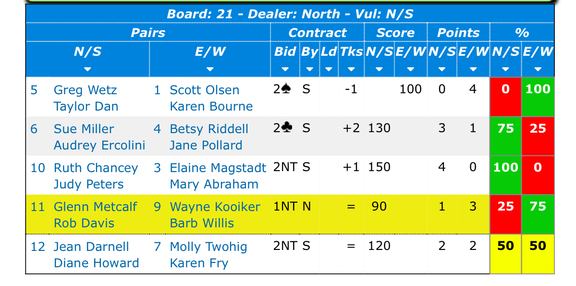
|
|
|
|
|
|
|