 Poser (Accepted Claims) Poser (Accepted Claims) |
POSER:. You are defending and pondering your lead to the next trick.. Declarer says: It does't matter the rest are mine making 5.. The claim certainly looks good.. You and partner nod and start to mix your cards and put them in the board. But hey, wait a minute, maybe the claim has a hole in it. Poser 1: May you change your mind about the claim and suggest anoter outcome was at least possible? Yes or No? If so, until when? a) Until both defenders’ hands are back in the board, then you’re done. b.) Score in the Bridgemate and approved by East or West, fini! . )) You make a call on the next board or the round is called for the last board of the set. Poser . Same set up you are admiring your 55% tied for 2-3 in A, when another player approaches you and says “Glad we tied but how did you ever let them make 5 on board …”. Do you? a) Hum the Carole King classic “It’s too Late” and head for the door or b) Check your watch and go looking for the director. Is it “a” or “b”? Why?
Show Answer
First Answer: You have until your side bids on the next board or the round ends, which ever happens first.. Law. . Also you may ask the Director to adjust a score for an agreed result for either a trick you had already won before the claim. (You cash AK and another A. Three tricks later Declarer says Making 5 and you look at his hand and say Yes.) or same thing and Declarer says making 4 and you not only cashed the AK A but hold the Ace of Trump This would be an example of a trick which can not be lost. Law. ..
|
|
| Last updated : Oct 24, 2025 08:48 CDT |
|
|
|
|
|
| Poser II (Insufficient Bids) |
A bid laid is a bid made, right? The auction has gone 1♠ 1♥ followed by a chorus of "insufficient" and finally "Director, Please." So when the Director arrives at the table and after the Director has been given the basic fact of an insufficient bid what is the first thing the Director needs to determine? a) Did LHO to the heart bidder bid yet? b) Did LHO and Offender's Partner both bid? Or c) Did the 1♥ bidder simply pull the wrong card? Poser, part 2, assume the answers are "No," "No," and "Yes" now what can 1♥ bidder do a) They must bid 2♥ b) They can do anything they want except Pass Or Double. (It may be beyond most players power of persuasion to convince the Director they reached into the totally wrong pocket. And finally Poser, part 3 the answers are "No," "No," and "No" Now what?. Does any thing change?. If so what is it? Finally suppose it was 1♠ 1♥ Insufficient 2♥ (by 1♥ bidder) Di-Rec-Tor!! May LHO accept the intended but insufficient bid even after calling attention to it and now calling the director?
As before the answers are elsewhere on this site.
|
|
| Last updated : Oct 24, 2025 08:51 CDT |
|
|
|
|
|
| Poser III (Bidding, Super Acceptance) |
Continuing the weekly series of Q and A and introducing a new Click box to display the Answer.
The quedtion is what do these auctions have in common?. (Opponents kindly passing throughout and not shown.)
1NT---- 2♥ ---- 3♠ 1♥ ---- 1NT (Forcing) ---- 2♦ ---- 2♠ .
And assuming partnership is playing four way transfers, then
1NT ---- 2♠ (Clubs) ----- 2NT & 1NT —— 2NT (Diamonds) —— 3♣
Show Answer
These auctions all demonstrate forms of “super acceptance.” You know the feeling You open 1NT holding AKxx of spades and Partner says 2 ♥ showing 5 spades and “something”
The jump to 3♠ says: I really like this. We will be playing spades, is slam possible? Example 2 is the "Impossible Spade." A full discussion of this can be found under a Thinking Game with an example in the Interesting Hands tab.
The same excitement conveyed by 1NT 2H 3S can be shown if you are playing Four Way Transfers, with minor suits by bidding 1 below the target suit, For example: 1NT 2♠ (NT Opener says ‘Clubs’) then bids 2NT (ALERT) [Partner loves my clubs.] (if asked)
How good of a hand makes super acceptance? Keep in mind the acceptance is being made by the 1NT Opener. The 1NT hand is limited both in total points and distribution. The message to Responder is “This is as good as it gets!” Partners should discuss.
|
|
| Last updated : Oct 25, 2025 06:45 CDT |
|
|
|
|
|
| Poser IV (Play from Wrong Hand) |
First, an observation, (You are free to disagree!) The most common mistake at the table is for Declarer to play from the wrong hand. Oft times followed by clamorous corrections by both opponents and by the Dummy. Next, most often, Declarer will then correct himself or herself by playing the same suit from the correct hand. Poser 1. How much, if any, of this is required by the Laws? .Poser 2. Does any part of the forgoing actually constitute a further breach of the Laws? You think, I'll wait.
Show Answer
When the Declarer leads from the wrong hand, it is deemed a lead out of turn and Law 53 applies.
[ Law 53A. Lead Out of Turn Treated as Correct Lead: (…) Any lead faced out of turn may be treated as a correct lead (…). It becomes a correct lead if declarer or either defender, as the case may be, accepts it by making a statement to that effect, or if a play is made from the hand next in rotation to the irregular lead. Law 53A needs to be considered in context with: Law 45B. Play of Card from Dummy: Declarer plays a card from dummy by naming the card, after which dummy picks up the card and faces it on the table. Notably the card is played when it is named!! The dummy picking up and facing the card on the table happens after the card has been played. The first option of ether opponent is to accept the lead from the wrong hand. If the Declarer's lead is not accepted Declarer must then lead from the correct hand. But there is no requirement to lead the same suit or to play the same card incorrectly faced previously.
Next, in the senario first posed has a further violation of the Laws occured? Poser 2. Yes! Law 42B provides for Dummy's Qualified Rights.... 2. He may try to prevent any irregularity. If declarer tries to play from the wrong hand, dummy may try to prevent it, calling partner’s attention to which hand won the previous trick. However, once declarer actually plays from the wrong hand, the irregularity is already committed, and dummy cannot prevent it anymore. Thus When Declarer says "Play the King of Spades." Dummy may not say: "You are in your hand." Such a statement is a violation. Declarer playing from his hand is a bit more nuanced and simply detatchig the card and moving it toward the table does not play the card Thus Dummy, on his toes as ever, may then say: "On the Board." No problem.
|
|
| Last updated : Oct 25, 2025 06:05 CDT |
|
|
|
|
|
| Poser V (2S / 1NT) |
Poser, How many meanings can you attribute to the bid of 2♠ in the auction 1NT Pass 2♠ ?. My count is four (4). Can you name them? Any others??
Show Answer
Here are my four:
- Natural, at least 5 spades 7 to 9 HCP.
- Relay to Clubs. Correct to Diamonds.. AKA 3 Way Transfers. [ALERT]
- Transfer to Clubs AKA 4 Way Transfers. [Announce: Clubs]
- Minor suit Stayman. [ALERT]
All four are part of a bigger picture. (1) Playing "Natural" likely no transfers are being used 2♦ and 2♥ are non forcing descriptive bids as well. (2) Part of a 3 Way Transfer System in which the initial Spade bidder may correct to Diamonds after the relay to Clubs. (3) Four Way Transfers: Spades to Clubs, 2NT to Diamonds useful but some what complicates showing a natural 1NT -- 2NT raise. (4) MSS asks for a 4 card minor;
|
|
| Last updated : Oct 31, 2025 12:42 CDT |
|
|
|
|
|
| Poser VI Lead out of Turn |
This week's Poser explores a bit of Law 53, Lead Out of Turn. There are numerous nuances to this occurrence, here are two. First, the simple case. West is on lead and East leads instead, South is Declarer. Law 53A applies. If South does not accept the lead, then the lead reverts to West, East's card becomes a Major Penalty Card and West's lead is subject possible lead restrictions or requirements due to the penalty card. Poser 1: Same situation but suppose South plays to East's improper lead. West says: "Hey, it is my lead! Director!!" What result and why? Poser 2: South is Declarer and is on lead. West leads out of turn. South does not notice and leads from their own hand. What happens now?
Show Answer
South's play to (acceptance of) East's improper lead as set up in Poser 1, changes the dynamic from the initial situation. West makes his normal lead to the trick but both South and East are allowed to pick up their cards. (Law 53B) East's improper lead does not become a penalty card but Unathorized Information (Law 16) may apply.
Poser 2 resolves thusly: South’s lead stands, West’s card is picked up and is Unauthorized Information for East (Laws 53B and 16C). Why? Because Declarer's play, even though a proper lead, acts to wave rectification. Had South noticed the lead, and called the Director then South would have been given the option to accept the lead and if not accepted the lead out of turn would become a Major Penalty Card. In some cases, like this,one, the exact sequence of events may change the outcome.
|
|
| Last updated : Nov 8, 2025 22:23 CST |
|
|
|
|
|
| Poser VII. (Bid out of Rotation) (edited: 3/19/26) |
|
This weeks Poser explores bids out of rotation the example comes from Duplicate Decisions by the ACBL. The "normal" situation is a player who bids out of rotation must either repeat the bid if previous players all pass or when it is their turn to call, make a comparable bid. (Fairure to make a comparable bid will bar partner and lead penalties may attach.) However this Poser explores an alternative occurance... South is dealer. East opens out of rotation with 1♣. South bids 1♠ and West calls the director after noticing the opening bid out of turn. What happens next?
Show Answer
The Director must ascertain (away from the table) if South thought they were calling over 1♣, with 1♠, in which case they accepted the bid out of rotation under Law 29A (the auction continues normally), or if they wanted to open 1♠ (maybe they didn’t notice the 1♣ bid). If this is the case, 1♣ is canceled, the auction starts with 1♠, no lead penalties, but 1♣ is UI for West. This result is required by LAW 28B which provides
Call by Correct Player Canceling Call Out of Rotation: A call is considered to be in rotation when made by a player whose turn it was to call before rectification has been assessed for a call out of rotation by an opponent. Making such a call forfeits the right to rectification for the call out of rotation. The auction proceeds as though the opponent had not called at that turn. Law 26 (lead penalties) does not apply, but see Law 16C2.
Law 16C2 is Unauthorized Information and is discussed on the Eductation Page. Incidentally, the reason for the "away from the table" admonishment is it is too easy for South to say something like "Well, I intended to open one spade but I'll just accept the bid and overcall." Now the director is in a quandary, because this conversation transmits UI to the innocent player's partner about the quality of the non-open, open.
|
|
| Last updated : Mar 19, 2026 07:47 CDT |
|
|
|
|
|
| Poser VIII (UI) |
This week a two part Poser. First, what is Unauthorized Information? (UI) What must you do should you be the receipiant of UI? First, which of the following is NOT an example of unauthorized information?
- You open 1♣ and the auction continues 2♥ , loooong pause, Pass, now it is your bid....
- A missed alert.
- A penalty card from partner's hand, face up on the table.
- A penalty card which has been picked up and replaced in partner's hand after a lead restriction has been exercised.
- An overheard comment clearly referring to the current hand from another player?
Show Answer
They certainly all LOOK like UI. Law 16C2 is the principle Unathorized Information law and lists some specific actions and occurances which may convey Unauthorized Information. Not withstaanding Law 50 Disposition of a penalty card provides a specific rule dealing with a faced penalty card Law 50E provides: Information from a Penalty Card 1. Inforamtion derived from a penalty card and the requierements for playinng that penalty card are authorized information for all players for as long as the penalty card remains on the table. Laws 50E 2. and 50E 3. deal with after the card has been picked up and after it has been played, respectively. However the answer to this week's Poser (part 1) is 3. the face up penalty card is not UI
Part 2. If you have UI what is your standard of care? In other words, what may you do or not do?
- You have to pass at every opportunity during the auction especially in the case of the afformentioned long pause. (Also refered to as a break in tempo.)
- You dig in your ethical heels and take extra care to make the right bid or card play under the circumstances ignoring the UI.
- During the auction or play you need to consider what logical alternative choices you have then select one NOT suggested by the UI.
- You just go ahead and bid or play your hand, opponents need to look out for themselves and call the director if injured.
Show Answer
Coming to grips with UI is hard to do. Some situations are more complex than others. However the Laws proscribe a solution and it isn't an option, it's the LAW. Number 3 above is the closest to the required course of action. For example imagine the auction: Pass, Pause-Huff-Pass, Pass, ??your call?? 23 of the finest HCPs and 4-4-3-2 distribution. This is a classic 2 Club opener to be followed by 2NT. There is no other logical bid only one. You may open 2 Clubs and rebid 2NT. OTOH suppose you have the 4-5-2-2 distribution, 10 HCPs and are in third or fouth seat, play Durry and parter made the same "Pause-Huff-Pass." Now you have some logical choices (1) Open the Hearts see if partner either bids spades or makes a Drury call or even passing Partner's NF 1NT all of which might work out if you open the Heart. Of course some folks might just Pass. What to do?? Here the UI Law kicks in. You MUST take an action not indicated by the UI. You Pass. You Pass, even when most folks with your skill and experience would open One Heart. Why? there are alternatives, and "Pause-Huff-Pass" could be seen to suggest a hand with some values.
About calling the Director... as a defender you should (but not must) wait until the play of the hand has finished to avoid adding to the UI at the table. For example consider the Auction (North Deals) 1♣ Pass 1♠ Pass; 3♠ All Pass. Partner leads, dummy (North) comes down with a stiff club. There were no alerts. If you call the Dirctor now it might certainly imply you are holding the club suit.
|
|
| Last updated : Nov 22, 2025 09:02 CST |
|
|
|
|
|
| Poser IX (forcing bids) |
This is more of a "What bids does your partnership have available?" type question. After I have initially passed I tend to rush the auction, lacking confidence I can keep the auction going. When the auction has gone Pass Pass 1 ____ (any suit), Pass, what bids are forcing at least one round?
Show Answer
A passed hand cannot force to game (since you’ve already limited your strength to < 12 HCP). But you can still make one‑round forcing bids — the same natural bids that would be forcing if you weren’t a passed hand.
✅ Forcing Options for a Passed Hand
- New suit at the 1‑level — always forcing for one round, even by a passed hand.
Example: Partner opens 1♦, you (passed hand) bid 1♥ → forcing one round.
- New suit at the 2‑level (non‑jump) — also forcing for one round.
Example: Partner opens 1♥, you (passed hand) bid 2♦ → forcing one round.
- 2/1 response (like 2♣ to 1♠) — normally game‑forcing if you’re unpassed, .
- As a passed hand, it’s only one‑round forcing (since you’ve already denied the strength for a game force).
- Conventional Bids such as Drury or Bergan
❌ Not Forcing
- 1NT response → Non‑forcing (6–10 HCP).
- Simple raises of partner’s suit → Non‑forcing (limit or preemptive).
- Jump raises → Invitational at best, not forcing.
- Jump shifts (natural)
- Partnership agreement comes into play. If your response to partner's first and second seat open is a Weak Jump Shift (WJS) Then this should change for third and fourth seat opens.
As a passed hand, they’re limited, most partnerships treat them as invitational or preemptive, not forcing.
Unless you’ve specifically agreed otherwise, don’t rely upon a jump shift as forcing by a passed hand
|
|
| Last updated : Nov 29, 2025 09:22 CST |
|
|
|
|
|
| Poser X A bit about Squeezes |
What do these terms have in common, "One loser," "Threat card," "Entry" ?? Okay there is one more term which mostly gives away the question, "Squeeze card."
Show Answer
- One loser → the condition that makes a squeeze possible (you must be down to exactly one potential loser).
- Threat card → the card that will become a winner if the opponent is forced to discard its guard.
- Entry → the way to reach the threat card once it’s established.
- Squeeze card → the card you actually play that forces the opponent into the bind.
These four concepts together with the preface to "One loser," "Correct the count" were the basis for Love's book, Squeeze Play (by Love) reportedly a best seller before people found out it was a bridge book, The overall theme of the book was squeeze plays either "are" or "are not." (In the words of Yoda, "Do or do not, there is no try.") You see the possibility, correct the count, and run the long suit containing the 'squeeze card.' Ether the card covering the threat card has popped or it has not, if not sluff the threat and hope the other maybe card will grow up. Take the classic case, Dummy AJ and K missing the KQ in the AJ suit and the A which is covering the King. You lead the 2 of something which defenders are out of and wait .... did the King grow up?? No then ditch the King and lead toward the AJ and pop the A either the J grew up or it did not. The book Squeeze Play by Love is not very long but contains multiple examples and many more elaborate plays. You can put it on your Holiday gift list, up to you whether you identify it as a bridge book or not.
|
|
| Last updated : Dec 6, 2025 17:12 CST |
|
|
|
|
|
| Poser XI Quiz Time True of False |
This week we have True or False Quiz on the question of Unauthorized Information pursuant to Law 16. There are a number of misconceptions about UI. Here are a few of them. This list is NOT exclusive.
True or False? Unauthorized Information is only a factor when something happens during the auction like a long pause for thought followed by a Pass.
T or F ❌ False. UI can arise both in the auction (as described) and the play such as when an unestablished revoke creates a penalty card. Hide Answer
True or False? When a player has UI their sole obligation is to act ethically and determine what they would do without the information.
T or F ❌ False. When you have UI which suggests a bid or play you must select a different action if one exists which some players of your experience level might consider and some might select. Hide Answer
True or False? The use of Unauthorized Information will be penalized by the director.
T or F ❌ False. The use of UI will result in an adjusted score (Law 16B(3)) pursuant to Law 12. Law 12C(1)(c) excludes the outcome suggested by the UI from consideration. However a procedural penalty is still possible in addition. Hide Answer
True or False? A penalty card is initially authorized information for both pairs, but after it is played or returned to the hand, it becomes unauthorized information for the offender's partner.
T or F ✅ True. While a penalty card is authorized information for both sides while visible, once it is played or returned to hand, it becomes unauthorized information for the offender’s partner. This distinction is important for determining legal actions and leads. Hide Answer
True or False? A card which has been played and returned to the hand without becoming a penalty card, may still be considered UI for the offending side.
T or F ✅ True. For example when correcting a revoke. Suppose a low heart is played from dummy. (North) East ruffs, South plays low. West plays low. East says: "Oh fudge" and produces a heart. South may change their card. If South changes, so may West. West's original card becomes a penalty card. But the knowledge South has an additional heart is UI for West. NB East and West both have a penalty card. West on lead. South may direct a lead of the suit (trump) shown by East's penalty card. If so East picks up the penalty card and may play any card in that suit, if not West leads his penalty card. Hide Answer
|
|
| Last updated : Dec 13, 2025 00:01 CST |
|
|
|
|
|
| Poser XII Score Adjustments |
The Posers thus far have had short answers hopefully worth some thought.. This one a bit longer deals with a Director's powers to Adjust Scores. There are actually four and half ways to adjust results in a duplicate game and only two (well one and a half) are intended to act as a penalty. Think a bit before clicking the "Continue" box. How many ways to make an adjustment can you come up with? (To shorten the display I have also inserted several "More" boxes to expand on individual subparts. I told you this was a long one.)
Continue
The four ways are a Trick Adjustment, an Adjusted Score, a Weighted Adjusted Score, and an Artificial Score. The "half" is a Procedural Penalty (Law 90).
A Trick Adjustment occurs after an established revoke. More...
LAW 64A provides for an automatic transfer of zero, one or two tricks to the non-offenders depending upon the circumstances. However, LAW 64C provides the Director shall assign an adjusted score in favor of the non-offending side when the automatic trick adjustment does not fairly compensate the non offender. Neither the adjustment nor the adjusted score is intended as a penalty, rather the purpose is to restore normal.
Less...
An Adjusted Score is a bridge result in which the score assigned is determined as the most probable outcome if the infraction had not occurred. More...
As a "bridge result" it is match pointed along with all the scores on the board. An Adjusted Score may also be split. Suppose N-S fail to alert a bid, E-W are damaged and possibly feeling the failure to alert could result in an adjusted score take a "flier" at a slam. Down 2. E-W will keep their table result of Down 2. But N-S may be awarded a minus 420 for the game E-W would likely have bid had the alert and explanation been made available to E-W at the time. (Yes, the perfect result, everyone is unhappy.)
Less...
A Weighted Adjusted Score is used in place of anAdjusted Score when the results of a board could be one of several possible outcomes depending upon the non-offender's choices during play. More...
For example, eight ever nine never but still sometimes a hook just feels right and sometimes the drop feels better. If the offense stops play before the non offender had to make a choice of a course of action then the Weighted Adjusted Score is used. For example, if possible outcomes are 3NT= or 3NT+1 and the choice is a toss up. The director match points 3NT= say that is 3 MP and 3NT+1 say that is 6 MP. Then awards 50% of 3 plus 50% of 6; or 4.5 MPs. However if the director think 3/4's would make the play for 6 then the Director awards 75% of 6 (4.5 ) + 25% of 3 (.75 ) MP for a total of 5.25 MPs.
Less...
Fourth are the Artificial Adjusted Scores, Average+ Average and Average-. Artificial Scores are used when an adjusted score or weighted adjusted score can not be determined with reasonable certainty. They are the exception, last ditch alternatives. More...
The non offenders are award average+ on the theory, at a minimum, they have lost the ability to compete for a good score. Offender's may be awarded Average or Average- depending upon the situation. Sloplay or a second late play due to a medical condition may warrant an Average. Slow play or a second late play due to too much time at the snack table or talking between boards then Ave- may apply. An interesting point, Average+ is nominally 60% of the match points on a board. However, if a pair is having an exceptional game and their average on all other boards is more than 60% then the Average+ is their actual average on the other boards. Likewise a pair receiving a 40% for Ave- with a game of 35% will receive a 35%. (LAW 12C 2(c)). Finally occasionally a Director's ruling will be wrong and cause damage or make a board unplayable. (Act in haste, regret at leisure.) In this case Average plus may be awarded to both pairs. (Everybody wins, except the Director.)
Less...
A Procedural Penalty found in Law 90, provides the Director with flexibility to assess a penalty related to procedures or decorum not related directly to the play of an individual board. I'd call this the "You should have known better," penalty.. It applies to the final match points of the contest as a whole. Between a half to a full board may be assessed in the sole discretion of the director. The range may be set by the sponsor but absent such a setting the director is not limited to a full board.
Hide Explanations
|
|
| Last updated : Dec 19, 2025 19:47 CST |
|
|
|
|
|
| Poser XIII NMF |
|
New Minor Forcing (NMF) is one of those quick "Check the box", "Do you play..." questions. However, maybe not everyone has the same expectations of when it applies. Because it is alertable you should be on your toes for both the correct time to use it and the alert when it happens. Here are some sample auctions.
1.
| N |
E |
S |
W |
| 1♣ |
P |
1♥ |
P |
| 1N |
P |
2♦ |
|
2.
| N |
E |
S |
W |
| 1♦ |
P |
1♥ |
1♠ |
| 2♦ |
P |
3♣ |
|
3.
| N |
E |
S |
W |
| 1♦ |
P |
1♥ |
P |
| 1♠ |
P |
2♣ |
|
4.
| N |
E |
S |
W |
| 1♥ |
P |
1♠ |
P |
| 1NT |
P |
2♣ |
|
5.
| N |
E |
S |
W |
| 1♣ |
P |
1♠ |
P |
| 2NT |
P |
3♦ |
|
Which ones are NMF?
Continue
#1, #4 and #5 are New Minor Forcing as the auction involved Opener Bidder's second bid being No-trump, followed by Responder bidding the new minor suit. #2 and #3 would be examples of 4th Suit Forcing (FSF). The NMF bid promises nothing about the new minor suit but does show 5 cards in the original major allowing opener to now raise with a three card fit. In addition the NMF bid shows an invitational hand with real values at least 9 HCP.. #5 is a bit unusual as we generally think about NMF over just 1NT but where it was your intention to show both a 5 card major and extra values you should not be dissuaded by partner's strong showing with the jump to 2NT!
Hide Explanations
|
|
| Last updated : Jan 31, 2026 09:18 CST |
|
|
|
|
|
| Poser XIV Specific Kings |
So you are getting ready to play with a new or infrequent partner and as you fill out your convention card you generally arrive at "Slam Conventions" about the same time as the Director says: "Bridgemates are active." So you say to partner, "Gerber, Blackwood 1430?" You receive a nodding assent. Next you say: "Specific Kings?" to which partner looks up and says "What??" Do you (a) explain Specific Kings in 20 seconds or less and the Queen Ask, while you are at it, or (b) just say: "Okay count only."?
Continue
"Specific Kings" is a part of RKC but it seems to me many players either don't recognize the sequences or don't understand the question. Specific Kings and the Queen Ask are "what happens next" after the initial response to RKC Blackwood 1430 or Gerber 1430 are on the table.
When the responses to RKC show 14 or 30, whether partner holds the Queen of trump is still up in the air. {Bring on the Queen Ask} The Queen Ask is simply bidding one step up the line from the 1430 response, skipping over the intended trump suit.
Example (Spade slam): 4NT – P – 5♣ [14] – P – 5♦ ← Do you have the Queen of Spades? No → bid 5♠ Yes → bid your lowest ranking King
Example (Heart slam): 4NT – P – 5♦ [30] – P – 5♠ ← Do you have the Queen of Hearts? 6♥ = NO Queen Anything else = YES + that specific King
After the 14/30 response, the next two steps show: • two key cards without the trump Queen • two key cards with the trump Queen The Queen question has been answered; now use 5NT to ask for the cheapest (specific) King.
Poser 14.5 — It’s fun to use conventions, but are there times you should just set the contract?
Continue
A most definite YES. If the answer is not going to help you decide between 6 or 7 or a No Trump contract instead of 6 of a suit, don't ask. The answer if it won't help you it may help the defense. No reason to show your soft underbelly if you don't have to.
Close Poser 14.5
Hide Explanations
|
|
| Last updated : Feb 2, 2026 08:25 CST |
|
|
|
|
|
| Poser XV Delayed Alerts |
What is the difference between a "missed alert" and a "delayed alert," if any?
Continue
After the third pass and before the opening lead is faced we are in a part of the auction referred to as the correction period. During the correction period Declarer or Dummy must advise opponents of any missed alert or explanation that was inconsistent with partnership agreements.
Show LAW 20F5 Law 20F5 A player must correct any misinformation given to the opponents at the end of the auction but before the opening lead is faced. Declarer or dummy must notify the defenders of any failure to alert or any explanation that was inconsistent with partnership agreements.
Under the Director's supervision the unfaced opening lead may be withdrawn
Show LAW 41A Law 41A The opening lead is made face down. The face‑down lead may be withdrawn only upon instruction of the Director after an irregularity has been identified.
and in a proper case the auction may be reopened with the call of the last defender to pass
Show LAW 20D3 Law 20D3 If a player has not had the opportunity to call because of misinformation or an irregularity, the Director may allow the auction to be reopened, permitting the last defender who passed to make a call.
A delayed alert is fundamentally different but also occurs during the correction period. Certain bids above the level of 3NT are not to be alerted when made, rather the alert occurs during the correction period and if you are quick enough before the opening lead is detached and placed upon the table. A delayed alert is intended to protect the non alerting side from opponents using the alert system to confirm they are both on the same page. A further explanation is found in the ACBL Alert Procedures Guide
Show more about Delayed Alerts Delayed Arerts
In any case where a bid is Alertable but the bid is 3NT or higher, and the auction is at or beyond opener's rebid, the Alert is to be delayed until the end of the auction. Additionally, Control Bids should be Alerted at the end of the auction even if they occur below the level of 3NT. Alerts of passes, doubles, and redoubles are not delayed regardless of the level of the auction. At the end of the auction, both defenders should Alert any Alertable bids made by their partners with a Delayed Alert. The declaring side should explain any Alertable bids for which Alerts were delayed.
Hide Explanations
|
|
| Last updated : Feb 2, 2026 08:25 CST |
|
|
|
|
|
| Poser XVI Eight Ever |
"Eight ever, Nine Never" we have all heard it. Let's start with: What does it mean?
Continue
It is the answer to the question should I finesse the Queen or go for the drop? Leaving the deep math behind, the drop with eight card fit is 32.8% while with a nine card fit the Queen will drop about 53% of the time. Hence the rule Eight ever, Nine never. (The hook is always taken as 50-50.) So when do we bend the rule?
Continue
When we have more information on the opponents' hands. The big one is a bid which would place a six card suit in one hand or another. Now playing the known long suited hand to NOT have the Queen is much better. The hook goes up to 65% and the drop falls to about 48%. Thus, Eight ever, Nine never, is for an "in the dark hook / drop" more information always changes the odds. A second case of "more information" is an opponent opening 1NT but using 'whatever' you find yourself playing a nine card fit but with only 12 to 14 HCP in the combined hands. Now the NT bid way skews the odds and the drop falls into the low 40s while the hook remains at at least 50% and as high as 65% if you hook against the NT opener.
Hide Explanations
Hide Explanations
|
|
| Last updated : Feb 2, 2026 08:26 CST |
|
|
|
|
|
| Poser XVII Convention Cards |
It has been said: "How you do anything, is how you do everything.", emphasis on the need to take care of details. Many partnerships "sort of" fill out a convention card but ignore the fact a convention card is intended to guide their opponents to understand the methods and agreements being played. So what might happen at a Sectional (or higher) event if there is a significant failure to complete identical cards?
Continue
ACBL Conditions of Contest — Convention Card Requirements
5) Each member of a partnership must have a completed convention card available.
a. Both cards of a partnership must be identical.
b. If the Tournament Director determines that neither player has a substantially completed card, then:
- The partnership may play only the ACBL Standard American Yellow Card (SAYC), if available, or other basic methods approved by the TD.
- The pair may use only standard carding.
- This restriction remains in effect until the start of a later round, after properly prepared cards have been submitted and approved by the TD.
- The partnership receives a 1/6 board matchpoint penalty for each board played, beginning with the next round and continuing until the restriction is lifted.
- In IMP-scored team games, penalties are at the discretion of the TD.
c. If the TD determines that the partnership has at least one substantially completed card but is still not fully compliant with ACBL regulations, the TD may:
- Issue warnings, and
- If the deficiency is not corrected in a timely manner, assign penalties as deemed appropriate.
Hide Explanations
|
|
| Last updated : Feb 2, 2026 08:26 CST |
|
|
|
|
|
| Poser XVIII Last Train |
What is the "Last Train to Clarksville?"
Continue
Last Train to Clarksville—usually shortened to Last Train—is a modern slam‑bidding tool used after a major suit (hearts or spades) has been agreed and the partnership is exploring slam. It is not a cue‑bid, not a control, and not a sign‑off. It is simply a soft, invitational slam try.
The Basic Idea: Once hearts or spades are agreed as trumps, the game level is four of either one:
The Last Train bid is the call one suit below game in the agreed major. It shows extra interest in slam when no further cue‑bid is available. It asks partner to cooperate if holding a maximum.
| Agreed Major |
Game Level |
Last Train Bid |
| Hearts |
4♥ |
4♦ |
| Spades |
4♠ |
4♥ |
For example:
1♠ — 3♠ [9-11 limit] or 2NT [CFR 12+] or 3♦ [Bergan]
4♦ = cue‑bid (diamond control)
4♥ = Last Train (soft slam try)
The 4♥ bid does not promise a heart control. It simply invites slam and lets partner judge:
- Sign off in 4♠ with a minimum
- Cooperate with a maximum
- Cue‑bid again with perfect cards
Why Use Last Train?
In many major‑suit auctions, you may want to encourage slam but have no cue‑bid available, and you do not want to jump to the 5‑level or shut down the auction. Last Train provides a gentle way to say “I’m close—are you?”
Alert Status (ACBL)
Last Train is artificial and above 3NT, so it receives a Delayed Alert. After the auction ends, partner explains: “That bid was Last Train—a soft slam try.”
Summary
- Used only when a major suit is agreed
- The bid one level below game in that major
- A soft, invitational slam try
- Does not show a control
- Helps the partnership decide between game and slam
Hide Explanations
|
|
| Last updated : Feb 2, 2026 08:26 CST |
|
|
|
|
|
| Poser IXX Splinters |
|
Splinter Bids, do you "Know it when you see it." like Justice Stewart or a bit in the dark as to what separates a Splinter from a Weak Jump Shift (WJS) or a Que bid? Here are four sample auctions, take a look and click for an explanation. NB will not expand on a small screen, for an iPad hold horizontally.
1♣ — P — 2♠ [Answer]
Definitely a Weak Jump Shift. Single jump, new suit, weak values, long spades. Zero splinter DNA.
1♥ — P — 3♠ [Answer]
A textbook splinter. Double jump, short spades, heart support, game‑forcing.
[Answer]
A straightforward reverse. Non‑jump, higher‑ranking suit, extra values. No shortness, no fit shown.
[Answer]
Another splinter. Opener jumps into a suit he is not showing length in, promising short hearts and strong spade support. As my father once said: "Son, there is no such thing as a jump‑shift reverse."
More About Splinters
A splinter is not just “some random jump.” It carries a very specific message:
- Fit: I like your suit.
- Strength: I’m strong enough for game.
- Shape: I’m short in the suit I just bid.
- Jump: I showed it with a double jump.
If it’s a single jump into a new suit, it’s usually a Weak Jump Shift. If it’s a double jump into a suit you don’t really have, it’s probably a splinter. Justice Stewart might say, “You’ll know it when you see it” — but now you also know why.
1♠ — P — 4♣
[Answer]
A classic splinter by responder. Double jump, short clubs, strong spade support, game‑forcing.
1♥ — P — 4♥
[Answer]
Not a Splinter bid — just a simple game raise. Shows heart support and enough strength for game, but says nothing about shortness.
[Answer]
This is a splinter by opener. Double jump into diamonds, showing short diamonds and strong support for spades with game‑forcing values.
| Bid Type |
Jump? |
Shows Shortness? |
Shows Fit? |
Strength |
| Splinter |
Double jump |
Yes |
Yes |
Game‑forcing |
| Weak Jump Shift |
Single jump |
No |
No |
Weak/preemptive |
| Reverse |
No jump |
No |
No |
Extra values |
Hide "More About Splinters"
|
|
| Last updated : Mar 7, 2026 08:02 CST |
|
|
|
|
|
| Poser XX Conventions we love to hate |
I like my coffee black. YMMV (Your Mileage May Vary). This week there is no right answer. It is simply "my" list. YMMV. What convention do you "like" and yet tend to miss when it pops up in a game?
Continue
- Drury I think it is a great tool. Two way Reverse Drury is my favorite variety. I miss it because I forget I opened in third or fourth seat and my head says "1♠ 2♣s, Oh boy, Game on, I think I'll show my six card spade suit, 2♠s " then swish, I am playing Two Spades for a +200.
- Liebensohl I know it, I like it. But the 2NT relay to 3♣s just looks so natural I miss the relay. And boy am I disappointed when partner can't stop opponents' suit and I am playing No Trump.
- Smullen Again, I know it, I like it, I miss it. Why? It just does not seem to come up enough to make it recognizable automatically.
So why play things you consistently mess up? In my case it is simply that is how I learn, kick me in the teeth a few times and I'll get it, sooner or later. Of course, this does tend to stress my partners some.
Please add the conventions you love to hate in the comments.
Hide Explanations
|
|
| Last updated : Feb 15, 2026 07:03 CST |
|
|
|
|
|
| Poser XXI BBO Robots |
Do you play on BBO? Do you pay attention to what robot you are using? It actually makes a difference. When BBO says: "SAYC" there is no RKC, no Lebensohl, and No a lot of other things. However, the Two over One robots do play Lebensohl. (and more)
After being burned by not recognizing Lebensohl a couple of times, one learns to question the robot bids on BBO and follow directions. The question of the week started to be: "When does Lebensohl come in to the auction?" But it has grown. This is more like a full force Lebensohl lesson.
Continue
Lebensohl After Interference with your 1NT Auction
Lebensohl comes up in two situations but the responses are the same. The first is when LHO makes a simple overcall or conventional overcall of your One No Trump opening. The basic responses swirl around Two No Trump.
- Responder bids above the overcall and below 2NT; the bid is to play right there. One NT opener should pass.
- Responder bids 2NT; it is a relay to 3 Clubs. One NT opener bids 3 Clubs. (Opener does not think, Opener bids 3 Clubs) Responder will set the contract.
- Responder bids above 2NT the suit is real and Game Forcing. Opener smiles and bids on.
But, you might say: The utility of 2NT, showing an invitational hand and a good stop in the overcalled suit is gone. Lebensohol has a fix for that commonly called:
Stopper Stopper, who has the Stopper?
When opponents interfere and you have points to place the contract at game, generally 9+ with partner opening 15-17, you have two ways to show partner both your interest in playing game and the stopper, if you have it.
Here is the rule. With a stopper: Responder bids 2NT and after Opener relays to 3 Clubs, Responder bids 3 No Trump. The message is: I have strength and a stopper.
In the alternative, Responder bids 3NT directly which specifically shows game points But No Stopper. (Memory clue: Direct Denies) Opener may then evaluate. With a stopper Opener passes and plays 3NT with the lead coming up to his hand.
With no stopper Opener starts the scramble to relative safety and bids his cheapest 4 card suit, Responder passes with a fit or bids his lowest 4 card suit, up the line.
What to Alert
Actually the correct ALERT structure is more complicated than the convention itself. Here is how it goes:
- Bids below 2NT natural, not alertable
- 2NT as a relay to 3 Clubs. ALERT! If asked you say it is a relay to 3 Clubs.
- Bids above 2NT ALERT! If asked you say it is a real suit and Game Forcing. (1NT 2H 3C is not GF in a non-Lebensohl auction.)
- The Auction 1NT 2H 2NT! P 3C P 3NT!! ALERT! If asked, explain the 2NT relay of course but explain 3NT as game values with a stopper in Hearts.
- The Auction 1NT 2H 3NT! ALERT!, if asked you will say 3NT shows game values but no stopper in Hearts.
Now for the Scramble bids:
| N |
E |
S |
W |
| 1NT |
2♥ |
3NT |
P |
| 4♦** |
__ |
__ |
__ |
The Scramble bid of 4♦s is the subject of a Delayed Alert and explained by Declarer or Dummy after the auction is over and before the opening lead, if possible.
Hide Alert Information
Now on to the case in which Opponents open a Weak Two.
Leb Over Weak Twos
Lebensohl over Weak Twos
Over opponent's Weak Two openings the exact same principles continue to apply as when there has been interference over One No Trump. The situation arises when an Opponent opens a Weak Two and you are holding 15 plus HCP.
You start with a Take Out Double (TOX) Partner, techically now the Advancer knows Partner's HCP range is 15+ and can make an appropriate responses using the Lebensohl tools at his disposal. Partner / Advancer is able to define his hand with clarity, just like after No Trump interference. This leaves in place the "Stopper-Stopper" sequence based upon Direct Denies.
The only thing lost is the ability to make a penalty double of the Weak Two open. However, if you are playing TOX after Weak Twos without the Lebensohl responses you have lost the direct penalty double anyway.
After Partner (acting as Advancer) describes his hand in Lebensohl terms, 'game going' or 'hold up', Doubler may still show an independent suit by bidding it. Doubler has the benefit of knowing more about the hand. Danger!! What about this auction? 2D X Pass 2NT [Alert relay to Clubs] Pass ???? Partner expects you to bid 3 Clubs. Should you be looking at 5-5 in the major suits there is a real risk the 3 Club bid would be passed. At this juncture a descriptive 3 spade call would seem to be in order. Thought might also be given to an initial 3D Michaels call rather than the TOX starting Lebensohl.
In general, playing Lebensohl over Opponents' Weak Twos does no harm to other available bids such as the direct overcall, which now implies your hand is limited to about 14 HCP above which the Double and Lebensohl responses would be used.
.
Hide Leb over Weak Twos
Hide Explanations
|
|
| Last updated : Mar 7, 2026 08:02 CST |
|
|
|
|
|
| Poser XXII What is SAYC |
Simple question: What does SAYC mean?
SAYC Explained
If you are thinking: “A simplified bidding system, not 2/1” then you are probably on track with most of today’s players. If you are thinking Glenn never has simple answers… then just what was “The Yellow Card?”
Show the card!
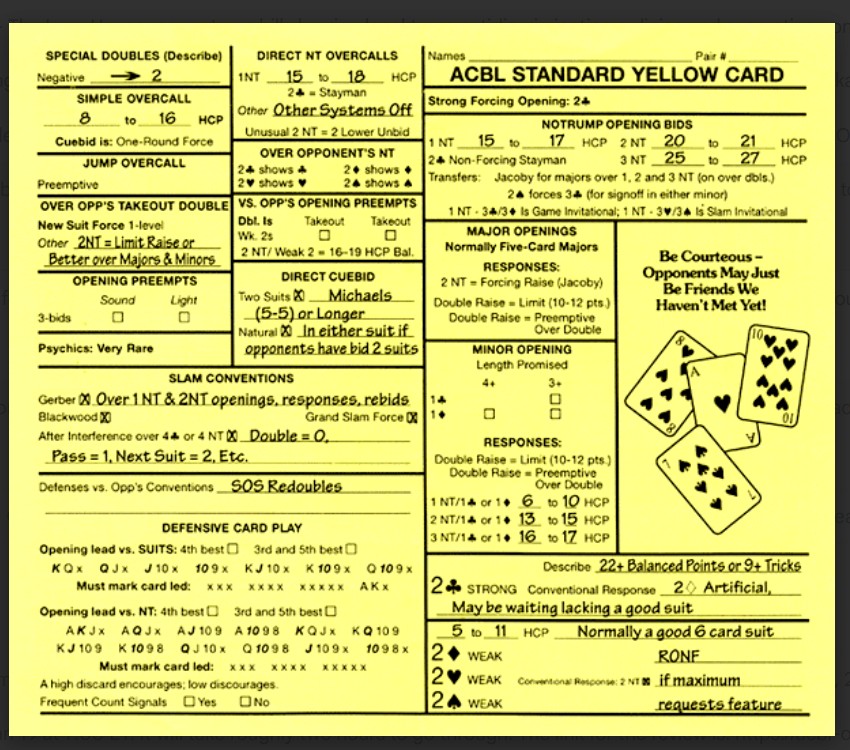
This isn't just filled in as an example. They were pre-printed with all the boxes filled in. The idea was if you saw a Yellow Card in front of an opponent you knew almost exactly what was on on it, no need to look.
But as time went on SAYC lost its simple meaning. It became short hand for "Not 2/1." Players added what ever they wanted to "Standard American" and called it SAYC.
Thanks for waking down memory lane with me on this one. One club I played in actually set out a stack of white convention cards and a stack of yellow ones for each game.
Hide the Yellow Card
Hide Explanations
|
|
| Last updated : Mar 7, 2026 08:01 CST |
|
|
|
|
|
| Poser XXIII Bookie's Rule |
Why 5 of a Minor Is the Worst Contract in Bridge?
Why???
Five of a minor Is the Worst of All Worlds
Playing 5m gives you:
- No game bonus improvement over 3NT •
- No slam bonus
- No safety (11 tricks is the hardest number to hit)
- No upside unless 3NT is impossible and 6m is hopeless
- It’s a contract that is too high for safety and too low for reward.
So to avoid the Five of a Minor trap apply Bookie's Rule: If you’re going to play a minor suit, play 4 or play 6 — never 5.
An extended discussion of Bookie's Rule is found under the Education tab and Advancecd Concepts. The 'rule' was named by R. Patrick Golden.
Close
|
|
| Last updated : Mar 7, 2026 08:01 CST |
|
|
|
|
|
| Poser XXIV Misinformation |
|
What do you do if you are Declarer or Dummy and you know Partner has made a mistaken explanation of a conventional bid?
First Step
Call the Director.
Why not just offer a clear explanation to the defendants?
Call the Director
Because...
When the declarer or dummy speaks up before the opening lead is faced, one of the Director’s options is to reopen the auction at the point of the last, non‑offender, passed...
"If the side that has given the mistaken explanation becomes the declaring side, the player MUST call the director after the final pass in the auction and before the opening lead is faced. He must inform the director and his opponents that, in his opinion, there has been a mistaken explanation. The director may allow the last bidder on the non‑offending side to withdraw his pass if he deems it probable that the pass was based on misinformation. If the player withdraws his pass and substitutes another call, the bidding can then proceed from that point. If the last passer on the non‑offending side does not change his call, the bidding as it occurred stands. The play now proceeds." From *The Club Director's Handbook.*
In the event the mistaken explanation was made by a defender, then the defender must wait until play has ceased before calling the Director to avoid giving Unauthorized Information (UI) to his partner. The Director may adjust the score if he believes the non‑offending side was damaged.
Close
Close
|
|
| Last updated : Mar 15, 2026 12:06 CDT |
|
|
|
|
|
| Poser XXV (Face Down Leads) |
|
**Why must the opening lead be placed face down?**
Answer
Because the Laws require it — and for very good reasons.
Law 41 A. Face‑Down Opening Lead After a bid, double or redouble has been followed by three passes in rotation, the defender on presumed declarer’s left makes the opening lead face down. The face‑down lead may be withdrawn only upon instruction of the Director after an irregularity; the withdrawn card must be returned to the defender’s hand.
The Rest of Law 41
- B. Review of Auction and Questions Before the opening lead is faced, the leader’s partner and the presumed declarer (but not the presumed dummy) each may require a review of the auction, or request explanation of an opponent’s call (see Law 20F2 and 20F3). Declarer or either defender may, at his first turn to play a card, require a review of the auction; this right expires when he plays a card. The defenders (subject to Law 16) and the declarer retain the right to request explanations throughout the play period, each at his own turn to play
- C. Opening Lead Faced Following this Clarification Period, the opening lead is faced, the play period begins irrevocably, and dummy’s hand is spread (but see Law 54A for a faced opening lead out of turn). After it is too late to have previous calls restated (see B), declarer or either defender, at his own11 turn to play, is entitled to be informed as to what the contract is and whether, but not by whom, it was doubled or redoubled.
- D. Dummy’s Hand After the opening lead is faced, dummy spreads his hand in front of him on the table, face up, sorted into suits, the cards in order of rank with lowest ranking cards towards declarer, and in separate columns pointing lengthwise towards declarer. Trumps are placed to dummy’s right. Declarer plays both his hand and that of dummy.
Close Law 41 Parts B. to D.
The Rest of the Story
During the auction. No player may correct his partner’s explanation until a third consecutive pass occurs, which begins the "Correction Period". Facing the opening lead ends the "Correction Period" which is considered to be part of the "Auction Period," The rights and duties of the contestants change when play begins:
- During the Correction Period the presumed declarer and dummy are required to correct any misinformation provided by partner or themselves during the auction. Further in the rare case of a delayed alert, an alert is given and an explanation made if asked. (N.B. A delayed alert is not the same as a missed alert. A "missed alert" is a form of misinformation requiring the director's attention. If the lead is made face up, or almost immediately turned over, while the declarer or dummy who realizes a missed alert or a mistaken explanation occurred, remains required to explain, the timing of the explanation changes.
- When the Declaring Side Is the Offending Side If the declaring side has provided misinformation: - Declarer must correct the misinformation after the final pass and before the opening lead is faced. - If the opening lead has already been faced, declarer's obligation1. is to correct the misinformation after the play has concluded, before the next board.
When the director is called before the opening lead is faced the director may in a proper case:
- Allow the opening face down lead to be retracted without penalty. or
- Restart the auction with the last defender to pass, if the defender's election to pass was influenced by the misinformation.
- The director should advise the non-offenders in either case to recall him to the table if they believe they were damaged by the misinformation when play ceases.
- When the Defending Side Is the Offending Side If the defending side has provided misinformation: The defenders must correct the misinformation after the play has concluded, before the next board.
- should declarer offer an explanation after a face-up lead, the lead still may not be changed. The face‑down requirement protects everyone.
- Once the card is turned face up, even the director can not change the card lead.
- The face‑down procedure is not optional. It is a legal safeguard ensuring questions can be asked, explanations can be corrected, and the auction is fully understood before the play starts.
1. After the lead is faced the director can do nothing except to say: "Call me later if you believe you have been damaged." For this reason facing the opening lead terminates the declarer's and dummy's immediate obligation to call the director. This distinction is clear in the WBF Laws but open to interpretation pursuant to the Laws adopted by the ACBL. ↩︎
Close Explanaiton
|
|
| Last updated : Mar 22, 2026 11:10 CDT |
|
|
|
|
|
| Poser Penalty Cards Part 1 |
Poser 26, The Penalty Card
What are the differences between a Minor Penalty Card and a Major Penalty Card?
Causation
First how they come about or "Causation". Major and minor penalty cards have different root causes. The short rule is if it is not a Minor Penalty Card then it is a Major Penalty Card with some exceptions for actually "not a penalty card, at all".
| Situation |
Spot Card (2–9) |
Honor Card (10–A) |
| Exposed before the auction |
NOT a penalty card |
Major penalty card (Law 50) |
| Exposed during the auction |
Minor penalty card (Law 50) |
Major penalty card (Law 50) |
| Exposed during the play |
Minor penalty card (if accidental) |
Major penalty card (always) |
| Exposed through deliberate play |
Major penalty card |
Major penalty card |
Disposition
The second difference is the applicable Law regarding disposition and play of such card.
Disposition of Major vs Minor Penalty Cards
(2017 ACBL - Laws)
| Topic |
Major Penalty Card |
Minor Penalty Card |
Law Reference |
| Definition |
Any honor card, or any card exposed through deliberate play (e.g., lead out of turn, correcting a revoke). If a defender has two or more penalty cards, all become major penalty cards. |
A single card below the rank of an honor, exposed unintentionally (e.g., playing two cards to a trick, or dropping a card accidentally). |
Law 50B |
| Card remains exposed |
Must be left face up on the table in front of the offender until rectification has been selected and completed. |
Law 50A |
| When offender must play the card |
Must be played at the first legal opportunity, including:
- As an opening lead
- When following suit OR
- When discarding
|
Must be played at the first legal opportunity in its suit, i.e.:
- Before playing any other spot card of that suit when following suit
- However an honor card, Ten or higher, may be played and the minor penalty card simply remains on the table.
Offender may freely lead or discard other suits. |
Law 50C, 50D |
| When offender is on lead |
The penalty card must be lead. |
Offender may choose any suit to lead. |
Law 50C, 50D |
| Lead restrictions on offender’s partner |
When offender’s partner is on lead and a major penalty card is on the table, declarer may:
- Require a lead of the suit of the penalty card, or
- Forbid a lead of that suit (partner must not lead that suit), or
- Allow any lead (no restriction).
When declarer requires or forbids the lead of a suit the penalty card is picked up. The restriction continues as long as offender's partner retains the lead. |
No lead restrictions apply to offender’s partner because of a minor penalty card. |
Law 50E |
| Failure to play penalty card when required |
If the offender fails to play a required penalty card, the Director applies the appropriate rectification (e.g., under Laws 50, 61, 64). |
Law 50F, related: 61, 64 |
| Multiple penalty cards |
When a defender has two or more penalty cards, all are treated as major penalty cards, with the associated obligations and lead restrictions. |
Law 50B |
Here is one of those "I have never seen #1 happen, but it could." Then there are #2, #3 and #4. When is a card which looks like a penalty card, not a penalty card, major or minor? I think I'll just let this one hang here. Come back next week for the exciting conclusion of "The Penalty Card" in Poser XXVII.
|
|
| Last updated : Mar 27, 2026 21:01 CDT |
|
|
|
|
|
| Posrr XXVII Penalty Card Concluded |
|
When is a card faced by an ultimate defender, which looks like a penalty card, not a penalty card, major or minor? I am going to explore FIVE cases. Think about it, count on your fingers. When what might "look" like a penalty card not be a penalty card?
Continue
There are several cases where a card may be faced and then withdrawn without penalty. There is one which is surprising to me. I'll call it Case #1.
Case #1
Case #1: You remove your cards from the board and start to sort. Everyone else is sorting their cards too. And you drop a spot card (duece to nine), face up on the table, It takes one definition, and two laws to determine what is going to happen with the spot card you just dropped on the table. Any ideas? Press "Show Laws" to read all the Laws applicable to the situation. To skip the legal details and get a (maybe) digestible answer, click "Case #1 Summary".
Show Laws
The Definition: Auction: 1) The process of determining the contract by means of successive calls. It begins when the first call is made. ...
Law 17A:. Auction Period Starts The auction period on a deal begins for a side when either partner withdraws his cards from the board.
Law 24:CARD EXPOSED OR LED DURING THE AUCTION When the Director determines that during the auction, because of a player’s own error, one or more cards of that player’s hand were in position for the face to be seen by his partner, the Director shall require that every such card be placed face up on the table until the auction ends. [Law 24, in full]
CARD EXPOSED OR LED DURING THE AUCTION … (full text exactly as provided) … [Hide Law 24]
LAW 50B . Major or Minor Penalty Card .... Any card of honor rank, .... becomes a major penalty card; (Law 50 is massive, a course of study all by itself and is not expanded here.)
Hide Laws
Case #1 Summary
Case #1 the inadvertant drop of a spot card turns upon two points of Law. First the deference between "The Auction Period" and "The Auction" as determined by Definitions and Law 24. Before anyone has bid, a spot card dropped just gets picked up because the auction has not yet started. An Honor Card will become a penalty card if the Offender also becomes a defender. However, any card exposed after the first bid by either side will become a penalty card of either the major or minor variety and will remain on the table until play begins. Also it is good to know, inadvertently facing an honor card during the auction will bar partner for one round. Apparently exposing an honor before the auction does not bar partner from bidding.
Hide Case #1 Summary
Show, the Rest of the Story
- Case #1 turns on the fact the dropped card was a spot card dropped during the Auction Period but BEFORE the Auction began. As such it is not controlled by Law 24 and does not remain on the table.
- Case #2, A defender asks Is it my lead? And Declarer or Presumed Dummy says "Yes it is." Defender then faces a card. The Director should allow it to be withdrawn without penalty and it may not be intentionally accepted.
See Law 53A (Paraphrased)
Law 53A — Lead Accepted or Withdrawn (Paraphrased)
If a defender asks “Is it my lead?” and declarer or dummy incorrectly says “Yes,” any card the defender faces as a result may be withdrawn without penalty. The opponents may not intentionally accept the card as a played card. No penalty card is created because the error was induced by misinformation from the opponents.
Hide Law 53A
- Case #3 Declarer revokes and before the revoke becomes established recognises his error and changes the card initially played. Director Please... Declarer's LHO may then change the card he played initially. Without penalty and without the initial play becoming UI for his Partner.
See Law 62C (Paraphrased)
Law 62C — Correcting a Revoke (Paraphrased)
If declarer corrects a revoke before it becomes established, the card originally played may be withdrawn. Declarer’s LHO, who played after the revoke, may also withdraw the card he played. Neither withdrawn card becomes a penalty card, and the withdrawn play does not create unauthorized information for the withdrawing player’s partner.
Hide Law 62C
- Case #4 Declarer leads from Dummy RHO follows suit, and LHO says "Stop, it is my lead." Director Please! RHO's play when it was not Declarer's lead from either hand, but rather his partner's, may be withdrawn and does NOT become a penalty card.
See Law 55A (Paraphrased)
Law 55A — Card Played to a Trick with Wrong Leader (Paraphrased)
If declarer leads from the wrong hand and RHO follows suit before LHO stops the play, RHO’s card may be withdrawn because the lead was illegal. The withdrawn card does not become a penalty card. Play reverts to the correct leader, and no penalty applies to the defender who followed suit in good faith.
Hide Law 55A
- Case #5 A player may retract a card played without penalty when such play was based upon misinformation from an opponent, but only before another card has been played.
See Law 47E2(a) (Paraphrased)
Law 47E2(a) — Retraction Due to Misinformation (Paraphrased)
A player may withdraw a card played without penalty if the play was based on misinformation from an opponent, provided the next player has not yet played a card. The withdrawn card is not a penalty card, and the player may substitute any legal card.
Hide Law 47E2(a)
All of the foregoing create what might seem like a penalty card. But they are not. What they have in common is either the error was enticed by an opponent. Or, they were a natural outgrowth of an Opponent's miscue. Contrast the result if either Partner answers when defender asks if it is his lead, Or Defender's partner is the first to lead out of turn. In both cases a penalty card may result. N.B. Case #5 This appears to be the narrowest of windows as The misinformation must have come from an opponent and be recognised before the next player plays.
Hide, the Rest of the Story
Reset All
|
|
| Last updated : Apr 5, 2026 07:19 CDT |
|
|
|
|
|
| Poser XXVIII (1NT - 3NT) |
This isn't a Rocket Science question rather more of a 'tendency' question. If you know YOUR answer I suggest you don't need to "Read On".
So, Poser: When the auction goes 1nt -- 3nt swish; what do you tend to lead, all other things being equal?
Read On
If your answer is: "A Major not a Minor and a Spade not a Heart." as the major suit tie breaker. You are on board with most experts and advanced players. This is not to say you could not have a good reason to do something else. (And a good reason always trumps a fall back position.) However, sometimes a fall back is all you have. This is about the fall back and why it makes sense. When the auction goes 1NT–3NT, defenders get almost no information. You’re not trying to beat the contract — you’re trying to beat the field. Consider the following: - Factor 1: modern bridge systems and the conventions associated with them, are designed to find eight card major fits. When the auction goes 1NT - 3NT the likelihood is Responder's hand does not fit into the "Let's Explore the Majors" mold.. And Opener has said with his 1NT open: "I have points but I am not claiming bragging rights in the majors." In a 1-3 auction setting the contract is not defender's initial goal but getting one defensive trick more than the field should be. One extra trick can be the whole world at match points. (At IMPs probably the most aggressive lead is the better.)
- Factor 2 weakness or shortness in a major when attacked can lead to a thought pattern in the Declarer of "Count to Nine and Go". This thought pattern is more likely to generate an extra trick for the defense than the Declarer thinking at trick one "I have this, I wonder where the extra tricks are??? ..." Leading a major may force Declarer to commit early: either take a finesse, duck, or expose shape. Minors rarely create that kind of immediate pressure.
- Factor 3 partnerships are more likely to step into NT when game in the minor is almost assured but likely low reward. (See , Old Poser 23 Bookie's Rule.)
Why choose a spade over a heart when you are in the dark? Now we are really down to hair splitting. This comes to a Declarer's tendency to chose 1NT with a weaker 5 card heart suit but trot out the spades with the same in suit honor values. This is especially true for 14-17 No Trump openers or hands with a bare 15 playing a 15-17 No Trump range. Claiming the spades early is just instinctive. Keep in mind the auction under discussion is the 1NT -3NT variety providing the defender on lead with minimal information. More information almost always breaks all the ties and points to the best lead.
It is also time to do a little quick arithmetic: Start with 40 subtract 26 , then subtract the HCP in your hand. You are likely close to partner's points. Really low? Partner's hand is hopeless lead your 4th down. You have one certain outside entry and a 5 card suit? Again, I would go with 4th down. Otherwise lean toward top of nothing. (You hold the hopeless hand and you might promote something for Partner.)
|
|
| Last updated : Jun 22, 2026 07:28 CDT |
|
|
|
|
|
| Poser XXIX XYZ |
|
XYZ? Have you noticed it at the bottom of the convention card? If you see it on the opponents' card and don't know, then ask "What is XYZ?" The likely answer will be: "It doesn't come up a lot. We will alert if it does." This may or may not be enough. The stage is set for XYZ whenever an auction has gone 1-1-1 with the opponents (you) passing. What are the implications when it is not used after the stage is set?
Continue
First briefly XYZ is any 1-1-1 auction "XYZ" being like algebraic variables standing in for suits or NT so 1C 1D 1N and 1H 1S 1N are both 1-1-1 and every combination between is as well. However none of them are artificial and none are alerted. Next bid by Responder is definitive and alertable: 2C shows an invitational hand is a relay to 2D In the alternative, 2D is game forcing. Both will be alerted. After the 2C relay Responder will make another call. However, 1D 1H 1S 2H will not earn an alert but much more information has been shared by the Responder. The XYZ responder has said he does not want to invite or to make a GF bid. (2D) and has opted for the mildly preemptive raise. The may have significant implications on the decision to jump into the auction with some type of balancing bid.
Hide Explanations
|
|
| Last updated : Oct 9, 2026 07:14 CDT |
|
|
|
|
|
|