 Page Introduction Page Introduction |

I do not intend for the pieces here to be complete discussions of any aspects of bidding or play but rather an introduction to various concepts. I like writing about bridge, I find noting solidifies a convention and its nuances in my mind like writing about it. However sometimes it is a waste of time especially if there is a neat concise job done elsewhere. ACBL.org has a Bidding Toolkit These are reprints from various Bridge Bulletins. it is a great refresher on a number of topics, here is a list.
If you like a concept you and your partners can add it to your tool kit, study it further from numerous sources or just be a bit more knowledgable when opponents use or alert a convention or treatment.
Anyone is welcome to leave comments. I wish you would! In order to leave a comment you do need to sign in first. Anyone is welcome to provide pieces for this or any page in the website. To do so, your user account must be set as a contributor. Ask me I will be happy to set your account appropriately. In the alternative you can email content to Glenn.Auman@gmail.com. I will place it on the website. You can take credit or post anonymously, your choice.
..... see less
I do not intend for the pieces here to be complete discussions of any aspects of bidding or play but rather an introduction to various concepts. I like writing about bridge, I find noting solidifies a convention and its nuances in my mind like writing about it. However sometimes it is a waste of time especially if there is a neat concise job done elsewhere. ..........
..... see more |
|
|
|
|
|
| Transfers After a TOX |
Transfers After a Takeout Double by LHO
by Glenn Metcalf
Transfers after a TOX are a new concept to me, but one I’m ready to embrace. Two benefits stand out as “worth the trouble,” and the downside of interfering with other methods I like is minimal (or so it seems thus far).
1. The Trigger and Basic Idea
The trigger is simple: Your RHO makes a Takeout Double after partner opens. After that, all of responder’s bids (except Jordan 2NT) are transfers.
Responder bids one level below the suit he actually wants to play, showing 5+ cards in that suit. Opener accepts the transfer unless there is a tactical reason not to.
2. Why Bother? The Two Big Advantages
- The stronger hand declares. This improves the opening lead and protects the big hand from becoming dummy.
- The opening lead comes up to strength, not through it. This is especially valuable when responder’s suit becomes trump.
If either opener’s original suit or the transfer suit becomes the final contract, then not only is the opening lead up to the better (opening) hand, but it is also away from the second-strongest hand at the table (the doubler). In addition, like with Jacoby and Texas transfers, the bigger hand remains hidden and is not spread as dummy with its weaknesses exposed.
3. Splitting the Raises: Transfer vs Direct
Because the system allows responder to transfer to opener’s suit as well as raise it directly, we can split the raises into two types:
- Transfer raise = constructive (good raise, invitational or better)
- Direct raise = weak/preemptive (obstructive, limited values)
Example (after a 1♥ opening and TOX by LHO):
- 1♥ X 2♦ → 2♥ = transfer to hearts, constructive raise
- 1♥ X 2♥ = direct raise, weak/preemptive
4. Jordan 2NT and Redouble
Jordan 2NT remains in place, showing a limit raise or better: typically 4+ cards in a major or 5+ in a minor with values near opening strength (roughly 10+ HCP and a good fit).
A redouble is used with:
- 3-card support in a major or 4-card support in a minor, and
- positive values outside the trump fit.
In other words, redouble shows values and a partial fit, but not yet a full-blown limit raise.
5. Summary Tables – Responder’s Options After TOX
The following tables summarize responder’s transfer options after LHO makes a Takeout Double. Each table assumes:
- Opener has bid the suit shown in the heading.
- LHO has made a Takeout Double.
- Responder is now using transfers.
Opening: 1♣ – Responder’s Structure After TOX
| Type |
Bid |
Meaning |
| Constructive Raise |
1NT → 2♣ |
Good raise to clubs (transfer to opener’s suit) |
| Preemptive Raise |
2♣ |
Weak raise, obstructive |
| Step 1 |
1♦ → ♥ |
Transfer to hearts (5+ hearts) |
| Step 2 |
1♥ → ♠ |
Transfer to spades (5+ spades) |
| Step 3 |
1♠ → NT |
Transfer to notrump (balanced hand, stopper(s)) |
| Step 4 |
2♦ |
Natural, to play |
Opening: 1♦ – Responder’s Structure After TOX
| Type |
Bid |
Meaning |
| Constructive Raise |
2♣ → 2♦ |
Good raise to diamonds (transfer to opener’s suit) |
| Preemptive Raise |
2♦ |
Weak raise, obstructive |
| Step 1 |
1♥ → ♠ |
Transfer to spades (5+ spades) |
| Step 2 |
1♠ → NT |
Transfer to notrump (balanced hand, stopper(s)) |
| Step 3 |
1NT → 2♣ |
Transfer to clubs (5+ clubs) |
| Step 4 |
2♥ |
Natural, to play |
Opening: 1♥ – Responder’s Structure After TOX
| Type |
Bid |
Meaning |
| Constructive Raise |
2♦ → 2♥ |
Good raise to hearts (transfer to opener’s suit) |
| Preemptive Raise |
2♥ |
Weak raise, obstructive |
| Step 1 |
1♠ → NT |
Transfer to notrump (balanced hand, stopper(s)) |
| Step 2 |
1NT → 2♣ |
Transfer to clubs (5+ clubs) |
| Step 3 |
2♣ → 2♦ |
Transfer to diamonds (5+ diamonds) |
| Step 4 |
2♠ |
Natural, to play |
Opening: 1♠ – Responder’s Structure After TOX
| Type |
Bid |
Meaning |
| Constructive Raise |
2♥ → 2♠ |
Good raise to spades (transfer to opener’s suit) |
| Preemptive Raise |
2♠ |
Weak raise, obstructive |
| Step 1 |
1NT → 2♣ |
Transfer to clubs (5+ clubs) |
| Step 2 |
2♣ → 2♦ |
Transfer to diamonds (5+ diamonds) |
| Step 3 |
2♦ → 2♥ |
Transfer to hearts (5+ hearts) |
| Step 4 |
— |
Not applicable |
6. Teaching Use and Partnership Discussion
This structure is ideal for partnerships that already like transfers (Jacoby, Texas) and want to extend the same philosophy to competitive auctions after a Takeout Double. The key agreements to discuss with partner are:
- Which hands qualify as constructive raises via transfer.
- How aggressive you want to be with direct, preemptive raises.
- Follow-ups after Jordan 2NT and redouble.
Suggested next step: print these tables as a one-page handout and review them with your regular partner before your next club game. Try to play them for a month and then adjust based on experience.
..... see less
Transfers After a Takeout Double by LHO
by Glenn Metcalf
Transfers after a TOX are a new concept to me, but one I’m ready to embrace. Two benefits stand out as “worth the trouble,” and the downside of interfering with other methods I like is minimal (or so it seems thus far).
1. ..........
..... see more |
|
|
|
|
|
| Bookie's Rule |
Bookie’s Rule: Why 5 of a Minor Is the Worst Contract in Bridge?
Most players have heard bits and pieces of this idea, but few state it as cleanly as the late “Bookie,” who summed up decades of table experience in one unforgettable rule:
If you’re going to play a minor suit, play 4 or play 6 — never 5.
It sounds glib, but the logic behind it is mathematical, and overwhelmingly supported by real‑world results.
1. 3NT Beats 5m at Matchpoints.
At pairs, the scoring alone makes 5m a losing proposition.
• 3NT+1 = 630
• 5m = 600
• 3NT = 600
• 5m–1 = –50 or –100
So:
• 3NT+1 crushes 5m
• 3NT exactly ties 5m
• 5m down is a disaster
Unless 3NT is unplayable — not “iffy,” but on fire — it is almost always superior to 5m.
2. If You Can Make 5m, You Often Can Make 6m.
This is the heart of Bookie’s Rule.
Across thousands of double‑dummy simulations published in expert literature, deals where 5m makes but 6m fails are surprisingly rare. Deals where 6m makes are surprisingly common.
Typical findings:
• When 5m is cold, 6m makes 55–60% of the time
• 6m fails only 40–45%
• Hands that take exactly 11 tricks but not 12 occur only 15–20% of the time
Why?
Because minor‑suit slams succeed when you have:
• A long, powerful suit
• Control cards
• A source of tricks
• Ruffing value
Those same ingredients tend to produce 12 tricks, not just 11.
3. 5m Is the Worst of All Worlds
Playing 5m gives you:
• No game bonus improvement over 3NT
• No slam bonus
• No safety (11 tricks is the hardest number to hit)
• No upside unless 3NT is impossible and 6m is hopeless
It’s a contract that is too high for safety and too low for reward.
4. The Practical Rule
Bookie’s Rule captures all of this in one sentence:
If you’re headed for a minor suit contract, aim for 4 or 6 — never 5.
At matchpoints, choose 3NT whenever remotely feasible.
At IMPs, push toward 6m when 5m is certain.
And at both forms of scoring, avoid 5m like a pothole on the way to the club.
Bookie’s Rule isn’t just a cute saying — it’s a mathematically sound guideline that improves results across all levels of play. If your hand is good enough for 5m, it’s usually good enough for 6m, and if it’s not, 3NT is almost always better.
CAVEAT: Do I always apply Bookie’s Rule? No, when playing with a new partner I prioritize partnership confidence first. Bashing to Six, mumbling Bookie’s Rule while scoring a down 1 does not build confidence.
..... see less
Bookie’s Rule: Why 5 of a Minor Is the Worst Contract in Bridge?
Most players have heard bits and pieces of this idea, but few state it as cleanly as the late “Bookie,” who summed up decades of table experience in one unforgettable rule:
If you’re going to play a minor suit, play 4 or play 6 — never 5.
It sounds glib, but the logic behind it is mathematical, and overwhelmingly supported by real‑world results.
1. ..........
..... see more |
|
|
|
|
|
| RHO Interfered in our No Trump Auction, Now What? |
There is more than one way to skin a cat (as the saying goes), most important is to agree with your partner in advance what approach you are going to take. The most common I think is "Systems On" which in brief means you are going to ignore the interjected bid as much as possible. A second common approach may be "Natural" which more or less says we are going to throw out our formal no trump response routine and rely on WYSIWYG. (What You See Is What You Get.) Finally, Lebensohl as a creative alternative which allows playing off the interference bid and conveying more information than if the opponent had stayed out of the auction in the first place.
Natural, WYSIWYG, when agreed to, leaves very little room for misunderstanding and will tend to be very descriptive of certain hands. The disadvantage is it might be ambiguous as to length versus strength. For example 1NT--2♥--2♠ ... Is the two spade call 5 spades and 8 to 10 points? Or maybe 6 spades and 5 to 8 points? But clearly the good guys have retaken the initiative. One disadvantage is you have flipped declarer to the weaker hand and will have the opening lead coming through the stronger hand not up to it.
Systems On, which I believe is the most common in our club implies several things. First, a double is a stolen bid. So 1NT--2♥--X is a transfer to spades. Say "Spades" and go from there. 1NT--2♦--2♥, spades again, systems on 'Two Hearts' is a transfer to Spades. Cue bid is Stayman and tends to be a good hand not desperation. Several likely auctions 1NT--2♦--3♦ strongly suggesting 4-4 in the majors and probably 8+ HCP.. 1NT--2♥ --3♥ almost certainly four spades and a minor. Had responder held five spades they would double the 2♥ as stolen bid indication and transfer to spades. Interference bids like Cappelletti and DONT showing two suits present special problems as they are intended to do. It is important for both Opener and Responder to consider the meaning of the two suited bids. For example 1NT--2♦ (majors) -- 3♦ ??? I can't say I have seen it happen but I would make a strong case for holdings in both minors.
Lebensohl is an alternative to foregoing and offers three advantages.. First it allows responder to clarify their hand in two ranges. Second it provides for cue bid Stayman again bifurcated in two ranges. Third it allows Responder to propose a final contract of 3NT while showing or denying a stopper in the opponent's suit.. If you think about it that is a lot for any series of bids which has been already compressed by opening 1NT and a possible overcall of 2 spades. Here is how it works. The key is using 2NT as a relay bid. When Responder bids 2NT after interference then Opener bids Three Clubs, every time, unless his RHO bids then Opener should pass giving maximum flexibility for Responder to clarify his holdings. First priority for Responder after his partner's opening NT has been overcalled is to clearify whether the partnership has a game going HCP.. 1NT is 16 +|- 1 point. Game is about 25 (24 maybe in NT) and 26 in a major. Thus, when Responder has 9 plus he should make any descriptive three level bid. It is a simple, direct, game forcing, (call it highly invitational if you would rather) bid. When Responder want to close out the auction Responder bids his suit, if he can, below 2NT; OR bids 2NT and after the 3 Club relay sets the contract at the three level.. The 2NT relay or lack there if has allowed Responder to bifurcate his hand.. Next, we roll Cue Bid Stayman into the same structure. A direct cue bid of opponent's suit is game forcing and Stayman a 2NT--3 Clubs followed by a cue bid is non forcing Stayman.. Finally, Lebensohl structure allows the Responder to suggest playing Three No Trump. The systemic approach is to bid Three No Trump directly to show strength but no stopper in the overcalled suit. Alteratively, a relay of 2NT to 3 Clubs followed by 3NT shows a stopper in the overcalled suit. The mnemonic is Direct Denies. So what if.... The auction proceeds 1NT--2♦ --3NT -- P-- and well fudge, you don't have a Diamond stopper either. Opener now buckles on his track shoes and bids his lowest four card suit, Responder passes or bids his next suit up the line.
After interference in your NT auction, there are three possible treatments for a Double by Responder. Partners need to agree upon which approach they are using. The three possible treatments are: 1) Penalty Double; 2) A double shows a natural 2NT bid with a stopper. This allows partner to stop in 2NT; or 3) a toss-back TOX asking the Opener to choose from the other three suits. Consistent with my general philosophy, the partner of the NT Opener is in charge, I like the double being penalty. With favorable vulnerability the double is almost always left in. With a 600 point game on the line and needing a 4 trick set opener may opt to pull the double. In the words of Dirty Harry "Do you feel lucky?"
..... see less
There is more than one way to skin a cat (as the saying goes), most important is to agree with your partner in advance what approach you are going to ..........
..... see more |
|
|
|
|
|
| Lebensohl Part 2 over weak twos |
First if you did not read the previous No Trump Interference piece go do so now. The essential Lebensohl treatment and tactics are not repeated here. The lack of repetition is because over Weak Twos the application of the exact same principles continues to apply. When there has been interference over One No Trump, Responder knows what shape and HCP range his partner has and can make an appropriate decision using the Lebensohl tools at his disposal. So now if RHO opens a weak two apply the same logic. If you hold that 15+ hand, (no real reason to limit it to 15-17) say "Double." This starts the Lebensohl sequence and partner is able to define his hand with clarity, just like after No Trump interference. This leaves in place the "Stopper-Stopper" sequence based upon Direct Denies. The only thing lost is the ability to make a penalty double of the weak two opener. However if you are playing TOX after weak twos without the Lebensohl responses you have lost the Direct penalty double anyway. After Partner (acting as Advancer) describes his hand in Lebensohl terms, 'game going' or 'hold up', Doubler may still show an independent suit by bidding it after Advancer shows his suit. Danger!! What about this auction? 2♦ X Pass 2NT [Alert relay to Clubs] Pass ???? Partner expects you to bid 3 Clubs. Should you be looking at 5-5 in the major suits there is a real risk the 3 Club bid would be passed. At this juncture a descriptive 3 spade call would seem to be in order. Thought might also be given to an initial 3 diamond call rather than double but should the response be four clubs you are in worse shape than if you started with the double.
Further, playing Lebensohl over Opponents' weak twos does no harm to other available bids such as the direct overcall now implies it is limited to about 14 above which the Double and Lebensohl responses would be used.
..... see less
First if you did not read the previous No Trump Interference piece go do so now. The essential Lebensohl treatment and tactics are not repeated here. The lack of repetition is because over Weak Tw ..........
..... see more |
|
|
|
|
|
| When a Negative Double does not work |
Preface
I have a strong bias toward the adoption of a treatment to be used when a Negative Double (Neg-X) isn’t the answer. I’ve struggled to persuade partners to embrace my approach. That likely means my explanations haven't been clear or seemed to somehow interfere with using a Negative Double. Recently, I had an epiphany. The concept I present here—Expanded Neg-X 2.0—isn’t about changing how you use a Negative Double or what it means. Please keep using Neg-X exactly as you do now. This approach was taught to me years ago by a favorite partner R. Patrick Golden. He explained it as "Part of the Negative Double system," Just do it.
This treatment applies only in situations where partner opens, your right-hand opponent overcalls a suit (not No Trump), and Responder’s hand isn't suitable for a Negative Double. That’s the niche this discussion addresses.
Negative Double Review
Neg-X can—and should—be used over both simple and weak jump overcalls. I recommend playing it through 3♠. The primary function is to show shape and values in the two unbid suits and is generally the first option Responder ahould consider. (If the shoe fits, wear it.)
A standard Neg-X typically denies a five-card suit while showing 4-4 distribution in the unbid suits. For those not yet using Negative Doubles, I suggest reading the write-up on Bridgebum.com. It offers a solid foundation, particularly for hands with 4-4 distribution in the unbid suits or with four cards in the unbid major and a five-card minor.
Hands Unsuitable for a Negative Double
Responder will sometimes hold hands that are unsuited for Neg-X. These generally fall into one of the following categories:
- A suit of their own to bid
- Support for opener’s suit
- Values for No Trump, with the overcalled suit stopped—ideally twice
- A burning desire to double for penalties
Clarifying Weak vs. Invitational Hands
In two common situations—when Responder has their own suit to bid or support for Opener’s suit—standard auctions often leave room for interpretation. A simple raise or bidding a new suit doesn't make the strength of Responder’s hand clear. We can eliminate this ambiguity by bifurcating these actions into two distinct ranges:
- Weak: Zero up to 7–8 HCP
- Invitational: 8–12 HCP
With a weak hand, Responder passes, conveying a message: “I have something to tell you—give me a second chance.” That pass isn’t an abdication, it’s an invitation. Responder expects Opener to reopen the auction with a double. Once that reopening double rolls back around, Responder reveals their hand type with renewed clarity:
- Support Opener’s original suit — showing a weak hand with adequate support
- Bid a new suit — showing a weak hand but a legitimate suit, possibly KQxxx (see illustrative examples)
- Bid No Trump at the lowest level — This bid is a logical quandary, more about what Responder doesn’t have than about what he does have. He is not 4-4 in the unbid suits. He can not offer a suit of his own. Support for Opener is likely to be at best Hx or xx maybe Hxx if the open was a minor. But Responder has the Overcaller’s suit stopped, but not so stopped that Responder wants to play the Overcall doubled.
- Pass again! — indicating Responder’s dream scenario: a hand ripe for a penalty double
This maneuver—using the initial pass as a weak signal—sharply defines the meaning of subsequent actions.
Subsequent Bids by Opener after a Pass
Should Opener always reopen with a double? Absolutely not.
Two scenarios call for caution:
- Opener holds a weak two-suited hand and can’t risk Responder passing the double for penalties.
- Opener holds LHO’s overcalled suit, indicating Responder has either weak support or a modest suit of their own. In this case, defending may be preferable.
When Opener has distribution and two suits, it’s generally better to bid the second suit rather than pass. This action helps clarify Opener’s hand as a weak two-suiter. The new suit is non-forcing— with any game-going hand, Opener would choose to double instead.
After Opener makes the reopening double, Responder can reveal the nature of their hand as set out above.
Except when Responder passes the reopening double for penalties, Opener will have another bite at the apple—armed with new information which sharpens the subsequent decisions. For example, after the auction 1♣ – 2♠ – Pass – Pass, rather than trying NT blindly, Opener should double first, then reassess with a better picture.
Responder’s Invitational hands
When partner’s opening bid has been overcalled and you have a hand with invitational values you may simply bid as normal. A direct raise after the overcall shows a limit raise, and bidding a new suit directly reflects a stronger hand with a solid 5+ card suit. Partner however benefits by knowing you are not merely trying to be competitive with little value. (Those hands get passed and reopened.) A No Trump call shows stoppers in the overcalled suit and outside values but lacking the length one would want for a penalty double. (AK or KJT will stop a suit being run by the opponents.)
A Note on Cue Bids:
This treatment leaves the direct cue bid open. Its meaning depends on partnership agreements—whether played as a strong raise, an Eastern/Western cue bid, or something else. Personally, I prefer to treat the cue bid as a strong raise, keeping things simple and transparent.
ACBL Alert Requirements
The ACBL Alert sheet identifies a “Forcing Pass” as a bid requiring an alert. The question becomes do the two exceptions to the reopening double take it out of the mandatory alert category? I believe the answer is yes, two exceptions means it is not a 100% forcing pass and the alert requirement does not apply. I certainly welcome alternative thoughts on the matter. In balancing the need for an alert I have also considered whether the Auction 1C -- 1D -- Pass [ALERT] is more likely to inform the opponents or wake up your partner. In the latter case, the alert is arguably improper.
Here are some examples:
Negative Doubles. The typical one Diamond, One Spade, Double showing both Clubs and Hearts and lets opener decide.

The next example falls under the heading of woulda, coulda, shoulda. North playing the treatment described (which BBO Robots do NOT play) should pass, then bid the Club suit when the auction comes back after South doubles to re-open. This clarifies the hand held by North as weak with a single suit.
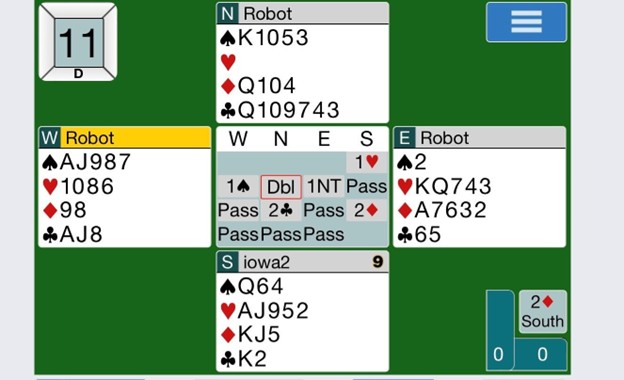
The Robot’s double of One Spade should show balance in the unbid suits. Having been misled South blunders into a 3-3 fit. (Yes, I blame the robot.)
Another example, why using the proposed treatment will provide better results. The auction as it played out is shown and the “improved” auction follows.

|
West
|
North
|
East
|
South
|
|
|
Pass
|
1 Club
|
1 Diamond
|
|
PASS
|
Pass
|
DOUBLE
|
PASS
|
|
???
|
|
|
|
After the reopening double the best bid is Pass. One Diamond Doubled goes down at least 2. One No Trump is an alternative to leaving the Double in. Both are more favorable outcomes compared to the result at four Spades.
The next hand is another example of the same principles:

Here is the auction as “it might have been”[1]
|
West
|
North
|
East
|
South
|
|
|
|
Pass
|
Pass
|
|
1 Diamond
|
2 Clubs
|
Pass
|
Pass
|
|
Double
|
Pass
|
2 Spades
|
And IDC
|
The key here is for East to have faith in their opportunity to bid again. My proposed auction is reopened with a double. With only 6 HCP East should just sit tight and wait for the double. In this case, after the reopening double East bids two spades. The message is clear: “Single suit, weak hand”.
The ACBL's Beginner Toolkit has this discussion as part of Negative Doubles:
You open 1♦, LHO overcalls 1♠ and partner bids 2♥. What do we know about partner’s hand? She has at least five hearts (a negative double would have promised only four) and at least 10 HCP, making the raise to 3♥ a standout.
The negative double lets you tackle problem hands such as this:
♠ K Q 10 9 6 5
♥ J 5
♦ Q 9 8
♣ 5 2
Partner opens 1♥ and RHO overcalls 2♣. You can’t bid 2♠ directly. That would show a good hand — at least 10 HCP. You can, however, make a negative double. If partner bids 2♦, you will bid 2♠. Partner will know that you have a relatively weak hand with a long spade suit, because you doubled first.
Special case
In this auction:
|
West
|
North
|
East
|
South
|
|
1♣
|
1♦
|
Dbl
|
|
East’s double should show both majors. What happens, however, if East is dealt a hand such as:
♠ A J 9 5
♥ Q 8
♦ Q 10 6 2
♣ 9 8 7
In this case, East should bid 1♠. Ordinarily, a direct bid shows a five-card or longer suit, but in this auction (a 1♣ opening and a 1♦ overcall), a 1♥ or 1♠ response may be made on a four-card suit. The negative double should be reserved for a hand with both majors.
It is my contention both of these situations can better be resolved with a PASS, then showing your hand after partner re-opens with a double. In the first case the spade bid is exactly as advertised, a weak hand with spades but not enough for a direct spade bid. In the second hand after the reopening double I would bid 1NT showing some values and a stopper in diamonds. With 3 diamonds and 4 clubs I would lean toward a rebid of partner's Clubs after the reopening double.
..... see less
Preface
I have a strong bias toward the adoption of a treatment to be used when a Negative Double (Neg-X) isn’t the answer. I’ve struggled to persuade partners to embrace my approach. That likely means my explanations haven't been clear or seemed to somehow interfere with using a Negative Double. ..........
..... see more |
|
|
|
|
|
| Inverted Minors (edited 2/15/26) |
**Inverted Minors – Quick Summary**
- **1♣ – 2♣ [ALERT]**: Strong raise (Game Forcing)
- Shows 12–13+ HCP, 4+ card support
- May hold a 4-card major – opener explores “up the line”
- Keeps auction low for exploration
- **1♣ – 3♣**: Weak preemptive raise
- Typically 6–8 HCP with 5+ clubs
- Makes opponent entry more challenging
- **Criss-Cross Raise**
- 1♣ – 2♦ or 1♦ – 3♣ = 9–11 HCP, 4+ support
- Denies 4-card major
- Forfeits Weak Jump Shift in opposite minor
**Footnotes**
- Passed hand: Inverted minor ranges shift
- Competition: Criss-Cross and Inverted Minors off, Negative Double back
- Minorwood: 4-minor = RKC 1430 inquiry toward slam
More than a summary and less than a book on Inverted Minors.
One Club Pass Two Clubs [ALERT], a seemingly innocent auction resulting in an ALERT and so often after the explanation and after the hand has been played a follow up question. Why do you call 1C – 2C an “Inverted Minor?” The answer only scratches the surface of the “Inverted Minor” and its first cousin, Criss-Cross, and step child Minorwood.
The simple answer is: It is called an Inverted Minor because the ‘old’ Goren bidding every jump bid was strong and Inverted Minors have been around so long the 1 Club or 1 Diamond jumping to 3 Clubs or 3 Diamonds as “weak” was the polar opposite of the original Goren “all jumps are strong” therefore “inverted” when using the one – two of the same suit as strong. Hence the meanings were backward or inverted.
The “Why” is more complex but rooted in the concept of describing your hand and getting in the way of the opponents at the same time is a good thing. The preemptive nature the One Three (1—3) jump makes it much harder for Opener’s RHO to back into the auction whether they be a passed hand or in the fourth seat. This One Two (1—2) bid says to partner: “Don’t worry, this hand is ours.” The One-Two bid also leaves the maximum room to explore fit and the proper final contract.
Point Ranges and Fit what do the 1—2 and 1—3 really show?
Let’s start with 1—2. Inverted minors are not played with “Short Club Systems” so in general the opening of one of a minor promises a three card suit. The 1—2 bid should show at least a four-card suit but more importantly 12-13+ point game forcing raise (GFR). The 1—2 does not deny a four card major. Therefore, opener may explore a 4-4 major fit by bidding his own four card majors “up the line.” In the alternative Opener may show the other Minor now describing a possible 4-4 or 5-4 holding. Reverses count here so tread lightly if you opened a 4-4 minor with One Club. Absent a four-card major or a minor suit holding, Opener should bid Two No Trump with full values and Three No Trump with nothing extra to show. Again, this is a bit of inversion based upon “fast arrival” and giving the opponents the least information upon which to base their defense. The bidding up the line looking for a four-card major fit allows Responder to continue over Two Hearts with Two Spades or rebidding Two NT or Three NT. Th only time Responder would bid Three Hearts over Two Spades is when they failed to show a five-card heart suit in deference to the 1—2 GFR.
Next 1—3, while technically there is probably no bottom to 1—3 I suggest normally a 5 to 8 HCP range, while subtracting 1 bottom point for each extra length card over 5 so 1—3 might be 4 HCP and 6 of the minor suit opened by partner. The dual purpose is to describe a hand with no four-card major and a weak hand, while making the next bid of LHO a bit more dangerous. Astutely, you may be saying “Okay 1—2 big hand, 12+ and 1—3 weak topping at about 8 there seems to be a gap here. Enter the Criss Cross Raise.
A Criss-Cross Raise (CCR) is made with a jump in the opposite minor. Thus, One Club, Two Diamonds and One Diamond, Three Clubs both signify a raise in the original minor, with points in the 9-11 range. This again has the advantage of being both descriptive and preemptive in nature. Opener can stop in three of either minor, if they desire. I suggest the Criss Cross Raise denies a four card major so opener’s need to search for a four card major fit are nonexistent. The 10 point +/- 1 point hand gives Opener enough information to decide if 3NT or a minor slam are in the cards so to speak.
The more artificial a bid is the more likely you are giving up something by using it it. In the case of Criss Cross you are giving up the Weak Jump Shift (WJS) in the opposite minor. You are also risking Partner’s brain registering WJS instead of Criss-Cross. (“Oh, what a tangled web we weave, when first we practice to deceive.” Sir Walter Scott 1808.) Notably the WJS between Minors 1C-2D has very little preemptive value a WJS might was well be 1C 3D or 1D 4C (rare) but the other use as a splinter is covered by the 1—2 GFR.
More of a Footnote on Inverted minors and criss cross, the chair matters. If Responder is a passed hand then the 1—2 can be downgraded to 9 to11, the very best passed hand one could hold, no four card major. And the 1—3 Is good for everything else. The true Game Forcing hand is out the window and philosophically the idea is a passed hand can not make a forcing bid (other than a cue bid.) This brings back the WJS after, it is what it is, personally I would avoid the bid. 1C 2D, or 1D 3C; sounds exactly like Criss Cross if partner has forgotten you have passed. You must ask yourself is partner really awake? Much like the line in Dirty Harry. “Do you feel lucky? Punk.”
Another Footnote, Inverted Minors and Criss Cross are off in competition. The Negative Double, and what ever else you play over interference bids are back in the bidding box. Why? Because both the inverted jump raise and the Criss Cross raise are justified by the preemptive nature of the bid which has been lost by the interference by Responder’s RHO.
🧩 Inverted Minors Summary Sheet
(with Criss-Cross and passed-hand adjustments; OFF in competition)
➕ When Not a Passed Hand (No Interference)
| Auction |
Meaning |
Points |
Support |
Notes |
| 1♣–2♣ / 1♦–2♦ |
Strong raise (Inverted) |
12+ |
4+ |
Game forcing; may hold 4-card major |
| 1♣–3♣ / 1♦–3♦ |
Weak raise (Preemptive) |
3–7 |
5+ |
No 4-card major |
| 1♣–2♦ / 1♦–3♣ |
Criss-Cross raise |
9–11 |
4+ of opener’s minor |
Limit raise; artificial & alertable; no 4-card major |
🔹 Inverted minors are OFF after competition
→ Revert to standard raises, cue bids, or Jordan 2NT if applicable.
➕ When a Passed Hand
| Auction |
Meaning |
Points |
Support |
Notes |
| 1♣–2♣ / 1♦–2♦ |
Best raise by passed hand |
10–11 |
4–5 |
Not forcing; denies 4-card major |
| 1♣–3♣ / 1♦–3♦ |
Preemptive raise |
7–9 |
5+ |
Not forcing |
| 1♣–2♦ / 1♦–3♣ |
Criss-cross still used |
9–11 |
4+ |
Applies by agreement |
⚠️ Important Reminders
- All artificial raises are alertable, including criss-cross and inverted raises.
- Strong raise does not deny a 4-card major — show the major ASAP if holding one.
- If opponents interfere, do NOT use inverted minor structure — switch to standard competitive methods.
- Be cautious with passed-hand raises — no bid is ever game forcing.
A second look written by the MS AI CoPilot for clarity and dumping some of my wordiness:
♣️ Inverted Minors: A Deeper Look
Opening Bid: 1♣ – 2♣ [ALERT]
At first glance, this innocent auction triggers an alert—and often leads to postmortem questions:
“Why do you call 1♣–2♣ an inverted minor?”
The short answer? In old-school Goren-style bidding, every jump bid was strong. But inverted minors flipped the script—where now a jump to 3♣ is weak, and a simple raise to 2♣ is strong. Hence: inverted.
♦️ The Why Behind the Bid
Inverted minors aren't just about strength—they’re strategic tools to:
- Describe your hand
- Claim territory early
- Leave room to explore fit and final contract
The 1–2 bid signals:
“Don’t worry, partner—this hand is ours.”
It also crowds the opponents, making overcalls harder—especially for RHO, whether they’re a passed hand or fourth seat.
♠️ Interpreting the Point Ranges
Inverted Raise (1♣–2♣ or 1♦–2♦)
- Support: 4+ cards
- Strength: 12–13+ HCP (Game Forcing Raise)
- Does not deny a 4-card major
→ Opener explores fit “up the line,” or shows other minor
→ If no major or minor to show, bids 2NT with full values or 3NT with nothing extra
This “fast arrival” strategy minimizes information leaks to opponents.
Preemptive Raise (1♣–3♣ or 1♦–3♦)
- Support: 5+ cards (preferably 6+)
- Strength: 6–8 HCP
→ Subtract 1 point per extra card beyond five
→ Denies 4-card major
→ Disruptive to LHO’s next bid
♥️ Criss-Cross Raise: Bridging the Gap
What if you have 9–11 HCP?
Use the Criss-Cross Raise—a jump in the opposite minor:
- 1♣ – 2♦ or 1♦ – 3♣
- Still shows support for opener’s suit
- Descriptive and preemptive
→ Opener may sign off at 3-minor or push toward 3NT/minor slam
- Denies 4-card major—so opener skips searching for a fit
✳️ Note: You give up the Weak Jump Shift in the opposite minor by using Criss-Cross. Beware of partner misinterpreting it!
💬 Notes on Context and Competition
Passed Hand:
- Inverted Raise can be downgraded to 9–11 points
- Game-Forcing logic goes out the window
- WJS may return—but risky if partner forgets you’ve passed
“Do you feel lucky, punk?” —Dirty Harry
Over Interference:
- Inverted and Criss-Cross are off
- Negative Double or your usual methods return
- Preemptive value is gone—so is justification
🔑 Minorwood: The Stepchild
Introduced here only briefly—Minorwood is:
- A variant of Roman Keycard Blackwood (1430)
- Uses 4♣ or 4♦ as the asking bid
- Tailored to reach minor suit slams
..... see less
**Inverted Minors – Quick Summary**
- **1♣ – 2♣ [ALERT]**: Strong raise (Game Forcing)
- Shows 12–13+ HCP, 4+ card support
- May hold a 4-card major – opener explores “up the line”
- ..........
..... see more |
|
|
|
|
|
| XYZ Explained |
XYZ Convention — A Clear, Practical Guide
XYZ is a universal checkback structure used after opener and responder have made three uncontested one‑level bids. It allows responder to sort weak, invitational, and game‑forcing hands efficiently while keeping the auction low and clarifying major‑suit fits.
When XYZ Is “On”
XYZ applies after any uncontested auction beginning with:
- 1♣ – 1♥ – 1NT
- 1♦ – 1♠ – 1NT
- 1♣ – 1♠ – 1♥
- 1♦ – 1♥ – 1♠
In short:
XYZ is on after 1X–1Y–1NT and after 1X–1Y–1M.
XYZ is off after interference.
XYZ is never used after opener “rebids” a minor at the one level — because that cannot occur without interference.
Responder’s Three Options in XYZ Auctions
When XYZ is on, responder has three families of choices:
- Natural calls (e.g., 2♥ or 2♠)
- The 2♣ route (weak or invitational)
- The 2♦ route (game‑forcing)
XYZ adds tools; it does not remove natural bidding.
1. Natural Calls (2♥, 2♠, etc.)
Natural bids remain purely natural signoffs. Examples:
- 1♣ – 1♥ – 1NT – 2♥ = to play
- 1♣ – 1♥ – 1NT – 2♠ = to play (responder has 5+ spades)
- 1♦ – 1♠ – 1NT – 2♠ = to play
These bids show a weak hand with a long suit and no interest in exploring game.
2. The 2♣ Route (Weak or Invitational)
2♣ is artificial. It asks opener to bid 2♦ as a forced relay.
After opener bids 2♦, responder clarifies:
- Pass = weak with diamonds
- 2♥ / 2♠ = weak signoff
- 2NT = invitational
- 2♥ / 2♠ / 3m = invitational values
This route allows responder to show invitational hands without jumping and to escape to a low‑level contract when weak. After 2♣ → 2♦, any natural rebid by responder (2♥, 2♠, 3♣, 3♦, or 2NT) shows invitational values — typically 9+ –> 11 HCP — and invites opener to accept or decline based on fit and strength.
3. The 2♦ Route (Game‑Forcing)
2♦ is artificial and game‑forcing. It says:
“Partner, we are going to game. Please describe your hand.”
Opener’s rebids are shape‑showing:
- 2♥ = 3+ hearts
- 2♠ = 3+ spades
- 2NT = balanced minimum
- 3NT = balanced maximum
- 3m = natural, extra length
This is the universal checkback portion of XYZ, similar to New Minor Forcing but available after any opening suit.
Why XYZ Works
- Separates weak, invitational, and game‑forcing hands cleanly
- Finds 3‑card major support efficiently
- Keeps auctions low
- Allows weak diamond escape
- Improves strain selection and slam exploration
Comparison: XYZ vs Natural Methods
| Concept |
Natural Auction |
XYZ Auction |
Benefit |
| Invitational with 5‑card major |
Must jump |
2♣ → 2♦ → 2M |
Saves space |
| Weak escape |
Often stuck at 2NT or 3m |
2♣ → 2♦ → Pass |
Lower contract |
| Game‑forcing checkback |
Only after minor opening |
2♦ GF after any opening |
Universal |
| Clarifying opener’s shape |
Limited |
Full shape‑showing rebids |
Better strain selection |
Bottom Line
XYZ is a universal checkback structure that uses 2♣ as a weak/invitational relay and 2♦ as a game‑forcing probe after any three uncontested one‑level bids, allowing responder to sort hand strength, clarify major‑suit fits, and keep the auction low.
..... see less
XYZ Convention — A Clear, Practical Guide
XYZ is a universal checkback structure used after opener and responder have made three uncontested one‑level bids. It allows responder to sort weak, invitational, and game‑forcing hands efficiently while keeping the auction low and clarifying major‑suit fits.
When XYZ Is “On”
XYZ applies after any uncontested auction beginning with:
- 1♣ – 1♥ – 1NT
- 1♦ – 1♠ – 1NT
- 1♣ – 1♠ – 1♥
- 1♦ – 1♥ – 1♠
In short:
XYZ is on after 1X–1Y–1NT and after 1X–1Y–1M.
XYZ is off after interference.
XYZ is never used after opener “rebids” a minor at the one level — because that cannot occur without interference. ..........
..... see more |
|
|
|
|
|
| Third or Fourth Chair Opening Bids |
Third and fourth seat openings are different for a number of reasons, most notably partner is a passed hand and therefore "limited". (You know partner does not have a 12+HCP hand, nor any one of several distributional hands that might be opened with less.) Second, in fourth chair one may pass out the deal for a zero.. (Which is a whole lot better than a slew of possible negative scores.) In third chair with a sub opening hand preceded by two passes there is an increased possibility LHO has the best hand at the table.. By taking the initiative, many of the possible descriptive opening bids by LHO are eliminated. For example both a strong 2 Clubs and a strong 2 NT are gone. This brings the light opener into use in third chair. Only a major suit should be opened light to gain the leverage of a major, a small preemptive effect, and avoid sequences in which partner makes a weak responsive bid seeking a major fit. The auction is harder to shut down after minor opening bid. After a third or fourth seat opening two scenarios are presented to Responder, either RHO has overcalled or passed. In the case of an overcall standard competing strategies are employed including negative doubles and alternative bids, If the opponent passes, Responder has the same responsibility to keep the auction open as with any other opening bid by partner. Not withstanding, strong, fit showing bids which may involve jumps should be avoided to protect the light open possibility and keep the auction level lower. Fit showing jump bids such as a limit raise and Bergen raises are replaced by Drury, in which a fit showing limit raise is made with a rebid of 2 clubs or 2 diamonds. (more on this later.)
In the fourth chair, the Rule of 15 comes into use. Your HCP plus the number of spades must total 15 to open. Please stop to consider. An opening bid of 1♠ might be as light as 10 HCP and 5 Spades, however the opening bid of 1♥ even with a tag-a-long 4 card spade suit must be 11 HCP but is more likely to be 12 plus. A light 5-5 or 5-4 major opening would always be opened with spades to avoid a reverse required to show the second suit. For this reason Responder's thought process can be slightly different when partner opens 1♠ than 1♥ in fourth seat. With 1♠ the possibility of a light open increases, temporising with Drury allows stopping in two of the major when a weak open meets a passed hand.
🧠 Two Way Reverse Drury (TWRD)
Two Way Reverse Drury is a convention used by a passed hand to ask whether partner’s third or fourth-seat major opening was sound—while also describing support strength. Quite the two-fer!
📜 Historical Origin: Douglas Drury (1914–1967), a Californian player, developed the original Drury in 1957 to manage his partner Eric Murray’s tendency to open light in late position.
Original Drury Structure:
- 2♣ by a passed hand: Artificial, showing 10–12 support points and 3+ card support
- 2♦ by opener: Denies a full opening hand
- Any other bid: Confirms a full opener
🔄 Modern Adaptation: Two Way Reverse Drury
TWRD uses both 2♣ and 2♦ bids to distinguish supporting hands. “Two Way” refers to the use of both Clubs and Diamonds; “Reverse” refers to opener’s rebid of two of the major to show weakness (fast arrival principle).
Responder’s Hand:
- Good 8 or any 9–11 HCP
- 3+ card support
- Passed hand (limited to 11 HCP or fewer)
TWRD Bids:
- 2♣ and 2♦: Artificial, Two Clubs shows 3 card support and Two Diamonds shows 4 card support, replacing 2/1 Game Forcing bids, Bergen raises, and jump limit raises
- Opener’s rebid of 2 of the major: Shows weakness (an ugly 12 or less.)
- Other rebids by Opener shows a normal full opening hand.
🧩 Additional Features
- 1NT by a passed hand: Semi-forcing
- Denies 3+ card support
- Shows 7+ HCP
- Direct raise of opener’s major: Shows 6–8 HCP with 3+ support
- 1NT semi-forcing: Allows opener to describe shape (e.g., 5–4 in majors)
Example Auction: P — P — 1♠ — P — 1NT — P — 2♥ Opener shows 5♠–4♥ distribution.
TWRD is 'off' after interference allowing the auction to revert to standard defensive measures such as the Negative Double and associated systematic tools.
..... see less
Third and fourth seat openings are different for a number of reasons, most notably partner is a passed hand and therefore "limited". (You know partner does not have a 12+HCP hand, nor any one of sever ..........
..... see more |
|
|
|
|
|
| New Minor Forcing |
You can (and should) use New Minor Forcing when you are 5-4 in the majors and have invitational-or-better strength.
 AK1053 AK1053  K974 K974  4 4  964 -- Partner opens 1C, you respond 1S, and partner bids 1NT. In this auction (after opener rebids 1NT), a bid of 2H by you should show a minimum response (6-9 points) with no interest in game -- it promises 5 spades and 4+ hearts and asks opener to pass or bid 2S if he prefers that suit. To show an invitational or better hand, bid 2D (yes, even with a singleton!) to force. This will allow you to find an 8-card fit in either major. If partner has 3 spades, he'll bid 2S and you'll raise to 3S to invite. If he has 2 spades and 4 hearts, he'll bid 2H and you can invite a heart game by raising to 3H. 964 -- Partner opens 1C, you respond 1S, and partner bids 1NT. In this auction (after opener rebids 1NT), a bid of 2H by you should show a minimum response (6-9 points) with no interest in game -- it promises 5 spades and 4+ hearts and asks opener to pass or bid 2S if he prefers that suit. To show an invitational or better hand, bid 2D (yes, even with a singleton!) to force. This will allow you to find an 8-card fit in either major. If partner has 3 spades, he'll bid 2S and you'll raise to 3S to invite. If he has 2 spades and 4 hearts, he'll bid 2H and you can invite a heart game by raising to 3H.
This example came from an article found in kwbridge dealing with NMF. The use of NMF with a 5-4 major hand was was 'news' to me so I wanted to include it in this description of the convention. The key as set out above is the NMF availability and thus the special significance of the 2♥ vs 2♦ (NMF) is the auction 1♣ 1♠ 1NT, preceding it "turning on" the NMF sequence. No "One No Trump"? No NMF. I also treated NMF in one of my recent "Posers" here is that bit repeated in full.
New Minor Forcing (NMF) is one of those quick "Check the box", "Do you play..." questions. However, maybe not everyone has the same expectations of when it applies. Because it is alertable you should be on your toes for both the correct time to use it and the alert when it happens. Here are some sample auctions.
1.
| N |
E |
S |
W |
| 1♣ |
P |
1♥ |
P |
| 1N |
P |
2♦ |
|
2.
| N |
E |
S |
W |
| 1♦ |
P |
1♥ |
1♠ |
| 2♦ |
P |
3♣ |
|
3.
| N |
E |
S |
W |
| 1♦ |
P |
1♥ |
P |
| 1♠ |
P |
2♣ |
|
4.
| N |
E |
S |
W |
| 1♥ |
P |
1♠ |
P |
| 1NT |
P |
2♣ |
|
5.
| N |
E |
S |
W |
| 1♣ |
P |
1♠ |
P |
| 2NT |
P |
3♦ |
|
Which ones are NMF?
Continue
#1, #4 and #5 are New Minor Forcing as the auction involved Opener Bidder's second bid being No-trump, followed by Responder bidding the new minor suit. #2 and #3 would be examples of 4th Suit Forcing (FSF). The NMF bid promises nothing about the new minor suit but does show 5 cards in the original major allowing opener to now raise with a three card fit. In addition the NMF bid shows an invitational hand with real values at least 9 HCP.. #5 is a bit unusual as we generally think about NMF over just 1NT but where it was your intention to show both a 5 card major and extra values you should not be dissuaded by partner's strong showing with the jump to 2NT!
Hide Explanations
..... see less
..... see more |
|
|
|
|
|
| Reverses 101 |
I have lost track of how many times I have had partners say: "I don't play reverses." This is often part of pre-game discussion in which, having been oft burned, I will say something like: "Just FYI, I never reverse by accident." Then if I get the "I don't play reverses." response.. Well, I have been warned. Then I will generally say something like: "Oh, of course you do, you just don't think about it." Which I have learned is not necessarily as true as I think it ought to be. Lets delve a bit deeper.
First, what is a reverse? A reverse is a natural bidding sequence in which the second suit named by a player is of a higher rank than the first suit.. For example, with opponents passing. 1♥ .... 1NT ... 2♠ The 2♠ bid is a reverse it shows a strong hand, How strong? Strong enough to force partner to bid an the 3 level to support the original heart bid. It can also be used by Responder for example 1♦ ... 1♥ ... [1NT, 2♣, 2♦, 2♥ ] .... 2♠ The 2♠ call is a reverse forcing the next bid up to the three level. Generally a reverse is an unlimited bid and invites consideration of slam not merely game. Here is an example hand where this came into play.

A bridge auction is a conversation within the constraints of the limited available vocabulary follow along
| 1♦ |
I have at least 12 points and no 5 card major.
|
| 1♥ |
I have at least 7 points and 4 or more Hearts |
| 2 ♦ |
I have a real diamond suit.. I do not have 4 spades. |
| 2 ♠ |
I have at least 4 good spades and enough strength to force you to pick hearts at the three level |
| 3 ♦ |
Diamonds!! Did I mention I have Diamonds? |
| 3 ♠ |
I have 5 Spades and by extension 5 Hearts as well. Pick a major. |
Given the above conversation consider the difference without the reverse.. If Responder starts with 1 Spade then rebids Hearts, twice, then Responder is never forcing Opener up another level in making their choice in the majors, Responder bidding Spades once and Hearts twice still shows a 5-5 major suit holding, simply not as strong. Responder's choice to bid Spades first, lacking the strength to reverse, is simply planning the auction.
|
|
|
|
|
|
| Robots Compared |
The BBO robots use different conventions depending upon whether you are using the 2/1 implementation or SAYC. The charts below compare the SAYC robot with the 2/1 bot and the conventions they use. The last column shows which should be alerted in a game with human opposition. I have tossed in few more conventions just to expand upon the alert structure a bit.
BBO SAYC vs. BBO 2/1 Robots
With ACBL Alert & Announcement Notes
Opening Structure
| Convention / Treatment |
BBO SAYC |
BBO 2/1 |
ACBL Alert / Announce? |
| 5‑card majors |
✔️ |
✔️ |
No |
| 1NT opening = 15–17 |
✔️ |
✔️ |
(Announce) “15 to 17” |
| 2/1 Game Forcing responses |
❌ |
✔️ |
No |
| Forcing 1NT response to 1♥/1♠ |
❌ |
✔️ |
(Announce) “Forcing” |
Major‑Suit Raises
| Convention / Treatment |
BBO SAYC |
BBO 2/1 |
ACBL Alert / Announce? |
| Single raise (1♠–2♠) = 6–9 |
✔️ |
✔️ |
No |
| Limit raise via 2NT |
✔️ |
✔️ |
No |
| Jacoby 2NT (GF raise) |
❌ |
✔️ |
(Alert) |
| Bergen Raises |
❌ |
❌ |
(Alert) |
| Drury (Reverse Drury) |
❌ |
✔️ |
(Alert) |
Minor‑Suit Structure
| Convention / Treatment |
BBO SAYC |
BBO 2/1 |
ACBL Alert / Announce? |
| Inverted minors |
❌ |
✔️ |
(Alert) |
| 1m–3m preemptive raise |
✔️ |
✔️ |
No |
| New Minor Forcing |
❌ |
✔️ |
(Alert) |
| Fourth Suit Forcing (GF) |
❌ (1‑round only) |
✔️ (GF) |
(Alert) |
Notrump Auctions
| Convention / Treatment |
BBO SAYC |
BBO 2/1 |
ACBL Alert / Announce? |
| Stayman |
✔️ |
✔️ |
No |
| Jacoby transfers |
✔️ |
✔️ |
(Announce) “Transfer” |
| Smolen |
❌ |
✔️ |
No |
| Puppet Stayman |
❌ |
❌ |
No |
| Lebensohl |
❌ |
✔️ |
(Alert) |
Competitive Bidding
| Convention / Treatment |
BBO SAYC |
BBO 2/1 |
ACBL Alert / Announce? |
| Negative doubles |
✔️ |
✔️ |
No |
| Support doubles |
❌ |
✔️ |
(Alert) |
| Michaels cue‑bids |
❌ |
✔️ |
No |
| Unusual 2NT (minors) |
❌ |
✔️ |
No |
| Weak jump shifts by responder |
❌ (strong) |
✔️ (weak) |
(Alert) |
Slam Tools
| Convention / Treatment |
BBO SAYC |
BBO 2/1 |
ACBL Alert / Announce? |
| Plain Blackwood (4NT) |
✔️ |
❌ |
No |
| RKC 0314 |
❌ |
✔️ |
No |
| Kickback |
❌ |
❌ |
— |
| Splinters |
❌ |
✔️ |
(Alert) |
Weak Two Bids
| Convention / Treatment |
BBO SAYC |
BBO 2/1 |
ACBL Alert / Announce? |
| Weak 2♦/2♥/2♠ openings |
✔️ |
✔️ |
No |
| Ogust (2NT) over weak twos |
❌ |
✔️ |
No |
| Any (other) 2NT over weak twos |
❌ |
❌ |
No |
Summary: 2/1 robot conventions that require Alerts
Alert required (BBO 2/1 robot):
- Jacoby 2NT
- Drury (Reverse Drury)
- Inverted minors (1-2 only) (1-3 weak is not alerted)
- New Minor Forcing
- Fourth Suit Forcing (game‑forcing)
- Lebensohl
- Unusual 2NT (minors)
- Weak jump shifts by responder (weak, not strong)
- Splinters
Announce required:
- 1NT opening range: “15 to 17”
- Forcing 1NT response to 1♥/1♠: “Forcing”
- Jacoby transfers over 1NT: Name the suit shown
..... see less
The BBO robots use different conventions depending upon whether you are using the 2/1 implementation or SAYC. The charts below compare the SAYC robot with the 2/1 bot and the conventions they use. The last column shows which should be alerted in a game with human opposition. ..........
..... see more |
|
|
|
|
|
|