In the Club we almost always play Match Point (MP) % scoring. There are many other types of bridge scoring, all with different advantages and disadvantages, one method is not better than the other, but some variety is nice. International Match Points (IMPs) is just one other scoring method, which it’s very popular on BBO, particularly in casual games. So we will be experimenting with an IMP tournament for the next Caste Trophy on Tuesday afternoons.
At the end of a 24 board session we might expect the winning pair at MPs to score 60% or more and the bottom pair to be 30% or so.
At the end of the 24 board session we might expect the winning pair at IMPs to have scored something like +50IMPs and the bottom pair to be -50IMPs.
Suppose we have ten tables playing and all N/S pairs bid and make 4S non-vulnerable for 420.
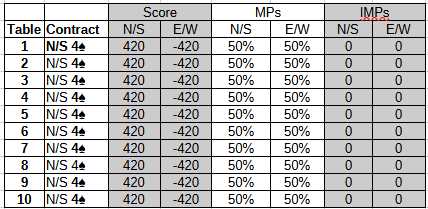
All of the N/S pairs score 420 and all of the E/W pairs score -420.
In Match Points scoring it’s an even field and every pair scores 50%.
In IMPs scoring, for an even field, every pair scores 0 IMPs.
So at the end of the tournament a score above 50% in MPs is good, or above 0 in IMPs is good.
Now supposing Pair 1 N/S played brilliantly, got a lucky lead or their opponents made a mistake and they made an overtrick 4S+1
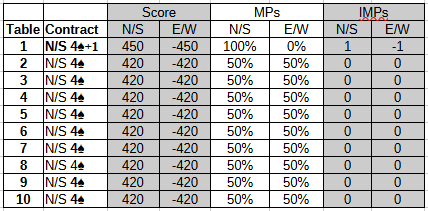
In MP, Pair 1 N/S score 100% and Pair 1 E/W get a 0%.
In IMPs scoring Pair 1 N/S gain only one IMP for their overtrick and Pair 1 E/W lose only 1 IMP.
There are no big gains or losses for anybody
Now, supposing Pair 10 N/S accidentally went one-down in 4S.
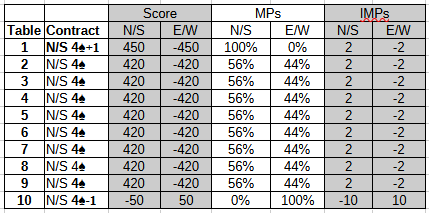
At MPs, Pair 1 N/S still get their top and 100%, but now pair 10 get a bottom and 0% and everybody else scores in the middle.
At IMPs the field is also flat for 9 pairs, all gaining 2 IMPs for 4S
and 4S+1, but Pair 10 N/S score -10 IMPs and Pair 10 E/W gain +10 IMPs.
So, at IMPs, if you bid and make your contract you are rewarded with a positive score. Making an overtrick makes little difference. If you go down in your contract when most other pairs make, you are penalised with a negative score.
One other characteristic of IMPs scoring is that things can change quickly. If you’ve played well for 23 boards of MPs, but you score 0% on the last board, it won’t make a big difference to your overall score or position, as it’s only one board in 24 with board scores limited to somewhere in the range 0%-100%.
At IMPs you can get some big swings. Supposing, on those same hands, vulnerable now, Pair 1 N/S bid and made a 6S slam, whereas pair 10 N/S went down in the same contract.
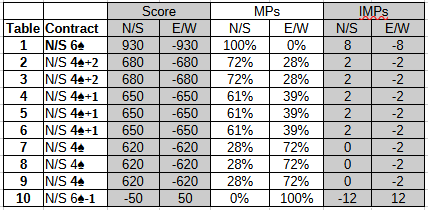
At MPs there is a top (100%) and a bottom (0%), but 4S+2 still scores twice what 4S does, so the overtricks matter.
At IMPs there is a swing of 20IMPs from top (8) to bottom (-12) which could make a big difference at the end of play.
However, the scores in-between differ only by a few of IMPs.
At MPs you may risk sacrificing and going one-off for -100 if your opponents look like making 3C and 110, and you could get a top. But at IMPs it makes no difference if you score -100 or -110, so you probably wouldn't.
You actually score IMPs depending on your score relative to the average. So, in the above the average score is 605. Pair 1 N/S scored 930, which is 325 above that, so they receive 8 IMPs on the scale below. Pair 10 N/S scored -50, a difference of -655 so they score -12 IMPs etc.

|